Paris Hotel Rooms: What Tourists Should Know Before Booking

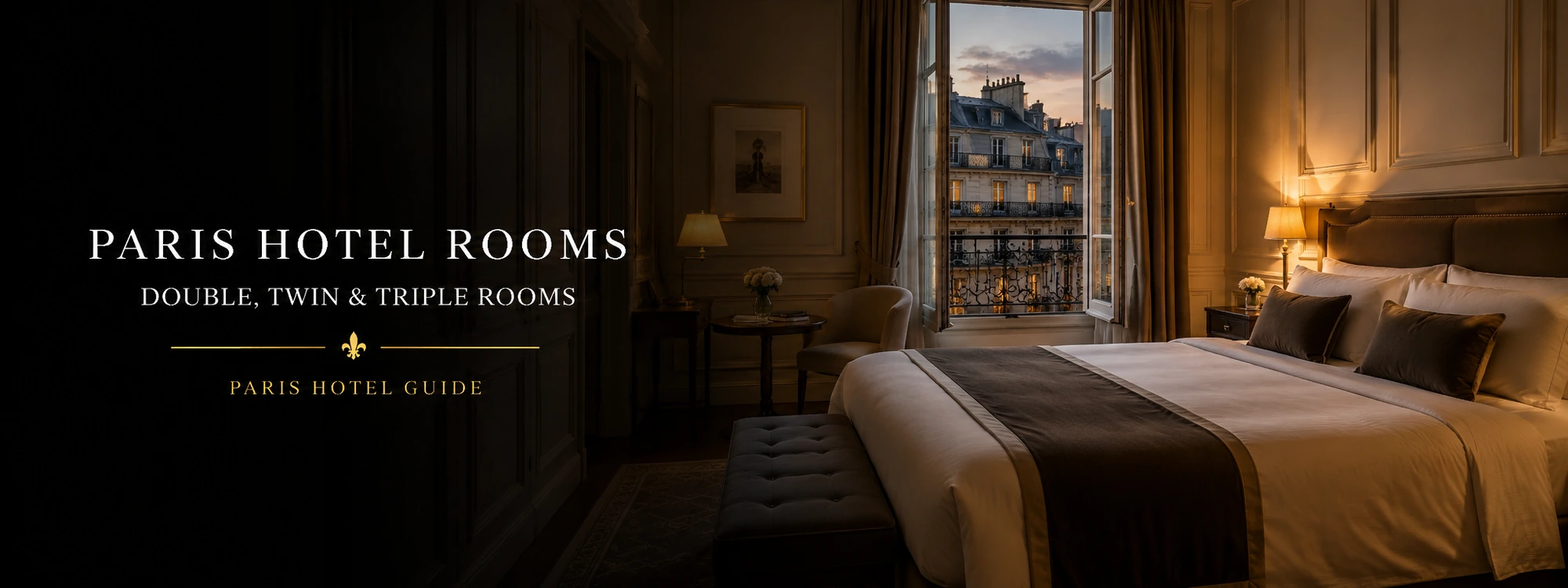
Elegant Paris hotel room with warm lighting and classic décor, illustrating double, twin and triple room options in Paris.

Choosing a hotel in Paris is not only about deciding which neighbourhood to stay in, comparing star ratings or finding the best price. The room itself can have a major influence on the quality of your stay, yet it is often the part of the reservation that travellers examine least carefully. A hotel can have an excellent location, very good reviews, an elegant lobby and beautiful photographs, while the room you finally receive may still be smaller than expected, have a different bed configuration, face a noisy street, provide a bathtub instead of a walk-in shower or offer a very different view from the photographs that initially attracted you to the property.

Paris is also different from destinations where most hotels were constructed recently and designed from the beginning according to modern hotel standards. Many Paris hotels occupy former residential buildings, private mansions, Haussmann-era properties or historic buildings that were converted into hotels over time. This gives many establishments considerable charm and character, but it can also produce irregular room shapes, narrow corridors, smaller elevators, differences between floors, unusual bathroom layouts and several very different room categories within the same property.

Travellers should therefore pay attention not only to the hotel but to the exact room category being booked. Names such as Classic, Comfort, Superior, Deluxe, Executive, Prestige, Premium, Junior Suite or Suite are not universal international standards. They are commercial descriptions chosen by each hotel. A Superior Room in one property may therefore be smaller than a Classic Room in another, while a Deluxe Room may cost more because of its view rather than because it provides substantially more space.

Photographs should also be interpreted carefully. Professional hotel photography often uses wide-angle lenses, carefully chosen lighting and favourable viewpoints that can make a compact room appear considerably larger. Hotel galleries may also combine photographs from several room categories, meaning that the most attractive bathroom, balcony or Eiffel Tower view shown on the website may not belong to the room category you are actually considering.

Throughout this guide, room surfaces are shown in both square metres and square feet, while bed dimensions are shown in centimetres and inches, making it easier for international travellers to understand and compare the accommodation they are booking.

1. Paris Hotel Rooms Are Often Smaller Than Expected

One of the most common surprises for visitors to Paris is the size of hotel rooms, particularly in central neighbourhoods. Paris is a densely built historic city where space is limited and many buildings were constructed long before modern hotel layouts became standard. A room that would be considered compact in a recently constructed resort hotel may therefore be perfectly normal in central Paris.

Room size should not automatically be interpreted as an indication of poor quality. A beautifully maintained 4-star or 5-star hotel in a historic building can offer excellent service, high-quality bedding and very good facilities while still having relatively compact entry-level rooms.

For a room occupied by two people, useful reference points are approximately:

  • 3-star hotel: 13.5 m² (145 sq ft)
  • 4-star hotel: 16 m² (172 sq ft)
  • 5-star hotel: 24 m² (258 sq ft)

These figures are useful reference points, but the actual size of individual rooms can be larger, and the way the space is arranged can be just as important as the total surface.

A room measuring 14 m² (151 sq ft) can be perfectly adequate for one person or for a couple staying only one or two nights with limited luggage. The same room can feel considerably less comfortable during a week-long stay with two large suitcases, coats, shopping bags and personal belongings.

Read More

A room of 18 m² (194 sq ft) generally gives two travellers noticeably more freedom of movement, while 20 m² (215 sq ft) or 25 m² (269 sq ft) can make a substantial difference during a longer stay.

A difference of only 5 m² (54 sq ft) may not sound particularly important when reading a booking website, but once the bed, bedside tables, desk, wardrobe and luggage are taken into account, that additional area can have a significant effect on comfort.

The shape of the room also matters. A well-designed rectangular room of 18 m² (194 sq ft) can sometimes feel more comfortable than a larger room containing a long entrance corridor, sloping ceiling, oversized furniture or several unusable corners.

Luggage storage should also be considered. Some rooms provide a luggage bench, large wardrobe or dedicated storage space. Others leave very little floor area once two large suitcases are opened.

For a short city break, a compact room may be a perfectly sensible choice if location and price are your priorities. For a longer stay, however, paying for a slightly larger room can sometimes improve the experience more than upgrading to a more prestigious hotel but reserving its smallest category.

What to do before booking: always look for the exact room surface in m² and sq ft rather than relying on words such as cosycomfortablespacious or superior.

Pitfall to avoid: do not assume that the room appearing first in the hotel’s photo gallery is the room category you are actually booking.

2. Double, Queen or King Bed: What Does It Really Mean in France?

Bed terminology can create confusion because words such as double, queen and king do not have exactly the same meaning in every country or hotel group. Travellers should therefore pay more attention to the actual dimensions of the mattress than to the marketing name.

Useful dimensions to recognise include:

  • 140 × 190 cm (55 × 75 in)
  • 160 × 200 cm (63 × 79 in)
  • 180 × 200 cm (71 × 79 in)
  • 200 × 200 cm (79 × 79 in)

A bed measuring 140 cm (55 in) wide is noticeably narrower for two adults than one measuring 160 cm (63 in). A bed measuring 180 cm (71 in) provides considerably more sleeping space and is often preferred by travellers accustomed to larger bedding.

Length also matters, particularly for taller guests. A mattress measuring 200 cm (79 in) long provides approximately 10 cm (4 in) more length than a mattress measuring 190 cm (75 in).

Another important point is whether the bed consists of one mattress or two individual mattresses joined together. This arrangement is common in hotels because it allows the same room to be sold as either a double or a twin configuration. When properly prepared with suitable bedding and a mattress topper, many travellers find this completely comfortable, but others strongly prefer one continuous mattress.

Couples should therefore check the width and length of the bed and, if it matters to them, whether the bed consists of one mattress or two joined mattresses.

What to do before booking: look for exact measurements such as 160 × 200 cm (63 × 79 in) or 180 × 200 cm (71 × 79 in) rather than relying only on the words large double bedqueen or king.

Pitfall to avoid: never assume that a bed described as king-size will automatically have exactly the same dimensions as a king-size bed in another country.

3. Twin Rooms vs Double Rooms

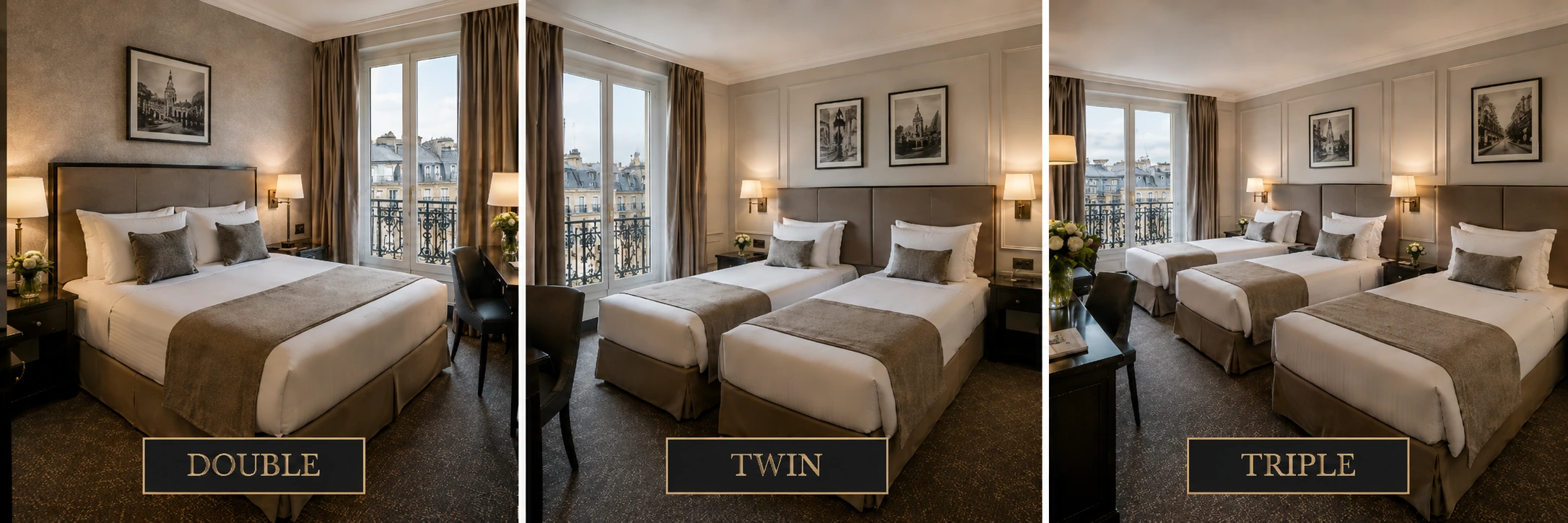
Comparison of double, twin and triple hotel rooms in Paris, showing different bed configurations and room layouts.

A double room normally contains one bed designed for two people, while a twin room provides two separate beds. This distinction is particularly important for friends, colleagues, adult children travelling with a parent, siblings or anyone who simply prefers separate sleeping arrangements.

In many Paris hotels, however, the physical room may be exactly the same. Two individual beds can either remain separated or be pushed together to create one larger sleeping surface.

This flexibility is practical for hotels, but it can create confusion when booking through third-party websites. Some reservation systems allow travellers to select one double bed or two single beds, but the choice may occasionally be recorded only as a preference and not as a guaranteed configuration.

Twin beds in higher-category hotels are often around 90 × 200 cm (35 × 79 in) each, although exact measurements vary.

For travellers who absolutely require separate beds, it is better to reserve a room explicitly described as a Twin Room and obtain confirmation if the configuration is essential.

What to do before booking: confirm the bedding arrangement directly when separate beds are important.

Pitfall to avoid: do not assume that selecting “twin preferred” on a booking platform automatically guarantees two separate beds.

4. Family Rooms and Connecting Rooms

Families need to distinguish carefully between family rooms, connecting rooms and adjacent rooms, because these expressions describe very different arrangements.

A family room generally means one accommodation unit that can sleep more than two people. It may include one double bed and a sofa bed, one double bed and two single beds, bunk beds or another combination.

A family room does not necessarily mean that parents and children will have separate bedrooms. Everyone may still sleep within one large open room.

Connecting rooms are different. These are two independent hotel rooms with an internal private door between them. This arrangement often provides considerably more space, two bathrooms and significantly more privacy while still allowing parents and children to move between the rooms without entering the public corridor.

Adjacent rooms simply mean rooms located close to one another. They may be next door, opposite each other or several doors apart, and there may be no internal connecting door.

This distinction is particularly important when travelling with younger children.

Connecting rooms can also be limited in many historic Paris hotels because the original buildings were not designed with family connections between bedrooms. During school holidays and other busy periods, they may sell out well before standard double rooms.

Families should enter the exact number and ages of children when searching because occupancy rules can vary. A room suitable for two adults and a young child may not necessarily accept two adults and a teenager.

For 5-star hotels, useful room-size references for larger occupancy include approximately:

  • 3 people: 26 m² (280 sq ft)
  • 4 people: 30 m² (323 sq ft)
  • 5 people: 35 m² (377 sq ft)
  • 6 people: 40 m² (431 sq ft)

However, the bed configuration remains just as important as the room surface.

What to do before booking: if connecting rooms are essential, ask the hotel to confirm specifically that the rooms are internally connecting.

Pitfall to avoid: never assume that adjacentneighbouring and connecting mean the same thing.

5. Triple Rooms: Why They Are Not Available Everywhere

Triple rooms are less common in Paris than many travellers expect because a standard double room cannot always accommodate a third permanent sleeping place.

The limitation is often simply physical. A relatively compact room may be comfortable for two people but become unsuitable once another bed, another suitcase and another guest are added.

A genuine triple room may contain:

  • three separate single beds;
  • one double bed and one single bed;
  • one double bed with a sofa bed;
  • another permanent or convertible sleeping arrangement.

Travellers should check whether the third sleeping place is a standard bed or a sofa bed. A sofa bed may be perfectly acceptable for a child staying one or two nights but may not provide the comfort expected by an adult during a longer stay.

This distinction becomes particularly important for three adults travelling together.

The age of children can also affect availability because some booking systems treat older children as adults when calculating the maximum authorised room capacity.

A room that accepts two adults and one younger child may therefore refuse a reservation for three adults.

What to do before booking: search using the correct number and ages of travellers and read the exact bedding configuration.

Pitfall to avoid: do not book a double room for three people with the intention of requesting an additional bed after arrival unless the hotel has already confirmed this arrangement.

6. Understanding Room Types in 5-Star Paris Hotels

Booking a 5-star hotel does not mean that every bedroom in the property offers the same amount of space, the same view or the same level of accommodation.

Luxury hotels frequently offer many room categories, sometimes ten or more, ranging from entry-level bedrooms to very large suites. The important point is that category names are commercial descriptions chosen by each hotel.

Deluxe Room in one hotel can be smaller than a Superior Room in another. A Prestige Room may primarily provide a better view rather than significantly more space. A Junior Suite may be one large open room rather than a bedroom and separate living room.

Travellers should therefore compare actual measurements, layouts and included services rather than relying on category names alone.

Classic Room

A Classic Room is usually one of the entry-level categories in a 5-star hotel.

This does not mean that it is basic or uncomfortable. It may still provide excellent bedding, high-quality bathroom products, professional service and all the facilities associated with the property. However, compared with higher room categories in the same hotel, it may be smaller, located on a lower floor or have a less desirable outlook.

A useful reference for a 5-star double room is around 24 m² (258 sq ft), although many luxury hotels provide larger entry-level rooms.

Travellers planning a long stay should check whether the Classic Room offers enough storage and floor space rather than assuming that the 5-star rating automatically guarantees a very large bedroom.

Read More

Superior Room

A Superior Room normally represents the next level above Classic, but there is no universal definition.

The upgrade may provide additional floor space, a higher floor, better natural light, improved decoration or a more favourable position within the hotel.

For example, a Classic Room might measure 25 m² (269 sq ft) while a Superior Room measures 29 m² (312 sq ft).

At another hotel, the two categories may have almost identical dimensions but different views.

Always compare the actual specifications rather than the room name.

Deluxe Room

A Deluxe Room is generally positioned above Superior and may provide larger dimensions, an upgraded bathroom, a more attractive view or a better location within the property.

However, the word Deluxe does not automatically guarantee a balcony, monument view, bathtub or king-size bed.

Some Deluxe Rooms justify their price primarily because of their location or outlook.

Before paying a substantial supplement, identify exactly what you are receiving in return.

Premium Room

Premium is another category that varies widely between hotels.

It may correspond to additional room size, upgraded decoration, a preferred floor or a better view.

In another hotel, a Premium Room may be almost equivalent to a Deluxe or Prestige category.

The name itself should therefore never be the main reason for selecting the room.

Prestige Room

Prestige Rooms are common in luxury independent hotels and upscale French properties.

They may offer more space, a more prestigious outlook, architectural details, balconies or larger bathrooms.

However, one hotel’s Prestige Room can be equivalent to another property’s Superior or Deluxe Room.

Compare the room surface, bed size, floor, bathroom and view rather than assuming that Prestige has a fixed meaning.

Executive Room

Executive Rooms are particularly common in larger international hotels.

In some properties, the principal difference is additional room space. In others, the main advantage is access to an Executive Lounge, which may include breakfast, drinks, snacks or evening refreshments.

Travellers should therefore determine whether the supplement pays for a larger room, extra services or both.

Someone spending most of the day sightseeing may place less value on lounge access than a business traveller or guest spending more time in the hotel.

Eiffel Tower View Room

An Eiffel Tower View Room is normally defined primarily by its outlook rather than by its size.

A smaller room with a direct Eiffel Tower view can therefore cost significantly more than a larger room facing an internal courtyard.

The words Eiffel Tower view can describe several different situations:

  • full and unobstructed view;
  • partial view;
  • lateral or angled view;
  • view over rooftops;
  • view visible only from one part of the room;
  • view from the bathroom;
  • view from the balcony but not directly from the bed.

If the view is one of the main reasons you are paying a supplement, ask exactly what will be visible from the category you are reserving.

Balcony Room

A balcony can also mean several very different things.

A substantial balcony may provide enough space for a table and two chairs, while a traditional Paris balcony may be quite narrow.

A Juliet balcony can consist mainly of French doors or windows opening behind a railing without any substantial outdoor floor area.

A private balcony measuring 5 m² (54 sq ft) is therefore very different from a narrow decorative balcony.

If outside space matters to you, ask whether the balcony is large enough to sit outside comfortably.

Terrace Room

A Terrace Room normally offers more substantial outdoor space than a standard balcony room.

Terraces can command a significant premium in Paris, particularly when they provide views over rooftops, gardens or monuments.

Check whether the terrace is private, how large it is, whether it has seating and whether the photographs shown correspond to the exact room being booked.

Twin Room

A Twin Room in a 5-star property normally contains two individual beds, often approximately 90 × 200 cm (35 × 79 in) each.

This configuration is particularly useful for friends, adult children, relatives or business travellers.

Again, confirm that the twin arrangement is guaranteed and not simply recorded as a preference.

Triple Room

A 5-star Triple Room may provide approximately 26 m² (280 sq ft) or more as a useful reference, but not every luxury hotel offers genuine triple rooms.

Some properties allow a third person only in larger categories, while others require travellers to reserve a Junior Suite or connecting rooms.

Three adults should always examine the third sleeping place carefully. A proper single bed provides a different level of comfort from a temporary sofa bed.

Family Room

A Family Room in a luxury hotel can take many forms.

It may be a large open-plan room, a room with separate sleeping zones or a category specifically designed to accommodate several occupants.

Useful 5-star size references include approximately 30 m² (323 sq ft) for four people and 35 m² (377 sq ft) for five.

However, the room can still feel crowded once several beds and several suitcases are added.

Families should therefore compare the bedding arrangement as carefully as the room surface.

Connecting Rooms

Connecting rooms are often one of the best solutions for families seeking both space and privacy.

Two internally connected rooms usually provide two bathrooms, two separate sleeping areas and much more room than a single family bedroom.

The drawback is that travellers are essentially reserving two rooms, so the total price can be considerably higher.

Because genuine connecting combinations are limited, families should reserve them early during busy travel periods.

Junior Suite

A Junior Suite usually provides more space than a standard bedroom and often includes a seating area.

However, the sleeping and sitting areas may remain part of the same open room.

This is especially important for families. If children are expected to sleep in the living area while parents use the bedroom, ask whether there is a real separating door.

A Junior Suite should not automatically be interpreted as two separate rooms.

Suite

A Suite generally represents a significant step above a Junior Suite.

It may contain a separate bedroom and living room or provide a very large open-plan accommodation.

A useful reference for a substantial suite is around 60 m² (646 sq ft), although luxury suites vary enormously.

Travellers should examine the floor plan whenever available because photographs alone can make it difficult to understand how the rooms connect.

Prestige Suite

A Prestige Suite is generally positioned above an entry-level suite.

It may provide a larger living room, better view, dressing room, enhanced bathroom facilities, terrace or additional guest toilet.

The category remains hotel-specific, so compare its actual dimensions and facilities with the lower suite categories.

Executive Suite

Executive Suites frequently combine a separate bedroom and living area and may include additional business-oriented services or Executive Lounge privileges.

Some are designed for guests who need room to work or receive visitors.

Again, check whether the price difference is primarily related to additional space, additional services or both.

Signature Suite

Signature Suites are normally individually designed accommodations intended to reflect the identity or history of the property.

They may have unusual layouts, special decoration, architectural features, exceptional views or private terraces.

Because these suites can differ from one another, confirm that the photographs shown correspond to the exact suite you are booking.

Presidential Suite

A Presidential Suite is usually one of the largest and most prestigious accommodations within a hotel.

It may include a bedroom, separate living room, dining area, dressing room, office, guest bathroom and sometimes a kitchen or pantry.

Some Presidential Suites can also connect to additional bedrooms, creating a large private residence.

There is no universal size attached to the category, and Presidential Suites in Paris can differ enormously from one hotel to another.

Accessible Room

An Accessible Room should not be judged only by its surface.

The important questions concern the complete route through the hotel and the actual room layout.

Travellers may need to check:

  • step-free entrance;
  • elevator size;
  • bedroom door width;
  • space around the bed;
  • accessible toilet;
  • walk-in or roll-in shower;
  • grab rails;
  • suitable sink height.

Every traveller’s mobility requirements are different, so it is better to describe your needs precisely to the hotel.

Palace Hotel Rooms and Suites

In France, 5-star hotel and Palace are not identical terms.

A Palace represents an exceptional level of luxury within the highest hotel category, but even in a Palace, room categories remain very different.

Booking an entry-level room in one of Paris’s most prestigious hotels does not automatically mean that you will receive its best Eiffel Tower view, largest bathroom, balcony or terrace.

The reputation of the property and the room category should therefore be considered separately.

7. Air Conditioning: Never Assume It Will Meet Your Expectations

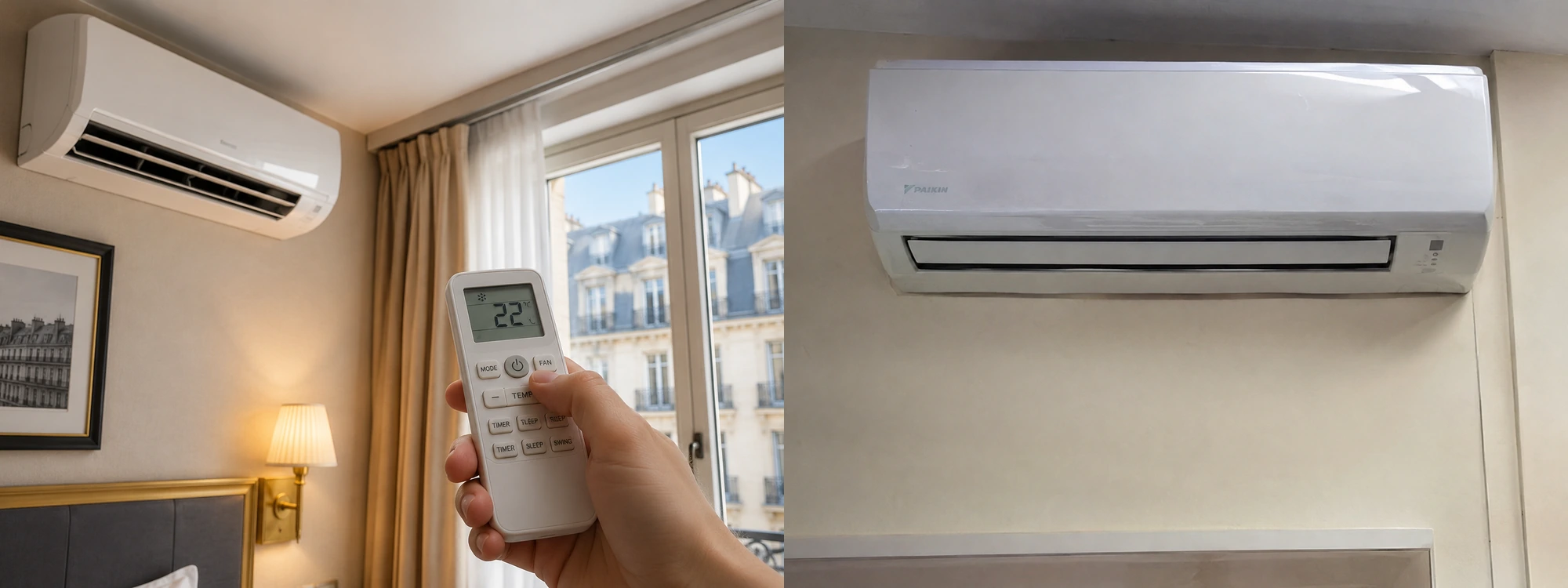
Air conditioning unit and remote control in a Paris hotel room, showing typical climate-control equipment available in hotels.

Air conditioning has become increasingly important for summer stays in Paris, particularly during periods of very high temperatures.

Many 4-star and 5-star hotels provide effective climate control, but the type of system can differ significantly.

Some rooms have individually controlled systems that allow guests to select their preferred temperature. Others use centralised systems where the hotel determines the general operating mode.

Historic buildings can also present technical constraints that make cooling systems less flexible than those found in modern purpose-built hotels.

Seasonality can create another difficulty. During an unexpectedly warm period in spring or autumn, the hotel may not yet have switched its system fully into cooling mode.

Opening a window may not always be a comfortable alternative because street-facing rooms can receive traffic noise, restaurant noise, scooters or early-morning deliveries.

What to do before booking: if air conditioning is important to you, confirm that it is available in the exact room and ask whether the temperature can be individually controlled.

Pitfall to avoid: do not rely only on an air-conditioning symbol without reading the room description.

8. Elevators in Older Paris Hotels


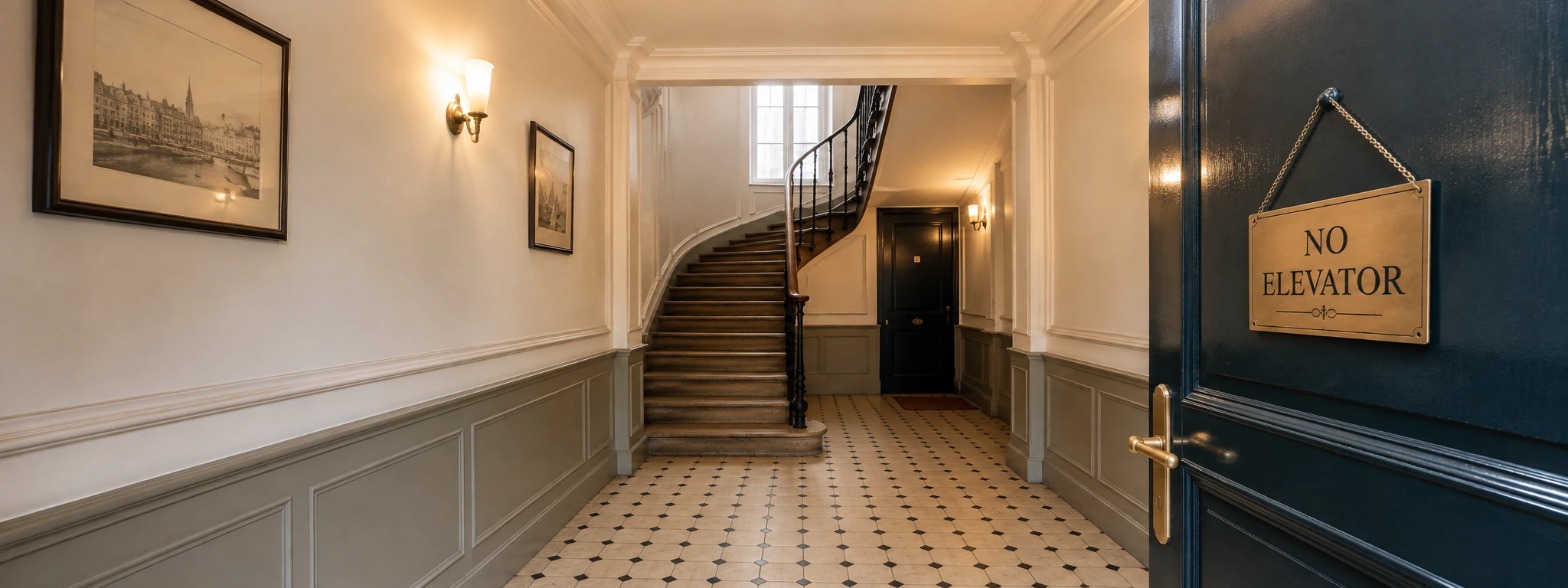
Traditional Paris hotel entrance with staircase and no elevator, illustrating that some older hotels may only be accessible by stairs.

An elevator in a historic Paris hotel may be much smaller than travellers expect. Many elevators were installed after the original building was constructed and therefore had to fit into extremely limited spaces.

Some can comfortably accommodate only one person and one suitcase. Others can take two passengers but almost no luggage.

This may be a minor inconvenience for many travellers but can become important for older visitors, people with reduced mobility, families with strollers or anyone carrying several large cases. An elevator also does not necessarily mean that the complete route to the bedroom is step-free.

There may be steps between the street and reception, a half-floor staircase before the elevator or several stairs between the elevator landing and certain rooms.

Top-floor rooms may occasionally require one final staircase after the highest elevator stop.

What to do before booking: if avoiding stairs is important, ask whether there is step-free access from the street all the way to your room.

Pitfall to avoid: do not assume that an elevator automatically means the hotel is fully accessible.

9. Bathrooms: Shower, Bathtub and Separate Toilets

Bathrooms can differ substantially between rooms in the same hotel. One room may have a walk-in shower, another a bathtub with a shower above it and another both a separate shower and bathtub. For travellers with limited mobility, this distinction can be important because stepping over the side of a high bathtub may be difficult.

Anyone specifically requiring a walk-in shower should therefore confirm it before arrival.

The expression separate toilet can also be misunderstood. In France, it normally means that the WC is located in a small separate room from the principal bathroom. It does not mean that the toilet is shared with other guests.

Some travellers prefer this arrangement because one person can use the bathroom while another uses the WC. Bathroom size can also change considerably according to room category. A higher room category may include double sinks, a separate shower, large bathtub and more storage, while an entry-level room may have a much more compact bathroom.

What to do before booking: ask specifically about shower, bathtub and toilet configuration if these features matter to you.

Pitfall to avoid: do not assume that the most attractive bathroom shown in the hotel gallery belongs to every room category.

10. Street View vs Courtyard View

Room orientation can have a significant effect on both atmosphere and noise. Street-facing rooms often provide more natural light and more recognisably Parisian views over façades, cafés, rooftops or neighbourhood streets, which can be an important part of the experience for visitors who enjoy watching the city from their room.

The disadvantage is that street-facing rooms can receive more noise from cars, buses, scooters, restaurants, pedestrians, rubbish collection and early-morning deliveries. A courtyard-facing room is often quieter from street traffic, but travellers should not automatically imagine a picturesque garden because the view may simply consist of an internal façade, neighbouring windows, rooftops or service areas.

Courtyards can also carry sound. Air-conditioning equipment, restaurant activity, staff areas or conversations from other rooms may echo between the surrounding walls, meaning that a courtyard room is not always silent. A higher floor can reduce some types of street noise, but it cannot guarantee complete quiet either.

Light sleepers should therefore consider several factors rather than requesting only a courtyard room. Asking for a room away from elevators, housekeeping cupboards, kitchens, bars and service areas can be just as important as the direction the windows face. The most useful request is often simply to tell the hotel that quietness is a priority and ask which rooms are normally considered the quietest.

What to do before booking: tell the hotel clearly that quietness is important and ask for the quietest available room rather than simply asking for a courtyard room.

Pitfall to avoid: do not automatically assume that courtyard means silent and street means noisy.

11. Upper Floors, Balconies and Eiffel Tower Views

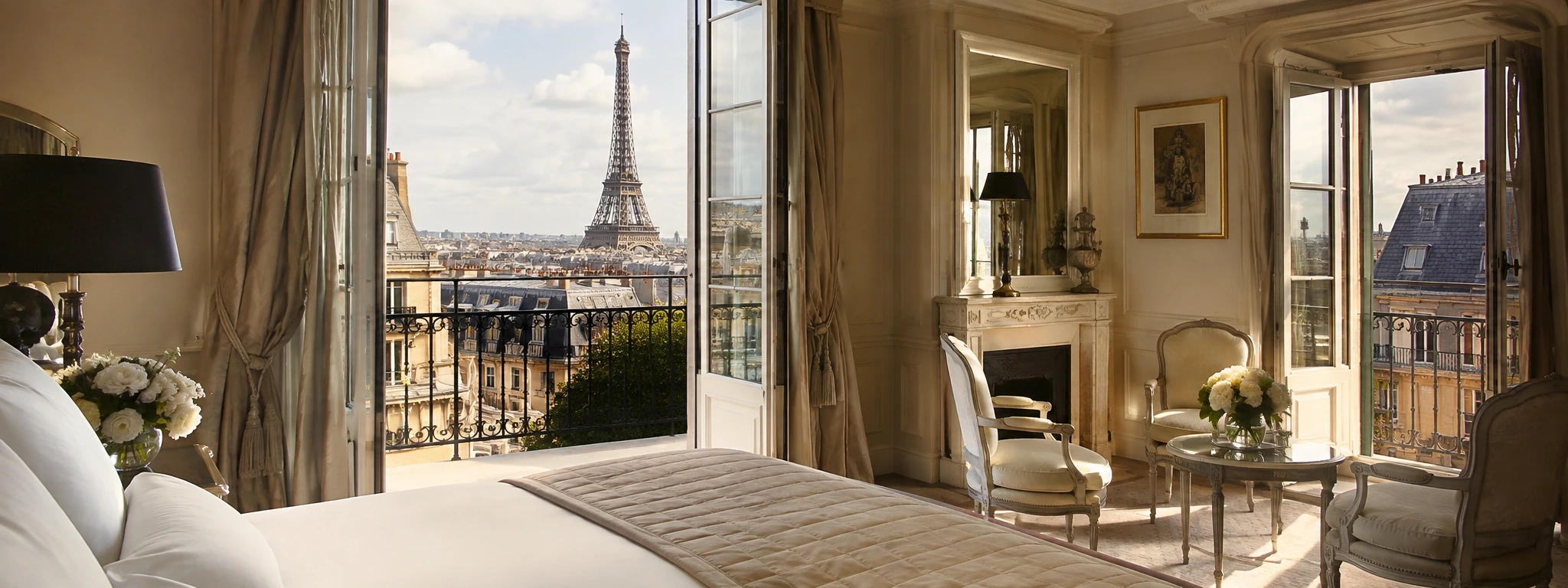
Elegant upper-floor Paris hotel room with large windows and a view of the Eiffel Tower across the Paris rooftops.

Paris hotel views can have a major influence on room prices, particularly when a famous monument is involved. An Eiffel Tower view may be panoramic and unobstructed, but it may also be partial, lateral, visible above rooftops or visible only from one particular part of the room, which means that two rooms carrying similar descriptions can offer very different experiences.

The same hotel may therefore sell several categories of Eiffel Tower View Room at very different prices depending on how much of the monument can actually be seen and from where. One room may allow guests to see the Tower directly from the bed, another may require standing beside a particular window, while another may offer the best view only from the bathroom or balcony.

Balconies also require careful interpretation because a large usable balcony with a table and chairs is very different from a narrow traditional Parisian balcony. A Juliet balcony may consist mainly of French windows opening behind a railing, without enough outdoor floor area to sit or sometimes even stand outside comfortably. The word balcony alone therefore does not tell you how usable the outdoor space actually is.

Upper floors often provide better views and more natural light, but rooms under the roof can have sloping ceilings that reduce usable floor space even when the published surface is relatively generous. Some top-floor rooms are extremely charming, but travellers should consider the architectural character alongside practical comfort. If a monument view or balcony is one of the principal reasons for paying a higher price, ask whether the view is full or partial, whether it is visible directly from the bedroom and whether the outdoor space is genuinely usable.

What to do before booking: ask whether the monument view is full or partial, whether it can be seen from the bed and whether the balcony is genuinely usable.

Pitfall to avoid: do not book the least expensive room in a hotel famous for its Eiffel Tower views and assume that every room has the same outlook.

12. Breakfast: Included or Extra?

Breakfast is not automatically included in Paris hotel prices, and the same room may be sold under several different rates, including room only, breakfast included, flexible cancellation and non-refundable options. Travellers comparing hotels should therefore make sure they are comparing equivalent offers rather than judging the properties only by the first price shown on a booking website.

A hotel that initially appears more expensive may already include breakfast, while a lower rate at another property may cover only the bedroom. For a couple or family staying several nights, the total cost of breakfast can become significant, so this additional expense should be included when comparing the real cost of the stay.

Hotel breakfast is not necessarily the best choice for every traveller either. Paris has many cafés and bakeries, and some visitors prefer to have a lighter breakfast outside the hotel, while others value the convenience of a buffet before beginning a full day of sightseeing. Early tour schedules are another consideration, because if an excursion departs before the breakfast room opens, paying for breakfast every morning may provide little value.

Before booking, compare the total accommodation price with and without breakfast and check the breakfast hours, particularly if several of your activities require early departures. This simple comparison can prevent paying for a service that you will rarely use.

What to do before booking: compare the total accommodation price with and without breakfast and check the breakfast opening hours.

Pitfall to avoid: do not pay for breakfast every morning if several of your planned activities require departure before breakfast service begins.

13. Security in Hotel Breakfast Rooms and Public Areas

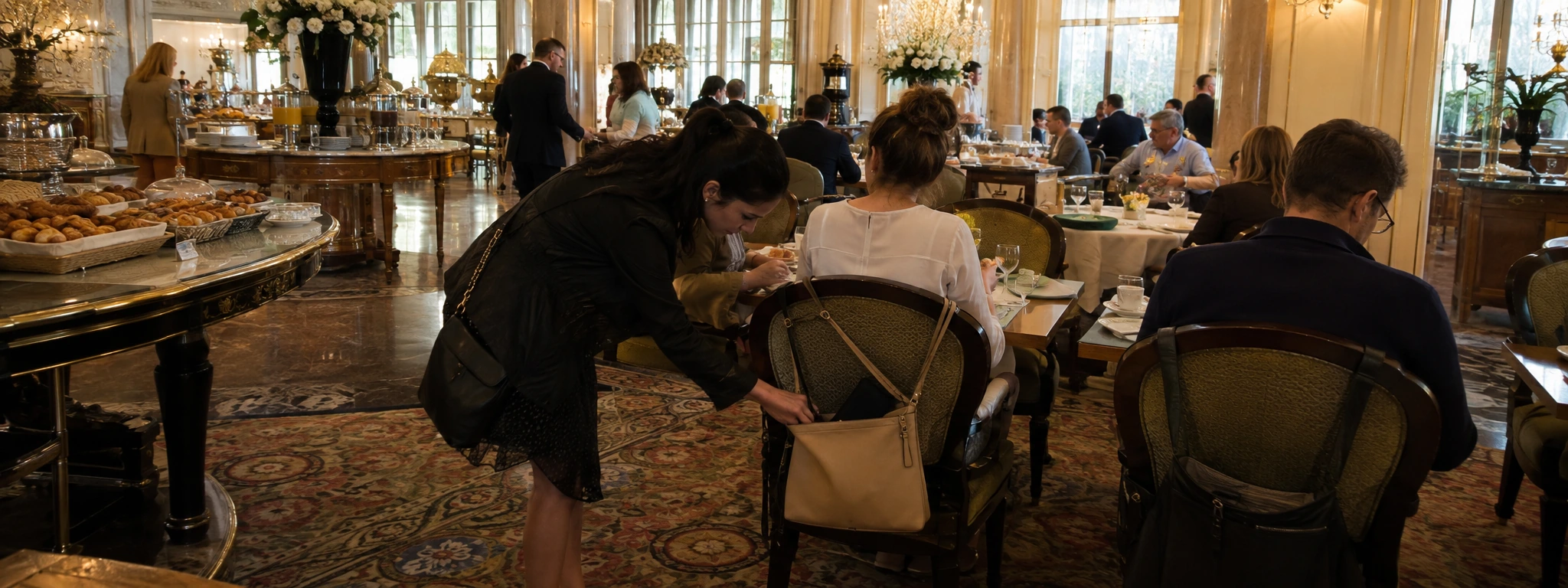
Guest handbag hanging from a chair in a luxury Paris hotel breakfast room while a thief attempts to steal from it.

Travellers often relax their normal precautions once they are inside a good hotel because the surroundings feel controlled and secure, particularly in a large 4-star, 5-star or Palace property. However, busy hotel public areas can still require attention because large establishments may have hundreds of guests, restaurant clients, conference visitors, drivers, suppliers and staff moving through the building throughout the day.

Breakfast rooms can be particularly busy because guests frequently leave their tables to visit the buffet, collect coffee or speak with family members. In this type of environment, opportunistic thieves or pickpockets can sometimes blend into the general movement of people without immediately attracting attention. The fact that the room is inside a prestigious hotel should therefore not lead travellers to leave handbags, wallets or phones unattended.

A handbag should never be hung over the back of a chair when it contains important belongings, especially when the bag is behind you and outside your direct line of sight. The same applies to backpacks, camera bags and jackets containing wallets or phones. Placing a handbag on an empty chair is not necessarily safer if everyone at the table then walks to the buffet at the same time.

When travelling as a couple or family, one person can remain at the table while another collects breakfast. Travellers eating alone should keep valuable belongings with them when leaving the table rather than assuming that a phone or handbag will remain safe for a few minutes. These precautions also apply to hotel lobbies, bars and lounges, where travellers can become distracted while checking in, speaking with reception or waiting for transport.

A high hotel category does not remove the need for normal travel awareness. Keeping handbags closed and physically close, taking phones and wallets with you when leaving a table and avoiding the habit of hanging a handbag over the back of a chair are simple precautions that can reduce unnecessary risk.

What to do: keep your handbag closed, visible and physically close to you. Take your phone and wallet with you if you leave the table.

Pitfall to avoid: never hang a handbag containing valuables over the back of a chair simply because you are inside an expensive hotel.

14. Luggage Storage Before Check-In and After Check-Out

Luggage storage is particularly useful in Paris because international flights often arrive several hours before standard hotel check-in times. Many hotels allow guests to leave luggage before their room is ready, but travellers should still confirm this service when it is important to their schedule rather than assuming that every property operates in the same way.

The same applies after check-out. Guests departing on an evening flight or train often leave their luggage at the property and continue sightseeing during the day, but smaller hotels may have limited storage capacity, particularly when many guests arrive and depart on the same date. Large suitcases, strollers and multiple pieces of luggage can also require considerably more storage space than expected.

Travellers should also consider how the luggage is secured. Some hotels operate dedicated locked luggage rooms and provide numbered tickets or tags, while others keep bags in supervised areas close to reception. If security is particularly important, asking how the hotel manages stored luggage can provide useful reassurance.

Passports, cash, jewellery, medication, expensive watches and important electronics are generally better kept with you rather than left inside stored suitcases. Before organising an entire arrival or departure day around hotel luggage storage, confirm that the service is available, determine whether there is a fee or collection deadline and ask how the bags will be stored.

What to do before booking: confirm that luggage can be stored both before check-in and after check-out, and ask whether there is a fee or collection deadline.

Pitfall to avoid: do not organise an entire arrival or departure day around hotel luggage storage without confirming the service first.

15. Check-In and Check-Out Times

Check-in and check-out times vary from one Paris hotel to another, although rooms are generally available during the afternoon and guests are usually expected to leave during the late morning. Travellers should always verify the exact times for their property, particularly when arriving on an overnight flight or departing on a late evening train or plane.

A traveller landing early in the morning can easily reach central Paris several hours before the room is available. The hotel may be happy to store luggage, but early access to the bedroom is generally not guaranteed unless a specific arrangement has been confirmed. An early check-in request often depends on when the previous guest leaves and how quickly the room can be cleaned and prepared.

Late check-out works in much the same way. A late flight does not automatically allow guests to keep the room until the afternoon or evening, and some hotels charge for guaranteed late departure while others provide it only when occupancy permits. Travellers should therefore distinguish between a request and a confirmed service.

Late-night arrival should also be considered, particularly in smaller independent hotels where reception procedures may differ from those of large international properties. Large hotels often operate a 24-hour front desk, while smaller establishments may use access codes or specific instructions for guests arriving after a certain time. Verifying these details in advance avoids unnecessary problems at the end of a long journey.

What to do before booking: verify the official check-in and check-out times and inform the hotel if you expect to arrive very late.

Pitfall to avoid: do not treat an early check-in request as guaranteed unless the hotel has explicitly confirmed it.

16. Housekeeping and Room Cleaning: What to Expect


Housekeeping is an important part of the hotel experience, but cleaning procedures can differ according to hotel category, property policy and accommodation type. In traditional hotels, guestrooms are generally serviced during the day, with housekeeping making the bed, cleaning the bathroom, emptying waste bins, replenishing toiletries and replacing towels when required.

Many hotels now apply environmental policies designed to reduce unnecessary water, electricity and detergent consumption, so towels may be replaced according to specific instructions and bed linen may be changed according to a schedule rather than every day. Travellers who specifically require fresh sheets or additional towels should ask reception rather than assuming that these items will automatically be replaced daily.

Guests should also understand the effect of the Do Not Disturb sign. If it remains displayed for much of the day, housekeeping may be unable to clean the room, and although staff may return later, this should not always be assumed. Travellers working from their room, families with children sleeping during the day or anyone who prefers cleaning at a particular time can usually avoid inconvenience by discussing their preferred schedule with reception.

Personal belongings also affect how thoroughly staff can clean. Housekeeping personnel need reasonable access to the bed, bathroom and surfaces, and if the room is covered with clothing, open luggage, documents or expensive personal items, staff may understandably avoid moving them. Passports, cash, jewellery, watches and important electronic devices should therefore be stored securely rather than left scattered across the room.

In luxury hotels, guests may also receive an evening turndown service in addition to the main daytime cleaning. This can involve preparing the bed for the night, closing curtains, refreshing bathroom amenities and replenishing water. Travellers staying in aparthotels or serviced apartments should pay particular attention to housekeeping arrangements because daily cleaning may not be included at all or may occur only on selected days.

What to do before booking: if daily housekeeping is important to you, check how often the room is cleaned and how frequently bed linen and towels are normally replaced.

Pitfall to avoid: do not assume that a hotel, aparthotel and serviced apartment all provide the same cleaning schedule.

17. Should You Tip Housekeeping Staff?

Tippping Housekepping

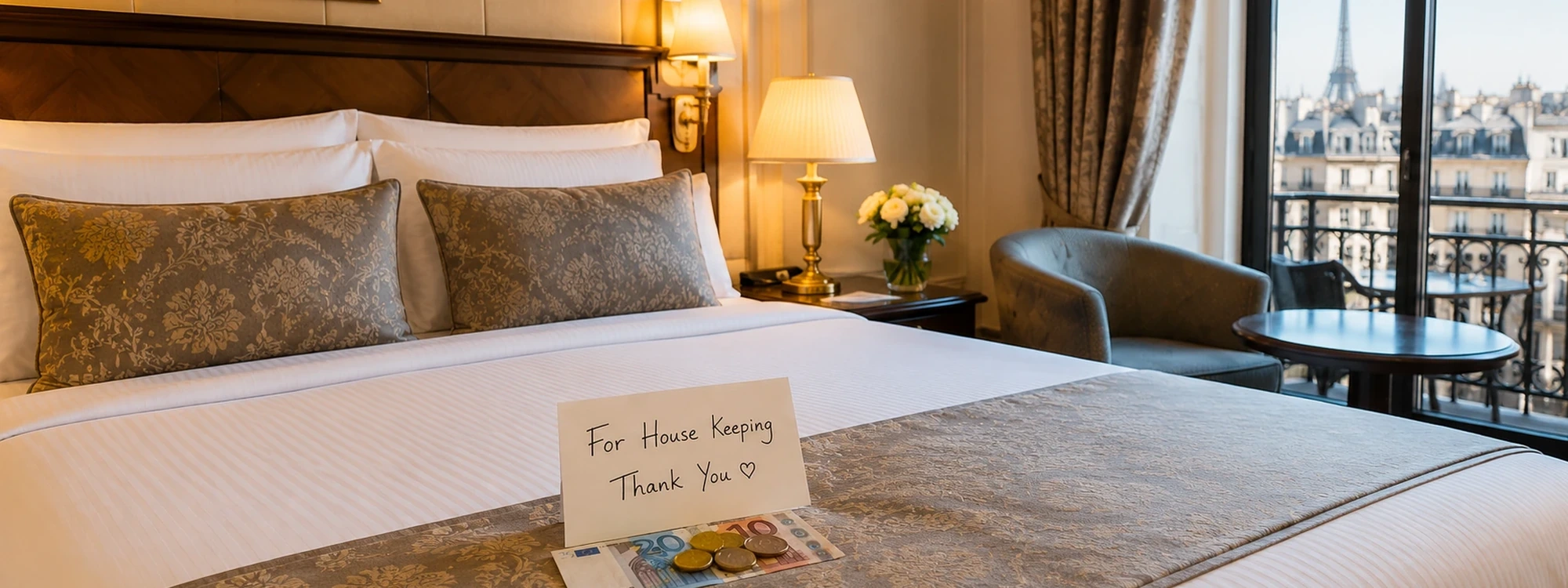
Tipping housekeeping staff in France is not compulsory, but travellers may choose to leave a gratuity when they have appreciated the service, particularly during a stay of several nights or when staff have provided additional assistance. If you decide to leave a tip, the most important point is to make it completely clear that the money is intentionally intended for the person cleaning the room.

Cash left casually on a desk, bedside table or shelf can create uncertainty because housekeeping staff may not know whether the guest deliberately left the money as a gratuity or simply forgot it. Professional staff may therefore avoid touching money that has not clearly been offered to them, which can lead to the guest wondering why the tip was not taken.

A clearer method is to place the gratuity on the bed or pillow, ideally with a short note such as “For Housekeeping – Thank you” or “Pour la femme de chambre – Merci.” An envelope is even clearer because it removes almost all ambiguity and shows that the money has deliberately been left for the member of staff.

During a multi-night stay, some travellers prefer to leave a small gratuity each day because the same person may not clean the room every morning, particularly in a large hotel where teams work according to rotating schedules. Others prefer leaving something at the end of the stay. Both approaches are acceptable, and tipping should always remain a personal choice rather than something travellers feel obliged to do.

What to do: if you want to leave a gratuity, make your intention obvious by placing it on the bed or pillow with a note or envelope.

Pitfall to avoid: do not leave loose cash on a desk and assume that housekeeping staff will automatically understand that they are allowed to take it.

18. Hotel Room Security, Safes and Protecting Your Belongings

Hotel-room security should be approached with the same common sense used anywhere else during a trip. Many Paris hotels provide an in-room safe, particularly in the 3-star, 4-star and 5-star categories, and these safes are usually suitable for passports, cash, jewellery, watches and smaller electronic devices.

Not every safe is large enough for a laptop or large tablet, however, so travellers carrying expensive professional equipment should check the available space when necessary. It is also important to make sure that the safe has actually locked correctly before leaving the bedroom, and any problem with the mechanism should be reported to reception immediately rather than leaving valuables unsecured.

Cash, jewellery, watches, passports and valuable electronics should not be left visibly on bedside tables, desks or inside open luggage. This is not about distrusting hotel employees; it is simply sensible travel practice because guestrooms may need to be accessed by housekeeping, maintenance staff or other authorised employees, and keeping valuable items properly stored reduces both risk and misunderstanding.

Travellers should also close and lock the room door correctly whenever they leave. Older hotels may still use physical keys, while newer properties generally use electronic key cards, and some smaller establishments may ask guests to leave a traditional key at reception when going out. Avoid saying your room number loudly in a busy lobby or restaurant, and do not leave your key card visible on a table in public areas.

If someone unexpectedly knocks on the door claiming to be from housekeeping or maintenance, guests do not need to open immediately. When no visit was expected, a quick call to reception can confirm whether the person is genuinely a hotel employee. Balcony doors and windows should also be secured when leaving, particularly in lower-floor rooms or buildings where neighbouring terraces and balconies are close together.

What to do: use the safe, room lock and hotel security procedures appropriately.

Pitfall to avoid: do not leave valuable objects visibly unattended simply because you are staying in a high-category hotel.

19. Do Not Become Less Careful Because You Are Staying in a Luxury Hotel

One common mistake is to associate a prestigious hotel with complete protection from theft. A 5-star hotel or Palace generally has professional staff, security procedures, controlled areas and cameras, but it can also be an extremely busy environment where guests, restaurant customers, conference participants, visitors, suppliers, drivers and staff move through different parts of the building throughout the day.

The larger and busier the property, the easier it can sometimes be for an unfamiliar person to appear as though they naturally belong there. Travellers should therefore continue using sensible precautions rather than assuming that an elegant lobby or expensive room removes every risk.

Large amounts of cash should not be displayed in reception areas, luxury shopping bags should not be left unattended beside an armchair and phones or wallets should not be placed on tables before walking away. When checking in, keep luggage together until it has been taken into the hotel’s care, particularly when the lobby is crowded.

The same principle applies to controlled guest areas. Travellers should not feel obliged to hold a secured door open for an unknown person simply because that person is walking immediately behind them. Hotel staff can manage access when necessary. Luxury should make the stay more comfortable, but it should not lead travellers to abandon the ordinary precautions they would use in any other busy environment.

20. Privacy: When Can Hotel Staff Enter Your Room?

Hotel guests reasonably expect privacy, but staff may sometimes need legitimate access to guestrooms for housekeeping, maintenance or safety reasons. Housekeeping normally enters during the daily cleaning period unless the guest has indicated that service is not wanted, while maintenance staff may need access if there is a technical problem involving plumbing, electricity, air conditioning or another hotel facility.

Guests who do not want housekeeping while they are inside should use the Do Not Disturb sign or electronic privacy control where available. However, leaving a Do Not Disturb sign displayed continuously for several days does not necessarily mean that the hotel will never attempt to contact the guest, because properties may have security or welfare procedures requiring staff to check on rooms after an extended period without access.

If you do not want a complete cleaning but need fresh towels, toiletries or drinking water, reception can usually arrange this without a full housekeeping visit. Travellers should also avoid leaving the room door propped open while briefly visiting another room or going to the elevator, because even a short absence can leave the room unnecessarily accessible.

Families occupying several rooms should explain basic room-security rules to children and teenagers, particularly when they are moving between connecting or neighbouring rooms. If someone requests access unexpectedly and you are uncertain whether they work for the hotel, contact reception before opening the door.

21. Accessibility and Mobility Issues

Accessibility needs to be examined carefully because every traveller’s requirements are different. A hotel may provide one or more adapted bedrooms while other areas of the building remain more difficult to navigate, particularly in historic Paris properties where entrances, elevators and corridors were originally designed long before modern accessibility standards.

A traveller who simply finds stairs difficult may need only reliable elevator access, while a wheelchair user may require a completely step-free route, wider doorways, sufficient turning space and an adapted bathroom. Another traveller may be able to walk normally but specifically need a walk-in shower, grab rails or a room close to the elevator.

The most useful approach is therefore to explain exactly what is required rather than asking only whether the hotel is “accessible”. Important details can include whether the entrance is step-free, whether the elevator serves the correct floor, the approximate elevator dimensions, the amount of space around the bed, the bathroom configuration, whether the shower has a level entrance and whether grab rails are provided.

A general accessibility symbol can be helpful, but it cannot answer every practical question. Travellers with specific mobility requirements should obtain written confirmation of the features that are essential to them before finalising the reservation.

22. Questions to Ask the Hotel Before Booking

The best way to avoid disappointment is to identify which room features genuinely matter to you and confirm them before making a non-refundable reservation. It is not necessary to send every hotel a very long list of questions, because most travellers only have a few priorities that could materially affect their stay. The objective is to determine which details are essential and which ones are simply preferences.

If space matters, ask for the exact room surface in m² and sq ft. If sleeping comfort matters, ask for the exact bed dimensions in cm and inches and whether the bed consists of one mattress or two joined mattresses. Families should confirm whether twin beds or connecting rooms are guaranteed, while groups of three or more should verify the maximum authorised occupancy and the exact sleeping arrangement.

Travellers concerned about comfort should ask whether the room has individually controlled air conditioning, whether the elevator reaches the room floor, whether there are stairs between the street and bedroom, and whether the bathroom contains a walk-in shower or bathtub. If noise is an important concern, ask whether the room faces the street or courtyard and whether a quiet room away from elevators or service areas can be requested.

Anyone paying for a view or balcony should determine whether the Eiffel Tower or other monument view is full or partial, whether it is visible directly from the bedroom and whether the balcony is genuinely large enough to stand or sit outside. Travellers should also check whether breakfast is included, when it begins, whether luggage can be stored before check-in and after check-out, whether the hotel has an in-room safe and whether the safe is large enough for important electronics.

Housekeeping, arrival and departure arrangements can also be confirmed before booking. Ask whether daily housekeeping is included, how often bed linen and towels are normally changed, whether early check-in is guaranteed or only requested, whether late check-out is possible and what procedure applies to late-night arrival. Travellers with mobility requirements should describe those needs precisely and obtain confirmation that the exact room and route through the hotel are suitable.

A short exchange with the hotel before booking can prevent a great deal of frustration. It is considerably easier to choose the correct room before arrival than to request a change when the property may already be full and alternative room categories are no longer available.

23. Book the Room, Not Just the Hotel

One of the most useful rules when booking accommodation in Paris is to compare the room itself, not only the hotel. Travellers often spend considerable time comparing neighbourhoods, star ratings, review scores, restaurants, spas and hotel facilities, then reserve the least expensive available bedroom without examining what actually distinguishes it from the categories above.

Within the same hotel, the difference between two room categories can sometimes be greater than the difference between two neighbouring hotels. A basic room may be smaller, located on a lower floor, face an internal courtyard or provide a more compact bathroom, while one category higher may add 5 m² (54 sq ft), a larger bed, better natural light, a quieter position or a significantly better bathroom.

For a one-night stay, these differences may not matter very much, but for a five-, seven- or ten-night stay they can have a substantial influence on comfort. Reviews should therefore also be interpreted at room-category level. When one traveller describes the hotel room as extremely small and another says it was spacious, both reviews can be accurate if the guests stayed in completely different categories.

Whenever possible, look for reviews mentioning the exact room type you are considering. The best room is not necessarily the most expensive one, because a traveller who spends almost the entire day sightseeing may prefer an excellent location and a quiet bedroom instead of additional floor space, while a family may value connecting rooms and two bathrooms more than a prestigious address.

A couple celebrating a special occasion may prefer a smaller room with a memorable Eiffel Tower view and balcony, while an older traveller may consider elevator access and a walk-in shower far more important than decoration. A business traveller may value Executive Lounge access, whereas a tourist who spends all day outside may rarely use it. The objective is therefore not to find a room that is perfect in every category, but to understand the compromises, know what you are paying for and choose the combination of space, bedding, quietness, view, comfort and services that best matches the way you actually travel.

Frequently Asked Questions About Paris Hotel Rooms

Are Paris hotel rooms really smaller than hotel rooms in other cities?

Many hotel rooms in central Paris are relatively compact because a large number of hotels occupy historic buildings that were not originally designed as modern hotels. This does not necessarily indicate lower quality, but travellers should always check the exact room size rather than judging from photographs alone. A difference of only a few square metres can noticeably affect comfort, especially when travelling with large suitcases.

What is a comfortable hotel room size for two people in Paris?

There is no single ideal size because comfort depends on the length of the stay, the amount of luggage and the way the room will be used. A room of around 15 m² (161 sq ft) can work well for a short city break, while approximately 18–22 m² (194–237 sq ft) generally provides more comfortable circulation and luggage space. In luxury hotels, rooms of approximately 24 m² (258 sq ft) or more are common reference points, although standards vary considerably between properties.

What is the difference between a Double Room and a Twin Room?

A Double Room normally provides one bed intended for two people, while a Twin Room provides two separate beds. The actual dimensions should still be checked because descriptions such as double, queen or king are not always used consistently between hotels. Travellers who specifically require two separate beds should book a confirmed Twin Room rather than simply adding a bedding request to a Double Room.

What bed sizes can I expect in a Paris hotel?

Bed dimensions vary between hotels and room categories. Common examples include approximately 140 × 190 cm (55 × 75 in) for a smaller double bed, 160 × 200 cm (63 × 79 in) for a larger double or queen-style bed, and 180 × 200 cm (71 × 79 in) for a king-style configuration. If bed width is important, compare the measurements rather than relying only on the name of the bed.

Are triple rooms common in Paris?

Triple rooms exist, but they are less common than double rooms because many historic Paris hotel rooms do not have enough floor space for three permanent beds. The third sleeping place may be a single bed, folding bed or sofa bed, and it can significantly reduce the remaining space in the room. Families and groups of three should therefore check both the total room size and the exact bedding configuration before booking.

What is the difference between a Family Room and connecting rooms?

A Family Room generally accommodates several guests within one room or a larger open-plan space. Connecting rooms are two separate hotel rooms linked by an internal door, usually providing more privacy and often two bathrooms. Travellers who require connecting rooms should obtain written confirmation because rooms described as adjacent or neighbouring are not necessarily internally connected.


Read More

Do Superior, Deluxe, Prestige and Executive mean the same thing in every hotel?

No. These names are commercial categories created by individual hotels and there is no universal system requiring a Deluxe Room to have a particular size or set of facilities. A Superior Room in one hotel can therefore be larger than a Deluxe Room in another. Always compare the actual surface area, bed size, floor, bathroom, view and included services.

What is the difference between a Junior Suite and a Suite?

A Junior Suite normally offers more space than a standard guestroom and usually includes a sitting area, but the bedroom and living area may remain within the same open space. A Suite is generally larger and may include a separate living room, although layouts vary from one hotel to another. The floor plan and stated room dimensions are more useful than the category name alone.

Does “Eiffel Tower View” guarantee a complete view of the Eiffel Tower?

Not necessarily. An Eiffel Tower view can be direct, partial, lateral or visible only from a particular part of the room or balcony. Before paying a significant supplement, check the description of the exact room category and, when the view is particularly important, ask the hotel to confirm whether the Tower can be seen directly from the bedroom.

Does a Paris hotel balcony always have enough space for chairs and a table?

No. Some Paris hotels have genuine balconies or terraces large enough for outdoor seating, while others have very narrow balconies or Juliet-style railings that provide little or no usable outdoor space. Photographs should be checked carefully, and travellers should confirm whether the balcony belongs to their exact room category rather than assuming that every room has the feature shown in the hotel gallery.

Do all Paris hotel rooms have air conditioning?

No. Many modern, 4-star and 5-star hotels provide air conditioning, but some historic properties may have limited systems, seasonal operation or centrally controlled temperatures. Even when a hotel advertises air conditioning, the level of individual room control can vary. During the warmer months, it is advisable to confirm that the exact room category has functioning air conditioning and that guests can adjust the temperature.

Do all Paris hotels have elevators?

No. Some smaller hotels in historic buildings have no elevator, while others have very compact elevators or lifts that begin above the entrance level. In certain buildings, the elevator may stop between floors or an upper-floor room may still require climbing a short staircase. Travellers for whom stairs are difficult should ask about the complete route from the hotel entrance to the room.

Is an upper-floor room always better in Paris?

An upper floor can provide more natural light, greater privacy and sometimes a better view over the Paris rooftops. However, it may also mean greater dependence on a small elevator, additional stairs or warmer temperatures during summer. The best floor depends on whether the traveller prioritises views, quietness, accessibility or convenience.

Are courtyard-facing rooms always quieter than street-facing rooms?

Not always. Courtyard rooms often avoid direct traffic noise, but they may still receive sounds from hotel kitchens, ventilation equipment, restaurants, neighbouring rooms or service areas. Street-facing rooms may provide better natural light and more attractive Paris views but can be exposed to traffic, deliveries or nightlife. Travellers who are sensitive to noise should read reviews mentioning the exact room category.

Is breakfast normally included in a Paris hotel room rate?

Not automatically. Many Paris hotels sell both room-only rates and rates including breakfast, and the difference can be significant when multiplied over several nights. Check the reservation conditions carefully and compare the total cost rather than assuming breakfast is included because the hotel has a breakfast room or buffet.

Should I keep my handbag with me in a hotel breakfast room?

Yes. A busy breakfast room can contain guests, visitors and staff moving continuously between tables and the buffet, and travellers are often distracted while serving themselves. Keep handbags closed and close to you rather than hanging them over the back of a chair, and do not leave phones, wallets or other valuables unattended on the table when going to the buffet.

Can Paris hotels store luggage before check-in or after check-out?

Many traditional hotels provide luggage storage, but the service should still be confirmed when it is important to your schedule. Ask whether bags can be stored before check-in, after check-out or during an overnight side trip, and whether the luggage area is controlled or secured. Passports, cash, jewellery, medication and important electronics are generally better kept with you.

Is daily housekeeping always included in Paris hotels?

Daily housekeeping is common in traditional hotels, particularly in higher categories, but it should not automatically be assumed in aparthotels, serviced apartments or certain environmentally focused accommodation programmes. Travellers staying several nights should check how often the room is cleaned and how frequently towels and bed linen are changed.

Should I tip hotel housekeeping staff in Paris?

Tipping housekeeping is optional rather than compulsory. If you wish to leave a gratuity, place it clearly on the bed or pillow, preferably with a short note such as “For Housekeeping – Thank you.” This makes it clear that the money has intentionally been left for the housekeeping staff rather than accidentally forgotten in the room.

Is early check-in guaranteed if I request it when booking?

Usually not. Early check-in is generally subject to availability unless the hotel has specifically confirmed or charged for guaranteed early access. Travellers arriving on an early flight who absolutely need the room in the morning may need to reserve the previous night rather than depending on a request.

What should travellers with reduced mobility check before booking a Paris hotel room?

They should verify the complete route from the pavement and hotel entrance to the bedroom and bathroom. Important points include entrance steps, elevator dimensions, whether the elevator reaches the correct floor, corridor width, space around the bed, bathroom access, shower or bathtub configuration and any additional steps between the elevator and the room. When accessibility is essential, these details should be confirmed directly with the hotel in writing.

Paris Webservices Advice


When choosing accommodation in Paris, start by deciding what actually matters during your stay. Location is important, but room size, bedding, quietness, air conditioning, bathroom layout, elevator access, family configuration, housekeeping arrangements, security and views can have just as much influence on the quality of the experience.

Do not select a room from photographs alone. Read the exact category description, compare the dimensions in m² and sq ft, check the bedding in cm and inches, and identify precisely what distinguishes one category from another. In luxury hotels, do not assume that words such as Deluxe, Prestige or Executive have the same meaning from one property to another, because the actual differences may concern space, floor, view, bathroom, balcony or included services.

Families should confirm whether rooms are genuinely connecting rather than simply adjacent. Travellers with mobility requirements should check the complete route from the hotel entrance to the bedroom and bathroom, while anyone paying extra for a special view or balcony should make sure that the feature belongs to the exact category being purchased rather than to another room shown in the hotel’s promotional gallery.

During the stay, the feeling of security inside a good hotel should not cause travellers to become careless. Handbags and phones should remain close in busy breakfast rooms, lounges and lobbies, valuables should be stored sensibly, and passports, cash or jewellery should not be left visibly unattended. A luxury environment may feel reassuring, but normal travel precautions remain useful.

Guests who appreciate the work of housekeeping staff and wish to leave a gratuity should make the intention clear by placing the money on the bed or pillow, preferably with a short note or envelope. Cash simply left on a desk may not be understood as a tip because staff cannot always know whether it was intentionally left for them.

A good hotel reservation is therefore not simply about finding the right hotel in Paris. It is about choosing the right room inside that hotel, understanding what is included, knowing how the property operates and knowing exactly what to expect before you arrive.

Elegant Paris hotel interior for our guide on where to stay in Paris
Paris neighborhoods and rooftops illustrating the best areas to stay in Paris
Paris hotel room and apartment compared for choosing the best accommodation
Paris Metro entrance near hotels and central neighborhoods with easy public transport access
Paris Hotel Rooms: What Tourists Should Know Before Booking
Paris hotels near major attractions and famous landmarks in central Paris
How Much Should You Budget for Paris ?
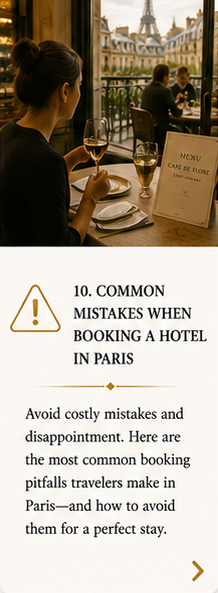
10. Traveler comparing Paris hotels online to avoid common hotel booking mistakes

Licence Travel Agent N°IM075120025 Paris | Financial guarantee : APST | Professional Liability Insurance HISCOX | © 2006–2026 Paris Webservices. All Rights Reserved.
Website Security Test