

Choosing the Right Hotel in Paris
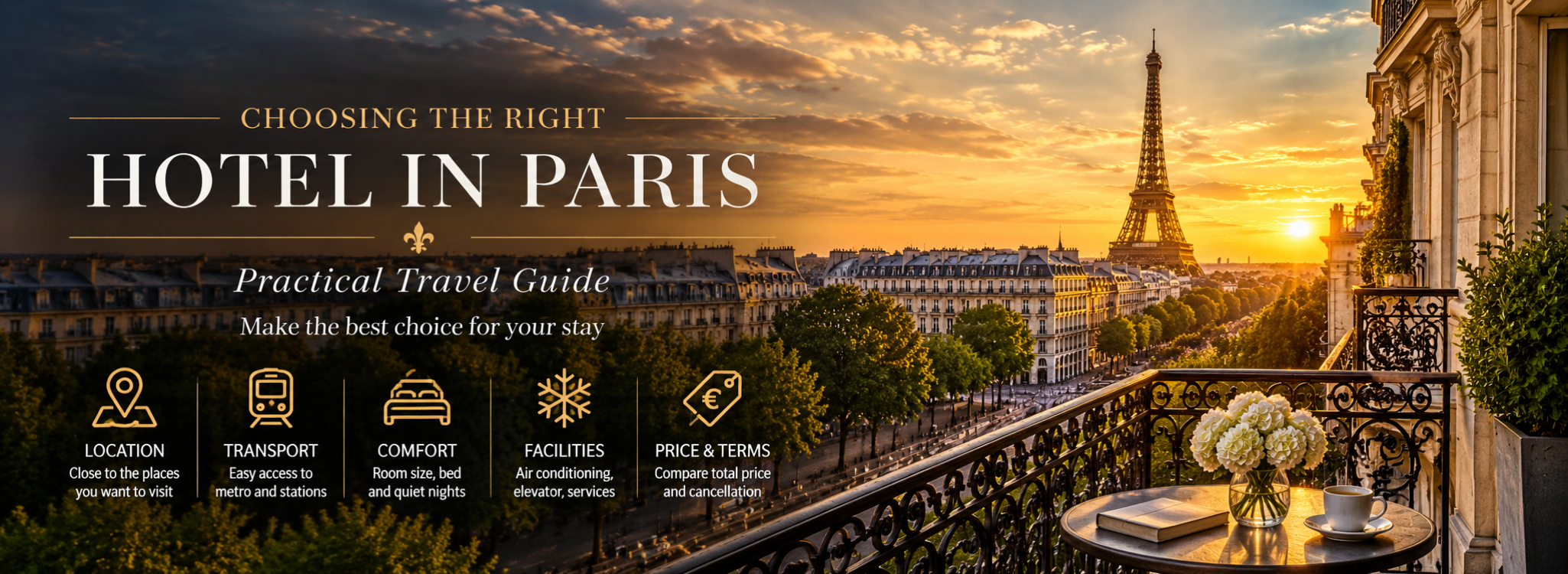
Everything You Should Know Before You Book
1. Introduction
Choosing a hotel in Paris may seem like one of the easiest parts of planning a trip. Today, thousands of properties can be compared in just a few minutes, with booking websites allowing travellers to sort hotels by price, star rating, guest reviews or distance from famous landmarks. At first glance, the process appears straightforward. Find a hotel that fits your budget, read a few positive reviews and confirm the reservation. Yet after many years of welcoming visitors from around the world, we have discovered that this approach often leads to disappointment, not because the hotel itself is poor, but because travellers begin with the wrong question.
Most people ask, “Which hotel should I book?”
A much better question is, “What kind of trip do I want to have?”
The answer completely changes the way you should choose your accommodation.
A couple celebrating their honeymoon, a family travelling with young children, a visitor discovering Paris for the first time and someone returning for a fifth visit are all looking for very different experiences. Even if they travel during the same week and have similar budgets, the hotel that perfectly suits one traveller may be completely unsuitable for another. This is why there is no universal “best hotel” in Paris. There are outstanding luxury hotels, charming boutique properties, excellent family-friendly hotels and comfortable budget options. The real challenge is finding the one that matches the way you intend to experience the city.
Many travellers unknowingly spend more time comparing hotels than thinking about how they will actually spend their days in Paris. They carefully study room sizes, breakfast menus and guest ratings but pay much less attention to the neighbourhood, the walking distances or how easily they can reach the places they hope to visit. Ironically, these are often the factors that influence the quality of a stay far more than whether the hotel has a spa or a rooftop bar. A beautiful room quickly becomes less important if you spend two hours every day travelling across the city simply because the location was chosen only for its lower price.
Read More
Paris is a city best discovered gradually. Some of the most memorable moments are rarely found inside a hotel room. They happen while walking through elegant streets on the way to breakfast, stopping at a neighbourhood bakery because the smell of fresh croissants is impossible to resist, discovering a small art gallery that was never mentioned in a guidebook or sitting on a café terrace watching everyday Parisian life unfold around you. The right hotel does not create these moments by itself, but it places you in the perfect position to experience them naturally.
Another common misconception is that the number of stars automatically reflects how enjoyable a stay will be. In reality, hotel classifications mainly measure facilities and services rather than location or atmosphere. A beautifully managed three-star hotel in Saint-Germain-des-Prés may provide a far richer Parisian experience than a five-star property located much farther from the historic centre. Likewise, a luxury hotel cannot compensate for a neighbourhood that simply does not match the type of holiday you had imagined.
Throughout this guide, we will help you look beyond the photographs and promotional descriptions that dominate booking websites. We will explain what really matters when choosing a hotel in Paris, which details are often overlooked before travelling and how a few simple decisions can dramatically improve your entire stay. Rather than recommending individual hotels, our objective is to help you understand how to choose the accommodation that best fits your travel style, your expectations and the way you want to discover one of the world’s most fascinating cities.
Because in Paris, the hotel is much more than the place where you sleep.
It becomes the starting point of every morning, the place you return to after a day of exploring and, ultimately, the neighbourhood you will remember long after the trip has ended. Choosing it carefully is therefore one of the most important decisions you will make before arriving in Paris.
Finding the Right Area for Your Travel Style
Before comparing hotel prices, reading guest reviews or looking at photographs of elegant rooms, take a few minutes to think about the kind of holiday you want to have. It may sound like an unusual place to begin, yet it is probably the most important decision you will make before booking your accommodation. Every year we meet travellers who have chosen an excellent hotel, only to discover that it simply did not suit the way they wanted to experience Paris. The hotel itself was not the problem. It was the choice of location, services or atmosphere in relation to their expectations.
Imagine two couples visiting Paris for four nights. The first dreams of spending long afternoons in museums, walking beside the Seine, enjoying traditional cafés and returning to a quiet hotel after dinner. The second wants luxury shopping, rooftop bars, lively evenings and fashionable restaurants. Both are looking for an unforgettable stay, yet recommending the same hotel to each of them would make very little sense. Their idea of the perfect holiday is completely different, and their accommodation should reflect those differences.


Read More
Families usually have another set of priorities. Travelling with children means thinking about space, convenience and simplicity rather than just location. A hotel close to parks, bakeries, supermarkets and public transport often proves much more practical than one located beside a famous monument. Parents quickly discover that reducing walking distances after a long day of sightseeing makes everyone happier. Being able to return easily to the hotel for a short rest, leave shopping bags or collect a forgotten jacket often becomes far more valuable than having the best view in the city.
Couples travelling alone often make different choices. Many are looking for charming neighbourhoods where they can walk hand in hand through beautiful streets, enjoy dinner without worrying about the journey home and experience Paris after dark. For them, the atmosphere surrounding the hotel is frequently just as important as the hotel itself. A pleasant evening stroll through Saint-Germain-des-Prés or the 7th arrondissement often becomes one of the most memorable parts of the entire trip.
Visitors returning to Paris for a second or third time also tend to approach accommodation differently. Having already visited the Eiffel Tower, the Louvre and Notre-Dame, they often prefer quieter residential districts where they can experience another side of the city. They are less concerned about being close to every major attraction because they already know the transport system and are happy to explore neighbourhoods that first-time visitors might never consider.
Budget naturally plays an important role, but it should never become the only deciding factor. Choosing a cheaper hotel farther from the places you intend to visit may appear to save money, yet the additional transport costs, extra travelling time and reduced flexibility often outweigh the initial saving. A slightly more expensive hotel in the right neighbourhood frequently offers much better overall value because it allows you to spend your time enjoying Paris instead of commuting across it.
Another point that many travellers overlook is how they intend to organise their days. Some visitors prefer leaving the hotel early in the morning and returning only late in the evening. Others like taking a break after lunch before going out again for dinner or a theatre performance. If you belong to the second group, choosing a central neighbourhood becomes even more important because returning to the hotel should feel easy rather than becoming another long journey.
Your plans outside Paris should also influence your decision. If you intend to join guided excursions to Versailles, Giverny or Normandy, or have already booked one of our small-group tours with hotel pickup, selecting accommodation within or close to our main pickup area on the western side of Paris can make your mornings considerably easier. Spending less time travelling before the tour begins means more time enjoying the destination itself.
Choosing a hotel should therefore never begin with photographs or star ratings. It should begin with an honest understanding of how you hope to experience Paris. Once you know whether your priority is walking, museums, shopping, restaurants, family activities, luxury, nightlife or organised day tours, selecting the right hotel becomes far easier. The hotel is no longer simply a place to sleep; it becomes an essential part of the experience you are creating for your stay in Paris.
It Is a City You Experience
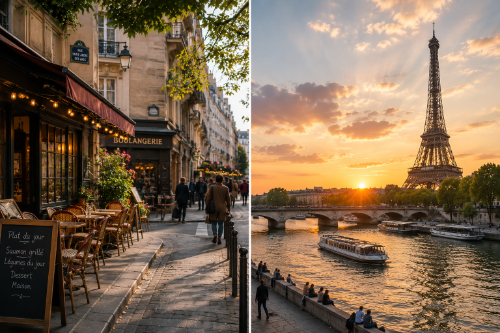
One of the biggest mistakes we see every year is travellers falling in love with a hotel before they have even decided where they want to stay. Beautiful photographs, excellent reviews and an attractive price often make a property appear irresistible, yet none of these details answer the most important question: Is this the right location for the holiday you have planned? In our experience, choosing the neighbourhood first and the hotel second almost always leads to a much better stay.
This may seem like a small difference, but it changes everything once you arrive in Paris. Two hotels offering the same level of comfort, the same breakfast and the same quality of service can provide completely different travel experiences simply because they are located in different parts of the city. One may allow you to spend your days walking between museums, cafés and monuments, while the other requires several Metro journeys before your sightseeing has even begun. At the end of the holiday, visitors rarely remember how elegant the hotel lobby looked. They remember how easy—or how difficult—it was to enjoy Paris every day.
Read More
Location influences much more than sightseeing. It determines where you have breakfast, how easily you can return to the hotel during the afternoon, whether you feel comfortable walking back after dinner and how much time you spend on public transport instead of discovering the city itself. A well-located hotel offers flexibility that many travellers only appreciate after they arrive. You may decide to return for an hour’s rest before going out again in the evening, leave shopping bags in your room rather than carrying them all day or simply change clothes before dinner without thinking twice about the journey. These small comforts rarely appear in hotel descriptions, yet together they have a remarkable effect on the quality of a stay.
This is particularly true for first-time visitors. Paris is much more enjoyable when your days are organised around neighbourhoods rather than transport. Instead of crossing the city several times in search of individual monuments, you can spend the morning around the Louvre, continue naturally towards the Seine, stop for lunch in Saint-Germain-des-Prés and perhaps finish the afternoon in the Luxembourg Gardens. When your hotel is located in or near these central districts, your itinerary develops almost naturally, allowing you to experience Paris at a relaxed pace instead of constantly planning your next Metro journey.
Another aspect often overlooked is the evening. Many visitors imagine themselves enjoying dinner on a charming terrace, perhaps followed by a leisurely walk beside the Seine before returning to their hotel. That experience is much easier when your accommodation is located in a lively central neighbourhood. If your hotel is forty minutes away by Metro, you may find yourself watching the time rather than enjoying the atmosphere. Little by little, transport begins to influence your decisions instead of your curiosity guiding them.
Location also becomes particularly important if you plan to include organised excursions during your stay. Visitors joining one of our small-group tours to Versailles, Giverny or Normandy often appreciate staying within our main hotel pickup area on the western side of Paris. Neighbourhoods such as the 6th, 7th, 8th, 16th and 17th arrondissements generally offer the most convenient hotel pickups, reducing transfer times before departure and allowing you to begin your excursion more comfortably. Guests staying elsewhere are always welcome, although depending on the tour, a nearby meeting point may sometimes be suggested instead of hotel pickup. Considering this before booking your accommodation can make your mornings significantly easier, particularly if you have several guided tours planned during your stay.
Price should therefore be viewed in relation to location rather than in isolation. A hotel that costs a little more but saves you two hours of travelling every day often represents far better value than a cheaper property located far from the places you actually intend to visit. Time is one of the most valuable parts of any holiday, and spending less of it commuting means spending more of it discovering the cafés, museums, gardens and neighbourhoods that make Paris so memorable.
Before comparing star ratings, breakfast options or room sizes, take a map of Paris and imagine how your days will unfold. Think about where you would like to have your morning coffee, how you plan to spend your afternoons and whether you would rather walk back to your hotel after dinner or take another Metro journey late at night. Once you have answered those questions, the choice of hotel becomes much easier because you are no longer selecting a building—you are choosing the part of Paris that will become your home for the duration of your stay.
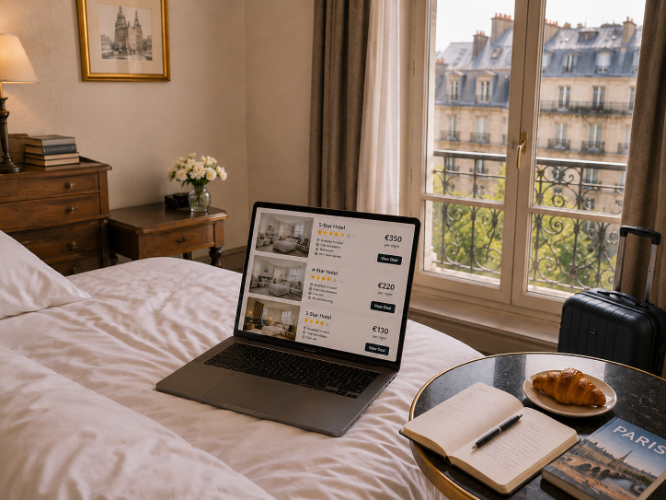
One of the most common assumptions travellers make when booking accommodation in Paris is that a higher star rating automatically guarantees a better stay. At first glance, the logic seems perfectly reasonable. A five-star hotel should naturally offer a superior experience to a three-star property, while a four-star hotel appears to represent the ideal compromise between comfort and price. Although hotel classifications are certainly useful for understanding the level of facilities and services provided, they rarely tell the whole story. In Paris, where location often plays a much greater role than luxury, the number of stars above the entrance should never be the deciding factor.
Hotel stars are awarded according to official criteria covering aspects such as room size, reception services, facilities, accessibility and the range of amenities available. They are not awarded because a hotel occupies the best neighbourhood or because it offers the most authentic Parisian experience. This explains why a beautifully managed three-star boutique hotel in Saint-Germain-des-Prés can provide a far more memorable stay than a luxury property located much farther from the places you actually intend to visit. The quality of your holiday depends not only on the comfort of the room, but also on what surrounds it.
Read More
Many visitors are surprised to discover that Paris is very different from cities where modern hotels dominate the skyline. Much of the accommodation occupies elegant nineteenth-century Haussmann buildings that were never originally designed to become hotels. This gives many properties their unique charm, but it also means that rooms are often smaller, corridors narrower and lifts considerably more compact than travellers from North America, Australia or parts of Asia might expect. Even some luxury hotels cannot completely change the architectural limitations of historic buildings.
For this reason, it is important to look beyond the star rating and understand what each category generally offers. A well-located three-star hotel often provides everything most visitors actually need: a comfortable room, private bathroom, reliable Wi-Fi, air conditioning, daily housekeeping and a helpful reception team. If your plan is to spend most of the day exploring Paris, the hotel becomes a comfortable place to sleep rather than the main attraction of your holiday. In this situation, paying significantly more simply to move from three stars to five may not always improve your overall experience.
Four-star hotels usually offer additional comfort, larger rooms, more refined decoration and a wider range of services. For many travellers, particularly couples celebrating a special occasion, this category represents an excellent balance between quality and value. Five-star hotels, meanwhile, provide exceptional service, concierge assistance, fine dining, luxury spas and beautifully designed public spaces. They are perfect for visitors looking for a truly luxurious stay, but they also come with significantly higher prices that are not always necessary if your priority is discovering the city rather than spending time inside the hotel.
Another point worth remembering is that photographs can sometimes create unrealistic expectations. Hotel websites naturally present their finest rooms, often those in higher categories or recently renovated. Standard rooms may differ in size, view or decoration, particularly in older buildings. Reading the room description carefully is therefore just as important as looking at the photographs. Paying attention to square metres, bed size, air conditioning, lift access and room location within the building often provides a much more accurate impression of what you will actually experience after checking in.
Location should always remain the first priority. We would generally recommend a comfortable three- or four-star hotel in an excellent neighbourhood before suggesting a luxury property located much farther from the areas you plan to visit. Being able to walk to cafés, museums, restaurants and many of Paris’ most famous attractions will almost always contribute more to the quality of your stay than marble bathrooms or a larger reception lounge.
If you are planning to join one of our small-group tours, the location of your hotel becomes even more important. To provide shorter pickup routes and more comfortable departures for all guests, most of our hotel pickups are organised in the western part of Paris. Hotels located in the 1st, 6th, 7th, 8th and 16th arrondissements are generally within our standard hotel pickup area. We also provide hotel pickup from the western sections of the 2nd, 5th, 9th, 14th, 15th and 17th arrondissements, depending on the exact location of your hotel. Guests staying outside these areas are always welcome to join our tours, although a convenient meeting point may sometimes be proposed instead of hotel pickup. If visiting Versailles, Giverny, Normandy or any of our other small-group excursions is part of your itinerary, checking whether your hotel is located within our pickup area before booking can make the beginning of your day significantly easier and more comfortable.
Ultimately, choosing a hotel in Paris is about finding the right balance between comfort, location and budget. A higher category certainly offers additional services, but those services only become meaningful if they correspond to the type of holiday you have planned. The most successful stays are rarely determined by the number of stars displayed at the hotel entrance. They are determined by waking up each morning in the right neighbourhood, stepping outside and feeling that Paris begins immediately around you.
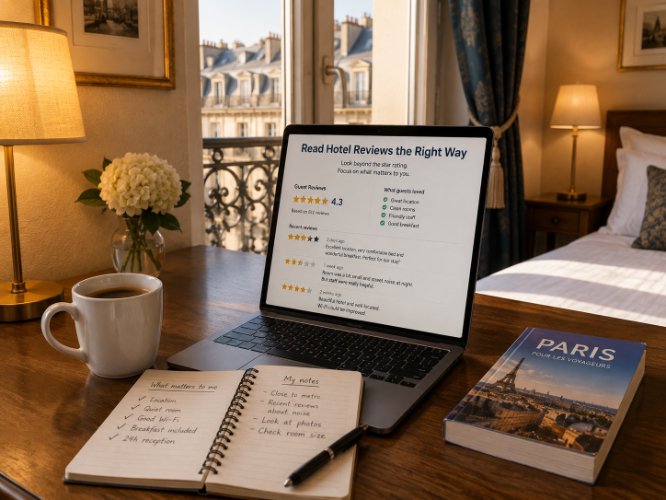
Reading hotel reviews has become one of the most important steps when planning a trip, yet many travellers make the same mistake: they focus almost entirely on the overall score without taking the time to understand what the reviews are actually saying. A hotel rated 8.8 out of 10 is not automatically better than one rated 8.5. The numbers provide only a general indication. What really matters is whether the hotel matches your expectations, your travel style and the type of experience you hope to enjoy during your stay in Paris.
One of the first things we recommend is paying close attention to recent reviews rather than relying on comments written several years ago. Hotels constantly evolve. Management changes, rooms are renovated, services improve and sometimes standards decline. A property that received outstanding reviews five years ago may offer a very different experience today. Recent comments usually provide the clearest picture of what you are likely to encounter when you arrive.
It is equally important not to read only the five-star reviews. Positive comments are naturally encouraging, but they often describe the same general qualities such as friendly staff, comfortable beds or a pleasant breakfast. Negative reviews, on the other hand, frequently contain useful information, provided they are read objectively. The goal is not to avoid hotels with criticism but to understand whether that criticism would genuinely affect your own stay.
Read More
For example, one guest may complain that the hotel is “too far from the Eiffel Tower.” That observation may be completely irrelevant if your plans are centred on the Louvre, Le Marais or Saint-Germain-des-Prés. Another traveller may describe the room as “very small,” yet hotel rooms in Paris are generally more compact than those found in many other international cities. Understanding the local context is essential before drawing conclusions from comments written by people whose expectations may be very different from your own.
Another useful habit is reading how the hotel responds to criticism. Professional, polite and constructive replies often reveal far more about the management than the original complaint itself. Hotels that acknowledge problems, explain situations respectfully and demonstrate a genuine interest in guest satisfaction usually inspire far greater confidence than those that ignore reviews or react defensively.
When reading reviews, concentrate on the subjects that will actually influence your stay. Rather than simply comparing overall ratings, look for repeated comments about cleanliness, noise levels, air conditioning, Wi-Fi reliability, breakfast quality, reception service, luggage storage, room maintenance and the condition of the bathrooms. If dozens of independent travellers repeatedly praise the same aspects of a hotel, those strengths are probably genuine. Likewise, if the same criticism appears consistently over many months, it deserves careful consideration.
It is also worth remembering that online reviews do not always tell the complete story. The overwhelming majority are written by genuine travellers sharing honest experiences, but, like every review platform, hotel websites occasionally receive comments that reflect personal disputes rather than the actual quality of the accommodation. In the travel industry, disagreements sometimes arise over cancellation policies, refund requests or services that were clearly described before booking. When a hotel applies its published conditions and refuses a refund outside those terms, a small number of guests may decide to express their frustration through an unusually negative review. This does not automatically mean the hotel failed to provide the service it promised.
Review platforms themselves have also changed considerably over the years. Millions of reviews are published every year, and moderation is increasingly supported by automated systems. While these technologies help process enormous volumes of content, no review platform is perfect. Occasionally, misleading, exaggerated or inaccurate reviews may remain online for some time before being examined more closely. This is one of the reasons why experienced travellers rarely base an important booking decision on a single comment or even on a single review website.
Another point that many visitors overlook is the profile of the reviewer. A business traveller spending one night in Paris has very different priorities from a family staying for a week or a couple celebrating a honeymoon. Some travellers value fast Wi-Fi above everything else, while others care far more about breakfast, neighbourhood atmosphere or room size. Reading reviews written by people with travel habits similar to your own usually provides much more relevant information than simply comparing overall scores.
Photographs uploaded by previous guests are often just as valuable as written reviews. Unlike the carefully selected marketing photographs displayed by hotels, guest photographs usually show standard rooms exactly as visitors found them. They provide a realistic impression of room size, natural light, bathroom condition, views from the windows and the general state of maintenance. Comparing official photographs with recent guest images is one of the simplest ways to avoid unrealistic expectations.
Ultimately, hotel reviews should be viewed as a valuable source of information rather than an absolute measure of quality. The most reliable decision comes from looking for consistent patterns across many recent reviews, reading the hotel’s responses, comparing information on several trusted platforms and considering whether the reviewers had expectations similar to your own. Combined with choosing the right neighbourhood and understanding what hotels in Paris typically offer, this balanced approach will almost always lead to a much better choice than simply selecting the property with the highest rating.
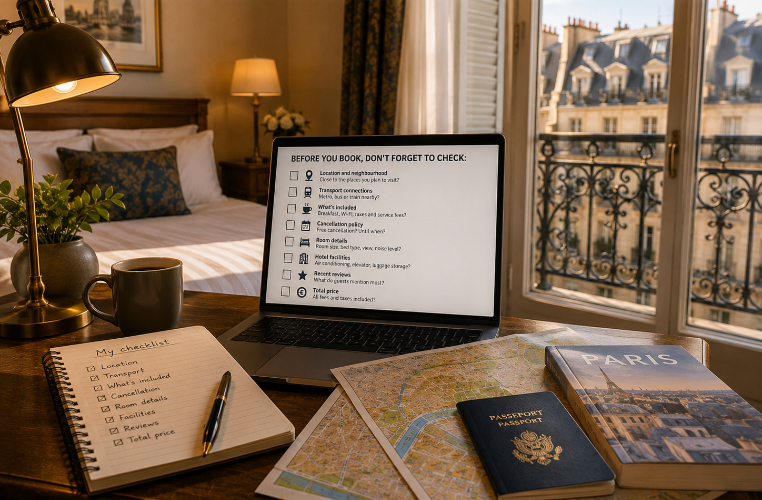
One of the biggest mistakes travellers make when booking a hotel in Paris is concentrating almost exclusively on the location, photographs and guest rating while overlooking the practical details that will influence their stay every single day. These details may seem insignificant when comparing hotels online, but after arriving in Paris they often become the difference between a comfortable holiday and a frustrating one. Spending a few extra minutes checking the hotel’s facilities before confirming your reservation can prevent many of the problems that visitors only discover after they have checked in.
One of the first things to verify is whether the hotel has a lift. This may sound surprising, but many hotels in Paris occupy beautiful nineteenth-century buildings that were constructed long before modern elevators became standard. Some properties have installed compact lifts, while others still have none at all. If your room is located on the fourth or fifth floor and you are travelling with heavy luggage, climbing several flights of stairs after a long international flight is rarely the welcome most visitors imagine. Families travelling with strollers, senior travellers and anyone with limited mobility should pay particular attention to this point before booking.
Read More
Air conditioning is another feature that should never be taken for granted. Although an increasing number of hotels now offer air-conditioned rooms, some smaller boutique hotels or historic buildings still rely on fans or natural ventilation. During spring and autumn this is rarely an issue, but temperatures in Paris can become very warm during July and August. If you are travelling during the summer, confirming that the room is equipped with air conditioning will often contribute more to your comfort than many luxury facilities advertised elsewhere.
Reception hours also deserve attention. Larger hotels generally operate a 24-hour reception, allowing guests to check in late or request assistance at any time. Smaller hotels, however, may have limited opening hours, particularly boutique properties or family-run establishments. If your flight arrives late in the evening or you expect possible delays, make sure the hotel offers late check-in procedures or has someone available to welcome you after reception closes.
Luggage storage is another service that many travellers only think about after booking. If you arrive several hours before your room is ready or your flight departs late in the evening, being able to leave your suitcases safely at the hotel allows you to enjoy your first or last day in Paris without carrying heavy bags through the city. Most hotels provide this service, but it is always worth confirming before your arrival.
Breakfast is another aspect where expectations often differ. Some visitors enjoy beginning every morning with breakfast at the hotel, while others prefer discovering local cafés and neighbourhood bakeries. Before paying extra for breakfast, consider how you usually travel. In many Paris neighbourhoods, an excellent bakery is located just around the corner, offering freshly baked croissants, pastries and coffee at a lower price while providing a more authentic local experience.
Room size is another subject that frequently surprises international visitors. Hotel rooms in Paris are generally smaller than those found in many cities in North America, Australia or Asia. This is particularly true in historic buildings located in the city centre. Rather than relying on photographs, always check the room size expressed in square metres or square feet. A beautifully photographed room can appear much larger than it actually is, especially when wide-angle lenses are used for promotional images.
The bathroom also deserves careful attention. Some older hotels have renovated bathrooms while preserving the original structure of the building, meaning layouts may vary considerably from one room to another. If features such as a walk-in shower, bathtub or accessible bathroom are important to you, verify these details before confirming your reservation.
Noise is another point worth considering. Hotels located on major boulevards, busy shopping streets or near popular nightlife areas naturally experience more activity than those on quieter residential streets. This does not necessarily make them poor choices, but if you are a light sleeper, requesting a room overlooking an interior courtyard or a quieter street can make a noticeable difference. Reading recent reviews often provides valuable information about the hotel’s sound insulation and the general atmosphere after dark.
Reliable Wi-Fi has become essential for most travellers, whether to organise sightseeing, use navigation apps, check flight information or stay in touch with family and friends. Most hotels provide free Wi-Fi, but connection quality can vary, particularly in older buildings with thick stone walls. It is also worth remembering that hotel Wi-Fi is a shared public network. While it is perfectly suitable for checking emails, browsing the internet or planning your day, we recommend avoiding sensitive activities such as online banking, accessing confidential business documents or making important financial transactions over a public connection. If your mobile phone includes an international data plan or an eSIM with mobile internet, using your own mobile connection is often the safest and most reliable solution. In many cases, it also provides a faster and more stable connection than hotel Wi-Fi, giving you greater peace of mind throughout your stay.
Another detail that many travellers overlook is the check-in and check-out times. Most hotels in Paris do not allow access to rooms before the middle of the afternoon, while check-out is usually required between 11:00 a.m. and noon. If your flight arrives early in the morning, do not assume that your room will already be available. Likewise, if you are flying home late in the evening, check whether the hotel offers luggage storage or a courtesy room where you can freshen up before leaving for the airport.
Finally, think about the services that will genuinely improve your stay rather than those that simply look impressive in hotel advertisements. A rooftop terrace, swimming pool or fitness room may sound attractive when browsing online, but many visitors never use them because they spend most of the day exploring Paris. By contrast, practical services such as luggage storage, a helpful reception team, reliable air conditioning, good Wi-Fi and, above all, an excellent location are benefits that almost every traveller appreciates every single day.
If you also plan to join one of our small-group tours, checking the hotel’s location becomes even more important. Hotels located in the 1st, 6th, 7th, 8th and 16th arrondissements, together with the western parts of the 2nd, 5th, 9th, 14th, 15th and 17th arrondissements, generally fall within our main hotel pickup area. Choosing accommodation within these districts can make your departure much easier and more comfortable, allowing you to begin your excursion directly from your hotel instead of travelling to a meeting point. It is a small detail when booking, but one that many of our guests appreciate once they arrive in Paris.
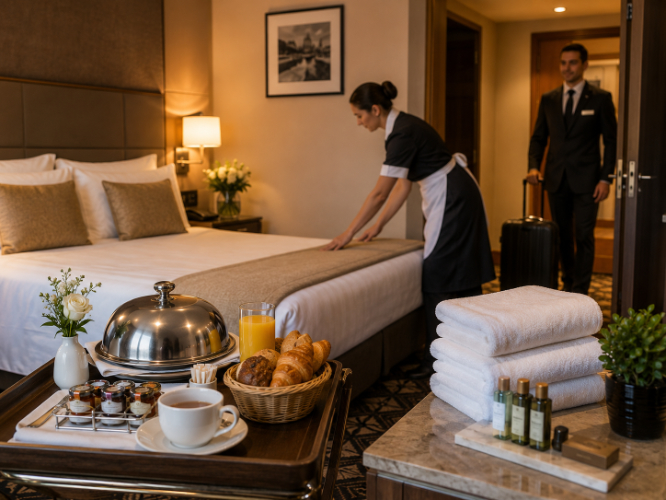
When comparing hotels in Paris, it is easy to become distracted by impressive photographs of rooftop terraces, designer lobbies, spas or fitness centres. These facilities certainly add to the appeal of a property, particularly in luxury hotels, but they are not necessarily the services that will make the greatest difference during your stay. Most visitors spend the majority of their time exploring Paris rather than relaxing inside the hotel, which means that many of the facilities highlighted in advertisements are used far less than travellers initially imagine.
Instead of focusing on luxury extras, we encourage visitors to pay attention to the practical services that they are likely to use every day. These are the details that often determine whether a stay feels easy and enjoyable or unnecessarily complicated.
A helpful reception team is probably one of the most valuable services any hotel can provide. Whether you need directions, assistance with restaurant reservations, advice about public transport or help organising a taxi early in the morning, knowledgeable staff can save both time and stress. Hotels with experienced reception teams often become an excellent source of local recommendations that you are unlikely to find in guidebooks.
Read More
Choosing the Accommodation That Best Matches Your Stay
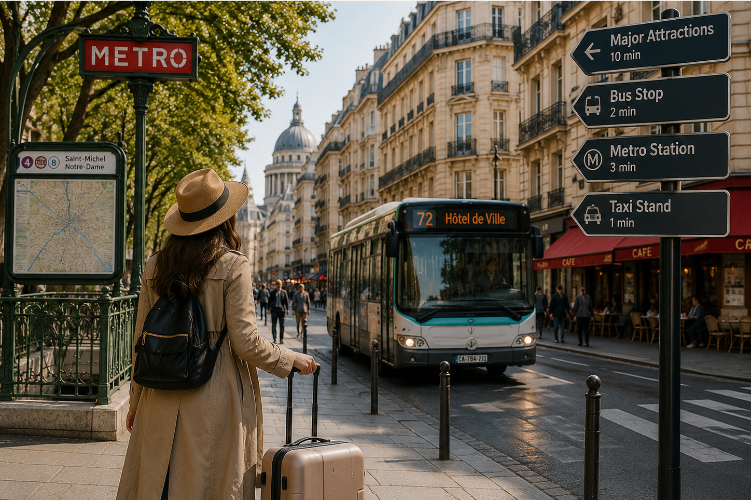
Many travellers begin searching for a hotel by looking at its price, star rating or guest reviews, while transportation is often treated as a secondary consideration. In reality, the opposite is usually true. The location of your hotel and the way you plan to travel around Paris will influence every single day of your stay. A hotel that appears slightly more expensive may actually save you hours of travelling, reduce transport costs and allow you to experience the city far more comfortably than a cheaper property located farther away.
One of the first questions to ask yourself is how you intend to discover Paris. If you enjoy walking and plan to visit museums, cafés and historic neighbourhoods, choosing a hotel in a central area such as Saint-Germain-des-Prés, the 7th arrondissement, the 1st arrondissement or Le Marais will often allow you to spend most of your day on foot. Many visitors are surprised by how close the city’s major attractions actually are once they arrive. Walking from the Louvre to the Seine, continuing towards Notre-Dame or exploring Saint-Germain-des-Prés often feels far more enjoyable than repeatedly entering and leaving the Metro.
Read More
Transport also becomes particularly important if you are arriving from one of Paris’ airports. After a long international flight, carrying heavy luggage through large railway stations, changing between the RER and the Metro or climbing several flights of stairs is not always the most relaxing way to begin a holiday. For first-time visitors, families with children or travellers carrying several suitcases, we generally recommend using an official Paris taxi or a pre-booked private transfer. Starting your stay comfortably often sets the tone for the rest of your visit.
The same principle applies when travelling around Paris after dark. Public transport remains available until late in the evening, but if you are returning to your hotel after dinner, leaving a theatre or coming back from a concert, an official taxi or a private transfer can often be the simplest and most comfortable solution, particularly if you are unfamiliar with the city or carrying shopping bags. Official Paris taxis are easy to recognise by their illuminated “TAXI PARISIEN” roof sign and can be found throughout the city.
If you plan to include day trips during your stay, hotel location becomes even more significant. Visitors joining one of our small-group tours to Versailles, Giverny or Normandy should remember that most of our hotel pickups are organised in the western part of Paris. Hotels located in the 1st, 6th, 7th, 8th and 16th arrondissements are generally within our standard pickup area. We also provide hotel pickup from the western sections of the 2nd, 5th, 9th, 14th, 15th and 17th arrondissements, depending on the exact location of the hotel. Guests staying elsewhere are always welcome to join our tours, although a convenient meeting point may sometimes be proposed instead of hotel pickup. Choosing accommodation within our pickup area can make early departures considerably easier and more comfortable, especially if you have several excursions planned during your stay.
Another point that many travellers overlook is the return journey at the end of the day. After spending eight or nine hours walking through museums, gardens and historic streets, even an additional thirty-minute Metro journey can feel much longer than expected. A well-located hotel allows you to return quickly, rest before dinner or simply enjoy a relaxing evening without constantly checking transport schedules. These small advantages are difficult to appreciate while planning a trip, yet they often become some of the most valuable aspects of choosing the right hotel.
Ultimately, transportation should never be considered separately from your accommodation. The two are closely connected. A hotel in the right neighbourhood reduces the need for transport, while good transport connections make it easier to discover places beyond the historic centre. Finding the right balance between both is one of the simplest ways to enjoy a smoother, more relaxing and far more memorable stay in Paris.
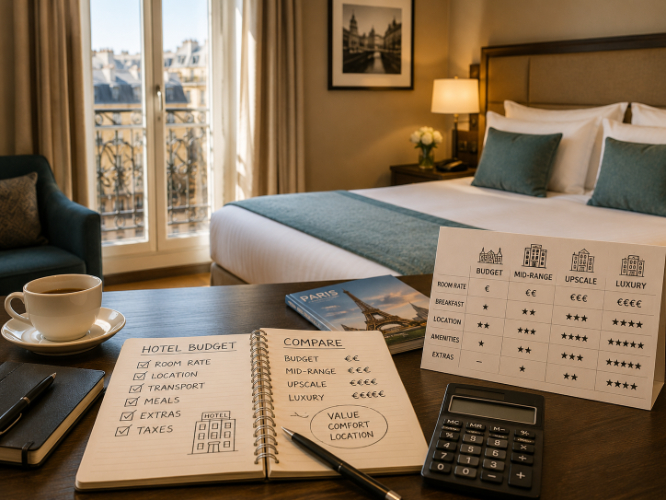
One of the first decisions every traveller faces when planning a trip to Paris is how much to spend on accommodation. Hotel prices vary considerably throughout the city, and it is easy to assume that paying more automatically guarantees a better experience. In reality, finding the right hotel budget is less about choosing the most expensive property and more about understanding where your money will make the greatest difference. For most visitors, the goal should not be to book the most luxurious hotel available, but to achieve the best balance between location, comfort and value.
It is perfectly natural to compare prices across different neighbourhoods. A hotel located outside the historic centre may appear significantly cheaper than one in Saint-Germain-des-Prés or the 7th arrondissement. At first glance, the saving can seem substantial. However, many travellers forget to consider the hidden cost of distance. Staying farther from the attractions you plan to visit often means spending more money on public transport, more time commuting and considerably less flexibility throughout the day. Returning to the hotel for a short rest, leaving shopping bags behind or changing clothes before dinner may no longer feel practical. A hotel that initially looked like excellent value can therefore become less attractive once these additional costs are taken into account.
Read More
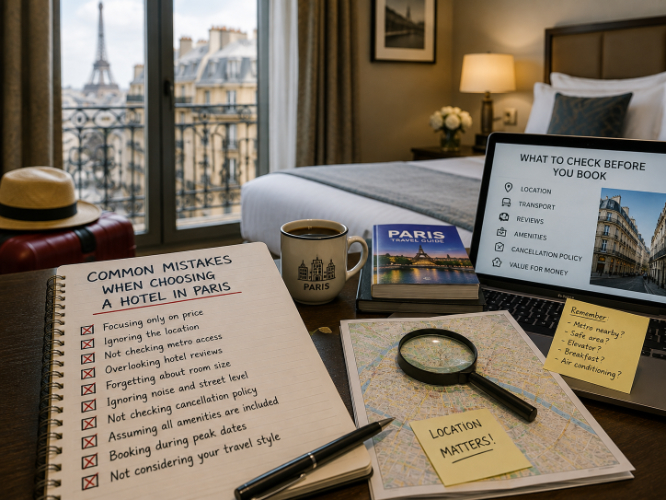
Every year, we meet visitors who tell us they wish they had chosen a different hotel. Interestingly, the disappointment is rarely caused by poor service or uncomfortable rooms. In most cases, the hotel itself meets expectations. The real problem is that it was chosen for the wrong reasons. A hotel can have excellent reviews, an attractive price and beautiful photographs while still being the wrong choice for the type of holiday you had planned.
One of the most common mistakes is choosing a hotel based only on the price. Saving fifty or even one hundred euros per night can seem like an excellent decision when comparing hotels online. However, if that saving means spending an extra two hours every day travelling across Paris, paying for additional Metro tickets, or relying on taxis late at night, the real cost quickly becomes much higher than expected. More importantly, you lose valuable holiday time that could have been spent exploring the city.
Read More
Another frequent mistake is choosing a hotel before choosing the neighbourhood. Many travellers fall in love with a particular hotel because of its photographs or exceptional reviews without first asking whether the location matches the way they want to experience Paris. A beautiful hotel cannot compensate for a neighbourhood that requires long journeys every morning or feels disconnected from the attractions you plan to visit. The neighbourhood should always come first. Once you have chosen the right area, finding the right hotel becomes much easier.
Many visitors also make the mistake of booking too late. Paris remains one of the world’s most visited cities, and the best hotels in the most desirable neighbourhoods often sell out several months in advance. Waiting until the last minute usually leaves fewer options, higher prices and the possibility of having to compromise on either location or quality. If you are travelling during spring, summer, the Christmas season or major international events, early booking is strongly recommended.
Another point that travellers frequently overlook is reading only the hotel’s description. Hotel websites naturally present the property in the best possible light. Professional photographs, carefully written descriptions and promotional language are designed to highlight the hotel’s strengths. Before making your decision, always compare this information with recent guest reviews and photographs uploaded by previous visitors. These often provide a much more realistic impression of the rooms and facilities.
Some visitors also underestimate the importance of room size. Hotel rooms in Paris are generally smaller than those found in many other countries, particularly in historic buildings. Looking only at photographs can create unrealistic expectations because wide-angle lenses often make rooms appear much larger than they really are. Always check the room dimensions before booking, especially if you are travelling with several suitcases or planning a longer stay.
Another surprisingly common mistake is assuming that all hotels offer the same facilities. Reception opening hours, air conditioning, lifts, luggage storage and breakfast arrangements vary considerably from one property to another. Taking a few minutes to verify these practical details before confirming your reservation often prevents unnecessary disappointment after arrival.
Location becomes even more important if you plan to include guided excursions during your stay. Some visitors reserve accommodation without checking whether it falls within our hotel pickup area, only discovering later that they need to travel to a meeting point early in the morning. Hotels located in the 1st, 6th, 7th, 8th and 16th arrondissements, together with the western sections of the 2nd, 5th, 9th, 14th, 15th and 17th arrondissements, generally provide the greatest convenience for guests joining our Versailles, Giverny, Normandy and other small-group tours. Checking this before booking can make the beginning of your day considerably more comfortable.
Another mistake we occasionally see is choosing accommodation solely because it is close to a famous landmark. Staying beside the Eiffel Tower may sound ideal, but if your plans include shopping, museums, restaurants and exploring several different neighbourhoods, another area may offer a much better balance. The same applies to hotels near major railway stations or airports. They are practical for specific situations but are not always the best choice for a sightseeing holiday.
Finally, many travellers simply overestimate how much time they will spend in their hotel. They choose expensive facilities such as spas, swimming pools or large fitness centres, only to realise that they leave the hotel after breakfast and return late in the evening. Paris itself becomes the real attraction. Investing in an excellent location almost always provides greater value than paying for services you may never use.
Choosing the right hotel is therefore not about finding the cheapest room or the highest star rating. It is about avoiding these common mistakes and selecting accommodation that truly matches the way you intend to experience Paris. A little extra planning before booking can save hours of travelling, reduce unnecessary stress and significantly improve the quality of your entire stay.
Choosing a hotel in Paris often raises many questions, especially if this is your first visit. Below are the questions we are asked most frequently by international travellers, together with the advice we usually give before they book their accommodation.
⋅ ⋅ ⋅ ✦ ⋅ ⋅ ⋅
When is the best time to book a hotel in Paris?
As early as possible. Paris is one of the world’s most visited destinations, and the best hotels in the most desirable neighbourhoods are often fully booked several months in advance. If you are travelling during spring, summer, the Christmas holidays or major international events, booking three to six months ahead usually provides the widest choice and the best prices.
⋅ ⋅ ⋅ ✦ ⋅ ⋅ ⋅
Which neighborhood is best for a first visit?
For most first-time visitors, we recommend Saint-Germain-des-Prés or the 7th arrondissement. Both neighbourhoods offer an excellent balance between sightseeing, restaurants, cafés, museums and walkability, allowing you to discover much of Paris without relying heavily on public transport.
⋅ ⋅ ⋅ ✦ ⋅ ⋅ ⋅
Is it worth paying more for a central hotel?
In most cases, yes. A centrally located hotel often saves both time and money throughout your stay. Instead of spending hours travelling across Paris each day, you can walk to many attractions, return easily to your hotel and enjoy evenings without worrying about transport.
⋅ ⋅ ⋅ ✦ ⋅ ⋅ ⋅
Are hotel rooms really smaller in Paris?
Yes. Compared with many hotels in North America, Australia or Asia, rooms in Paris are generally more compact, particularly in historic buildings located in the city centre. Always check the room size before booking rather than relying only on photographs.
⋅ ⋅ ⋅ ✦ ⋅ ⋅ ⋅
Do all hotels have air conditioning?
No. While many hotels now offer air-conditioned rooms, some smaller boutique hotels and historic properties still do not. If you are travelling during July or August, confirming this before booking is strongly recommended.
⋅ ⋅ ⋅ ✦ ⋅ ⋅ ⋅
Do all hotels have lifts?
No. Many hotels occupy nineteenth-century buildings where lifts were added later or, in some cases, are not available at all. If you are travelling with heavy luggage, a stroller or have reduced mobility, always check this detail before making your reservation.
⋅ ⋅ ⋅ ✦ ⋅ ⋅ ⋅
Is hotel breakfast worth paying for?
That depends on your travel style. If you like starting the day quickly before sightseeing, hotel breakfast can be convenient. However, many visitors prefer discovering local bakeries and cafés, which often provide an excellent breakfast experience at a lower cost.
⋅ ⋅ ⋅ ✦ ⋅ ⋅ ⋅
Should I choose a hotel close to a Metro station?
Being close to public transport is certainly convenient, but the neighbourhood itself is usually even more important. A hotel located in a pleasant central district where you can walk to restaurants, museums and attractions will often provide a better overall experience than one located beside a Metro station in a less convenient area.
⋅ ⋅ ⋅ ✦ ⋅ ⋅ ⋅
Which neighborhoods are most convenient for your guided tours?
If you plan to join one of our small-group tours, hotels located in the 1st, 6th, 7th, 8th and 16th arrondissements, together with the western parts of the 2nd, 5th, 9th, 14th, 15th and 17th arrondissements, generally benefit from our hotel pickup service. Guests staying outside these districts are always welcome to join our tours, although a nearby meeting point may sometimes be proposed depending on the itinerary.
⋅ ⋅ ⋅ ✦ ⋅ ⋅ ⋅
Should I stay near the airport?
Unless you have an early morning flight or are staying in Paris for only one night, we generally do not recommend it. Hotels near the airports are convenient for arrivals and departures but are located far from the city’s main attractions, meaning you will spend considerably more time travelling every day.
⋅ ⋅ ⋅ ✦ ⋅ ⋅ ⋅
Is it better to stay near a railway station?
Hotels close to Gare du Nord, Gare de Lyon or Montparnasse can be practical if you are catching an early train the following morning. For a sightseeing holiday, however, neighbourhoods such as Saint-Germain-des-Prés, the 7th arrondissement, Le Marais or the 1st arrondissement usually provide a far more enjoyable Parisian experience.
⋅ ⋅ ⋅ ✦ ⋅ ⋅ ⋅
Should I book directly with the hotel or through a booking website?
Both options have advantages. Booking platforms make it easy to compare hotels, prices and guest reviews, while booking directly with the hotel may sometimes provide greater flexibility, special offers or room preferences. Before making your reservation, it is worth comparing both options.
⋅ ⋅ ⋅ ✦ ⋅ ⋅ ⋅
Can hotels store my luggage before check-in or after check-out?
Most hotels in Paris offer luggage storage, allowing you to continue exploring the city if your room is not yet ready or your flight departs later in the day. However, because policies vary, we recommend confirming this service before your arrival.
⋅ ⋅ ⋅ ✦ ⋅ ⋅ ⋅
Is Wi-Fi available in most hotels?
Yes. Almost every hotel provides free Wi-Fi. However, for greater security when accessing online banking or personal accounts, using your own mobile data or an international eSIM is generally the safest option.
⋅ ⋅ ⋅ ✦ ⋅ ⋅ ⋅
What is the biggest mistake travellers make when choosing a hotel?
The most common mistake is choosing a hotel based only on the price. Saving a little money each night often results in longer journeys, additional transport costs and less time enjoying Paris. In our experience, choosing the right neighbourhood almost always has a greater impact on the quality of your stay than choosing the cheapest hotel available.
CONTACT
- 18 Rue José-Maria de Heredia
75007 Paris, France
Phone: +33 9 52 06 02 59 - Office Hours: Monday–Saturday, 8:00 AM–3:00 PM (April–October)
- Contact Us

✓ Licensed French Travel Agency
✓ Licensed VTC Private Transport Operator
✓ Licensed LOTI Transport Operator
✓ Atout France Registered (IM075120025)
✓ APST Financial Guarantee
✓ Fully Insured by Hiscox
✓ Secure Online Payment
✓ Recommended by Rick Steves
