
Hotel, Apartment or Aparthotel in Paris | Complete Guide
1. How to Choose the Right Accommodation in Paris
Planning a trip to Paris is exciting. You start imagining the places you want to visit, the cafés where you will enjoy your first coffee, the museums you have always wanted to see and the neighbourhoods you hope to explore. Very quickly, however, another question appears:
Where should I stay?
At first, choosing accommodation seems relatively straightforward. Booking websites allow you to compare thousands of hotels, apartments and aparthotels in just a few minutes. Reviews, photographs and star ratings make it easy to believe that the highest-rated property is automatically the best choice.
In reality, accommodation is one of the subjects that creates the most disappointment for travellers—not because the hotel or apartment is necessarily bad, but because it simply doesn’t suit the way they travel.
This is something we see surprisingly often.
A couple books a beautiful apartment with a modern kitchen, convinced they will prepare breakfast every morning and dinner several evenings during their stay. Two days later, they realise they have barely used it. Every morning they discover another bakery, another café or another terrace where they would rather sit with a coffee than eat indoors. In the evening, after spending the day exploring Paris on foot, the last thing they want to do is shop for groceries and cook dinner.
The opposite also happens.
A family books a standard hotel for eight nights because it appears to be the simplest solution. After only a few days, they begin wishing they had chosen accommodation with a washing machine, a small kitchen and enough space for everyone to relax separately. Parents quickly discover that travelling with children involves practical needs that are easy to overlook while planning the trip.
Neither decision is wrong.
Read More
The mistake is believing that one type of accommodation is better for everyone.
Paris welcomes every kind of traveller. Some visitors arrive for a romantic weekend, others are celebrating a honeymoon, travelling with children, visiting museums for a week, working remotely or discovering Europe for the first time. Their expectations are completely different, and their accommodation should reflect that.
One of the biggest misconceptions is that your accommodation will be the centre of your holiday.
In reality, Paris has a habit of drawing people outside.
You leave after breakfast intending to visit one museum and somehow find yourself wandering through hidden streets, stopping for lunch on a terrace, discovering a small bookshop, crossing the Seine several times and watching the city come alive as evening approaches. Many visitors are surprised to discover how little time they actually spend inside their room. The city becomes your living room. The cafés become your breakfast table. The parks become your place to relax. The neighbourhood where you stay gradually becomes part of your daily routine.
That is why choosing accommodation is about much more than comparing prices or counting stars. It is about choosing the starting point for every day of your holiday.
One of the most useful pieces of advice we can give is surprisingly simple. Before comparing hotels, stop thinking about accommodation for a moment and think about your holiday instead. Ask yourself a few practical questions. How many nights will you spend in Paris?
Will this be your first visit, or have you already explored the city’s main attractions? Are you travelling as a couple, with friends, with children or on your own? Do you enjoy planning every hour of the day, or do you prefer wandering without a fixed itinerary?
Will you spend most of your time visiting museums and monuments, or are you hoping to discover cafés, markets and neighbourhood life? These questions may seem unrelated to accommodation, but they are actually the most important ones Two travellers can reserve exactly the same hotel and leave with completely different opinions. One person may describe it as perfectly located.
Another may feel it was too far from everything. Neither traveller is necessarily wrong. Their expectations were simply different. The same applies to online reviews.
A business traveller who spends one night in Paris may value fast Wi-Fi, a comfortable desk and a quick breakfast before an early meeting.

Read More
A family staying for ten days may care far more about having enough space for luggage, nearby supermarkets and somewhere children can play after a long day.
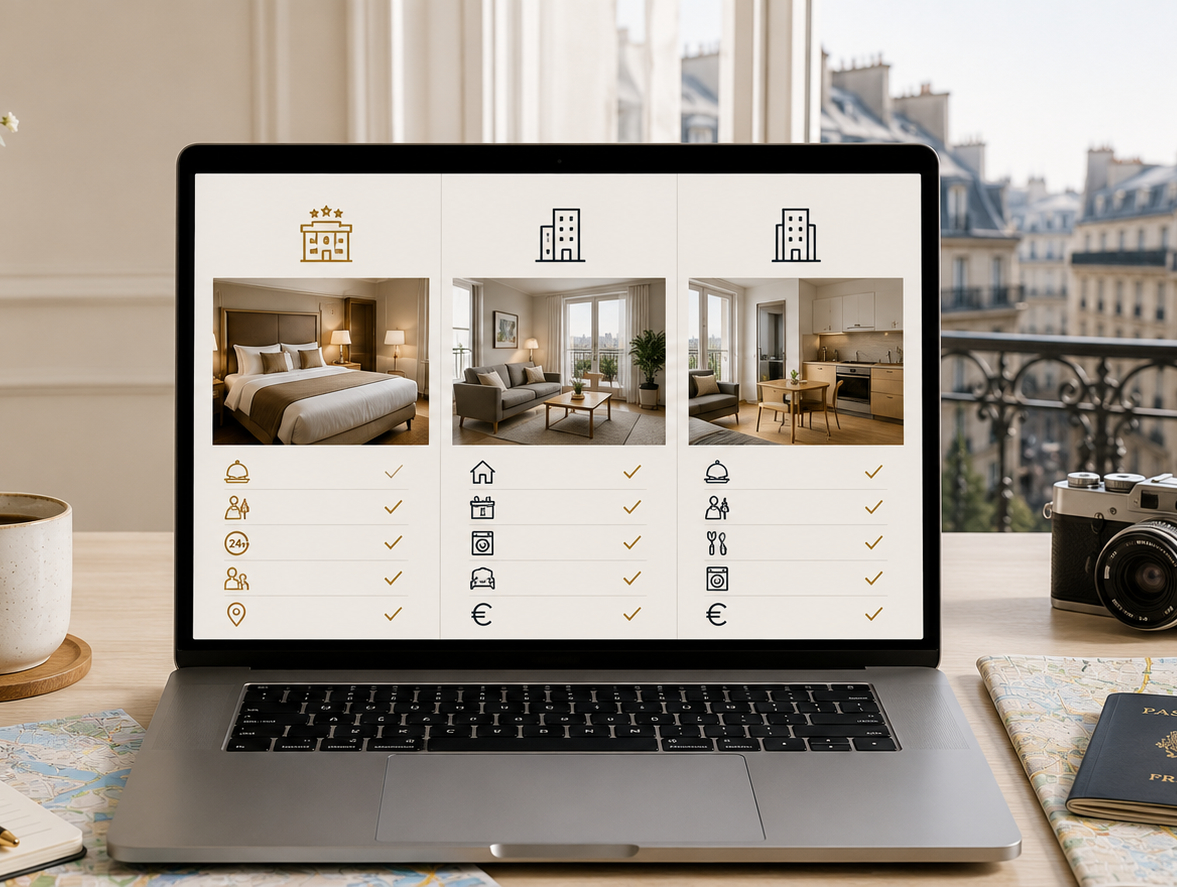
Reviews are useful, but they reflect someone else’s priorities—not necessarily yours. Another point that many visitors underestimate is how physically demanding Paris can be. People often imagine a leisurely city where they will slowly stroll from one attraction to another.
The reality is often quite different.
A typical sightseeing day easily reaches 15,000 to 20,000 steps. You climb the stairs of Montmartre, walk through the Louvre, explore the Latin Quarter, cross bridges over the Seine and continue discovering streets that were never part of your original plan. By the evening, even experienced travellers are usually tired. This is when practical decisions made before the trip suddenly become important. How far is your accommodation from the nearest Metro station?
Can you simply walk back after dinner? Will you need two trains to return each evening? Would you rather stay in a lively neighbourhood where restaurants remain open nearby? These are questions that rarely appear in promotional photographs, yet they influence your holiday every single day.
One detail that is frequently overlooked is that accommodation is not only about the room itself. It is also about everything surrounding it.
A small boutique hotel in Saint-Germain-des-Prés may offer a completely different experience from a larger property located on the outskirts of the city. Not because the room is better, but because the neighbourhood encourages you to step outside, explore on foot and enjoy Paris naturally instead of spending time travelling.
Many experienced visitors eventually reach the same conclusion. They stop searching for the biggest room. Instead, they look for the best location. Because they know that the real value of accommodation is not measured in square metres. It is measured in the quality of the experiences waiting just outside the front door.
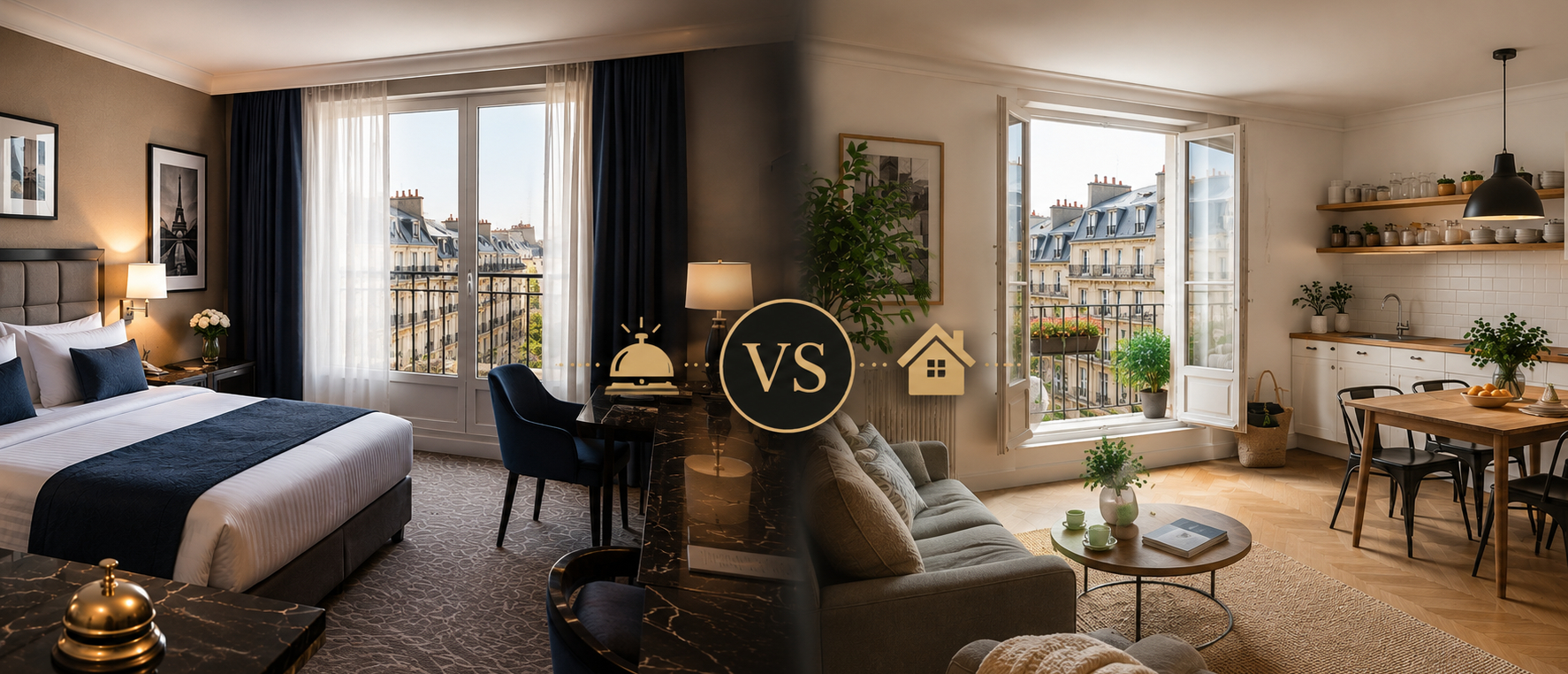
In the following sections, we will look at each accommodation option in detail, its strengths, its limitations and, most importantly, the type of traveller it is best suited for. Choosing between a hotel, an apartment or an aparthotel is not about finding the “best” option.
It is about finding the one that allows you to experience Paris exactly as you imagined.
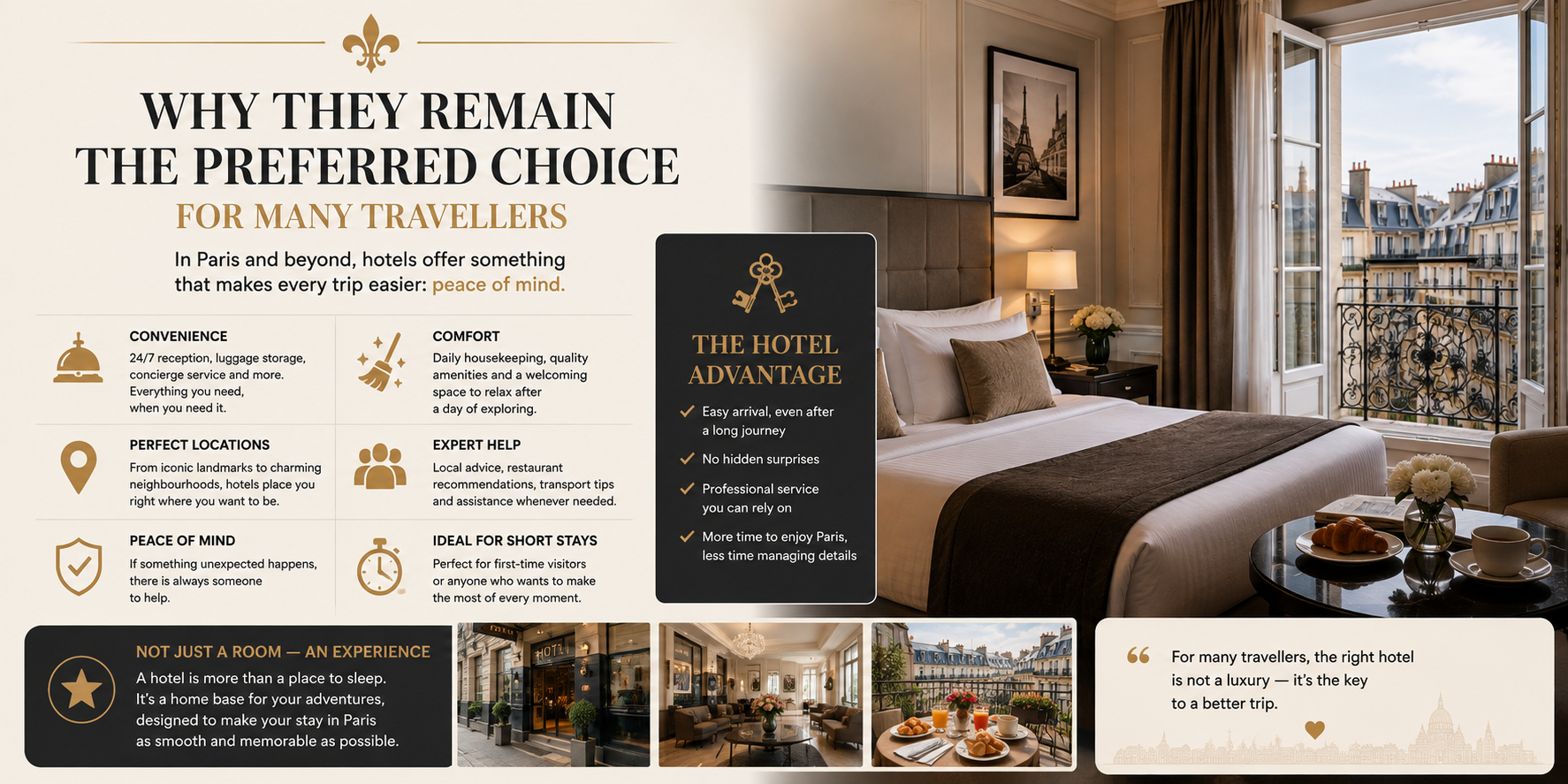
Despite the growing popularity of apartments and aparthotels, hotels continue to be the first choice for millions of visitors arriving in Paris every year. There is a simple reason for this: they remove much of the uncertainty that naturally comes with travelling in a foreign city.
For many people, especially those visiting Paris for the first time, simplicity has real value.
After a long international flight, navigating the airport, finding transportation into the city and checking into your accommodation, the last thing most travellers want is to worry about collecting keys, arranging a meeting with a property owner or finding the correct entrance to an apartment building. Hotels are designed to make arrival easy.
Reception staff welcome you, explain the facilities, answer questions and are usually available throughout the day should you need assistance.
It may sound like a small detail while planning your holiday, but once you arrive in an unfamiliar city, having someone available to help can make the beginning of your trip considerably less stressful.

4.Convenience You Only Truly Appreciate After You Arrive
Many hotel services are often taken for granted because they appear so ordinary. However, they become extremely valuable once your holiday begins. Imagine arriving in Paris at 9:00 in the morning after an overnight flight. Your room may not be ready until mid-afternoon, but most hotels will happily store your luggage. Instead of waiting in the lobby, you can immediately begin exploring the city, enjoy lunch, visit a museum or simply take a walk along the Seine. The same applies on your departure day.
Your flight may leave late in the evening, but your room must usually be vacated around midday.
Read More
Being able to leave your luggage safely at the hotel allows you to enjoy one final day in Paris without dragging suitcases through busy streets or public transport. These are simple services, yet they remove many practical concerns that visitors rarely think about before travelling. Another advantage is flexibility. Need help booking a taxi early the next morning? Looking for a restaurant nearby? Not sure which Metro line to take? Most hotel reception teams deal with these questions every day and can usually help within a few minutes.
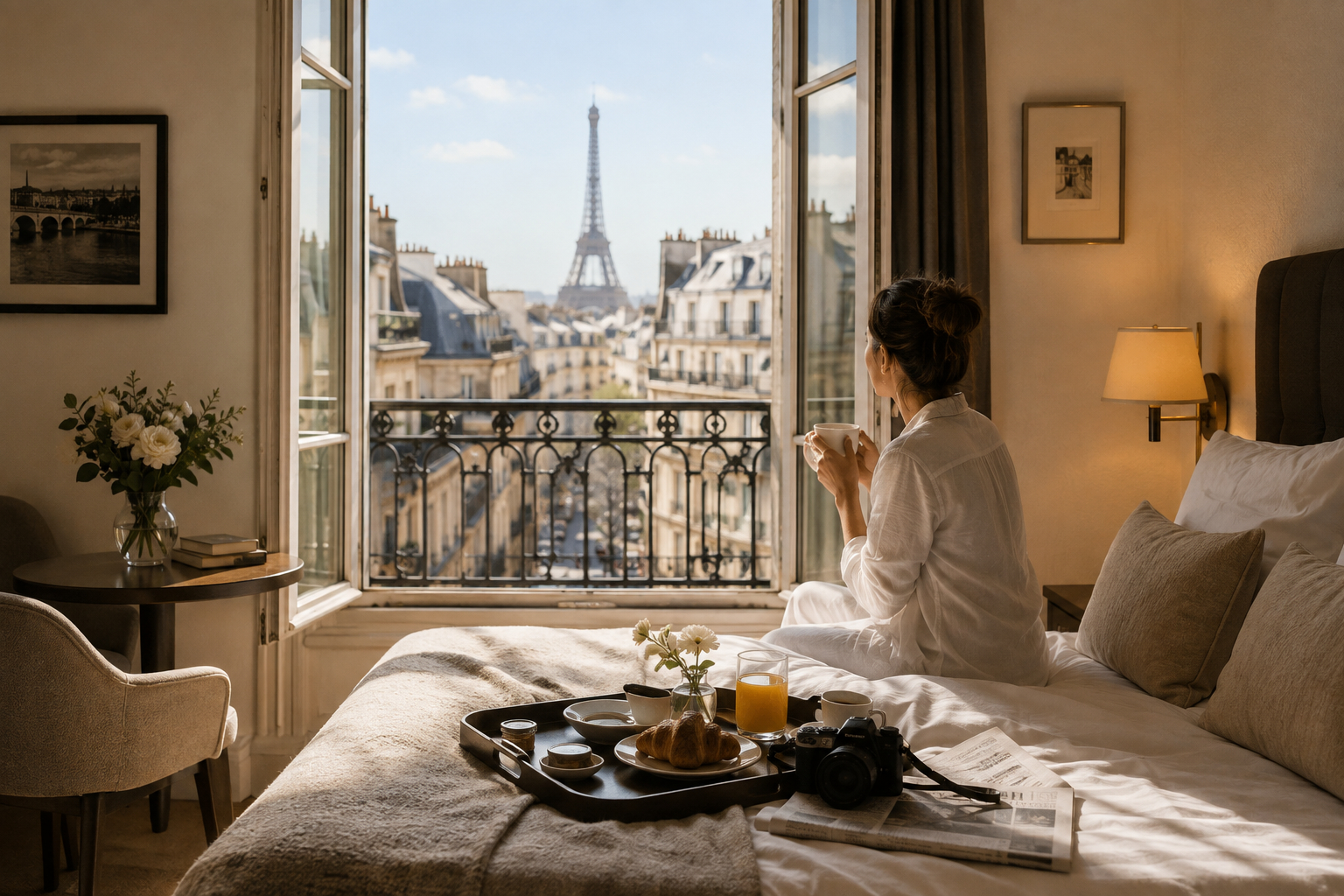
One observation we hear quite often comes from visitors who initially worried about the size of their hotel room Parisian hotels are generally smaller than many travellers expect, particularly compared with accommodations in North America, Australia or the Middle East.Yet after a few days, many people completely forget about it.
Why?
Because they are hardly ever in the room. A typical day in Paris starts early. Breakfast is followed by museums, monuments, neighbourhood walks, shopping streets, gardens, cafés and perhaps a river cruise before dinner. By the evening, most travellers simply want a comfortable shower and a good night’s sleep before beginning another day of sightseeing.
The room becomes a place to rest rather than the main attraction. In our experience, this is why many seasoned travellers place much greater importance on location than on room size. A small hotel within walking distance of cafés, restaurants and public transport often provides a much richer holiday than a spacious property requiring long daily journeys into the city centre.
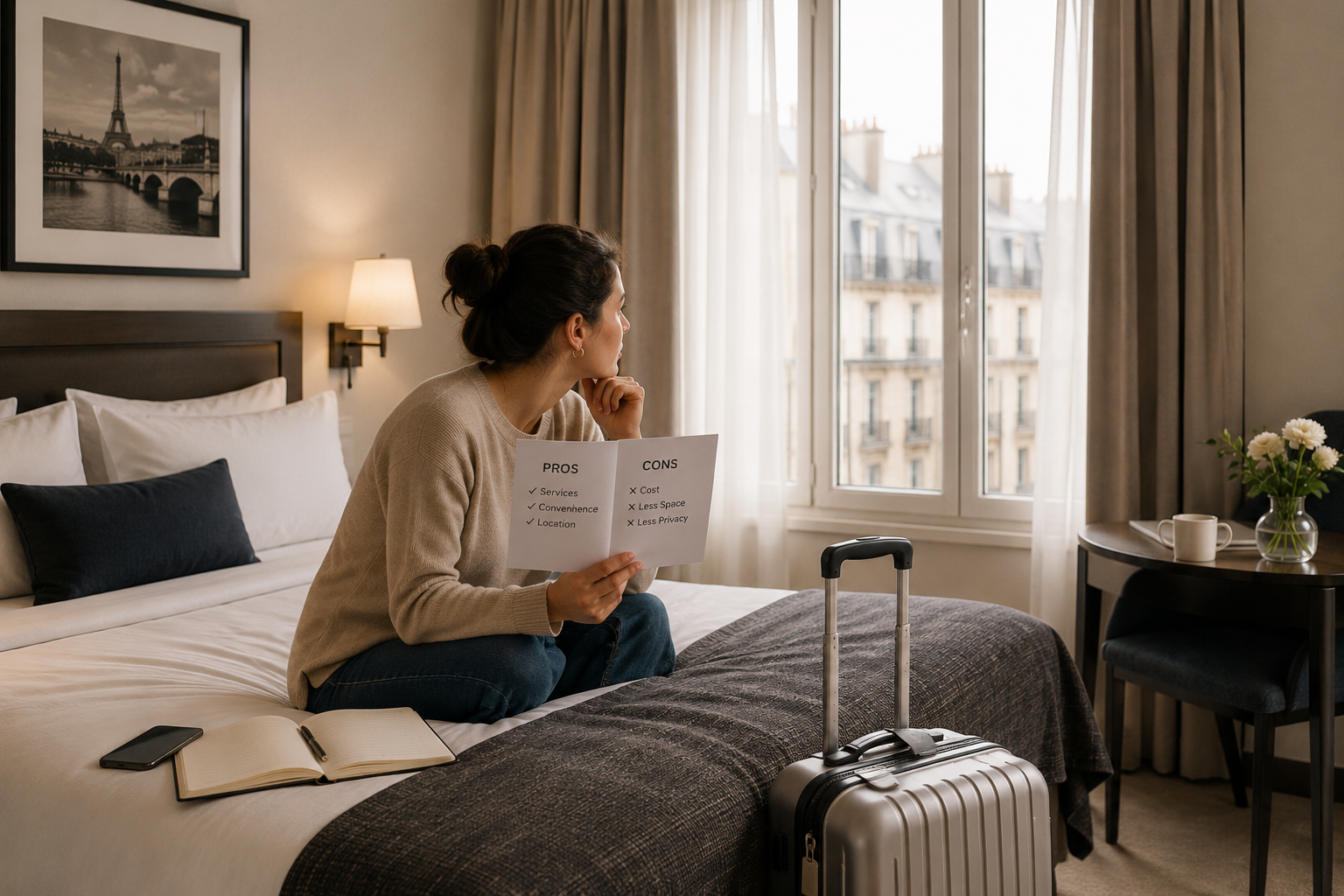
Although hotels offer many advantages, they are not automatically the right choice for everyone. One of the biggest misconceptions is believing that more hotel services always mean a better holiday. In reality, it depends entirely on your travel style. Families staying for a week or longer sometimes discover that sharing a single hotel room becomes difficult. Children may go to bed early while parents have nowhere to relax except the bathroom or a chair beside the bed.
Laundry services, when available, are often expensive compared with using a washing machine in an apartment. Preparing simple meals is generally impossible. Mini-bars are designed for drinks rather than storing groceries, and very few hotel rooms include facilities for cooking or reheating food. Some travellers are surprised to discover that enjoying takeaway meals is not always as convenient as they expected.
While many hotels allow guests to bring food into their rooms, others prefer meals to be eaten in designated areas, and even when permitted, most rooms offer little space for dining comfortably. A small desk or bedside table is very different from having a proper dining table. Visitors travelling with babies may also find themselves wishing they had access to a microwave, a larger refrigerator or a small kitchen for preparing bottles and children’s meals. These practical details become increasingly important during longer stays.
One lesson has become very clear over the years. Many booking disappointments could have been avoided by spending just a few extra minutes reading the accommodation description instead of looking only at the photographs.
Before reserving a hotel, it is worth checking several practical points. Is breakfast included in the rate? Does the hotel have air conditioning if you are travelling during summer? Is there a lift, particularly if you are carrying heavy luggage? Can luggage be stored after check-out? What time does reception close? Does the room overlook a lively boulevard that may remain noisy during the evening? If you plan to work remotely, is there a comfortable desk and reliable Wi-Fi?
These details rarely influence the overall review score, but they can significantly affect your own experience. Remember that online reviews reflect other people’s priorities. A business traveller staying one night may leave a five-star review because the Wi-Fi was excellent.
A family spending ten nights may have completely different expectations. Always compare reviews with the type of trip you are planning.


From our experience, hotels are usually the best option for:
- First-time visitors discovering Paris.
- Couples enjoying a short city break.
- Solo travellers.
- Business visitors.
- Travellers staying three to five nights.
- Anyone who values convenience, professional service and a straightforward travel experience.
The less time you spend organising practical details, the more time you have to enjoy everything Paris has to offer. And for many visitors, that peace of mind is worth far more than a larger room or additional facilities.
In the next section, we will look at apartments—a completely different way of experiencing Paris, with its own advantages, practical considerations and a lifestyle that appeals to many travellers looking for something beyond the traditional hotel experience.
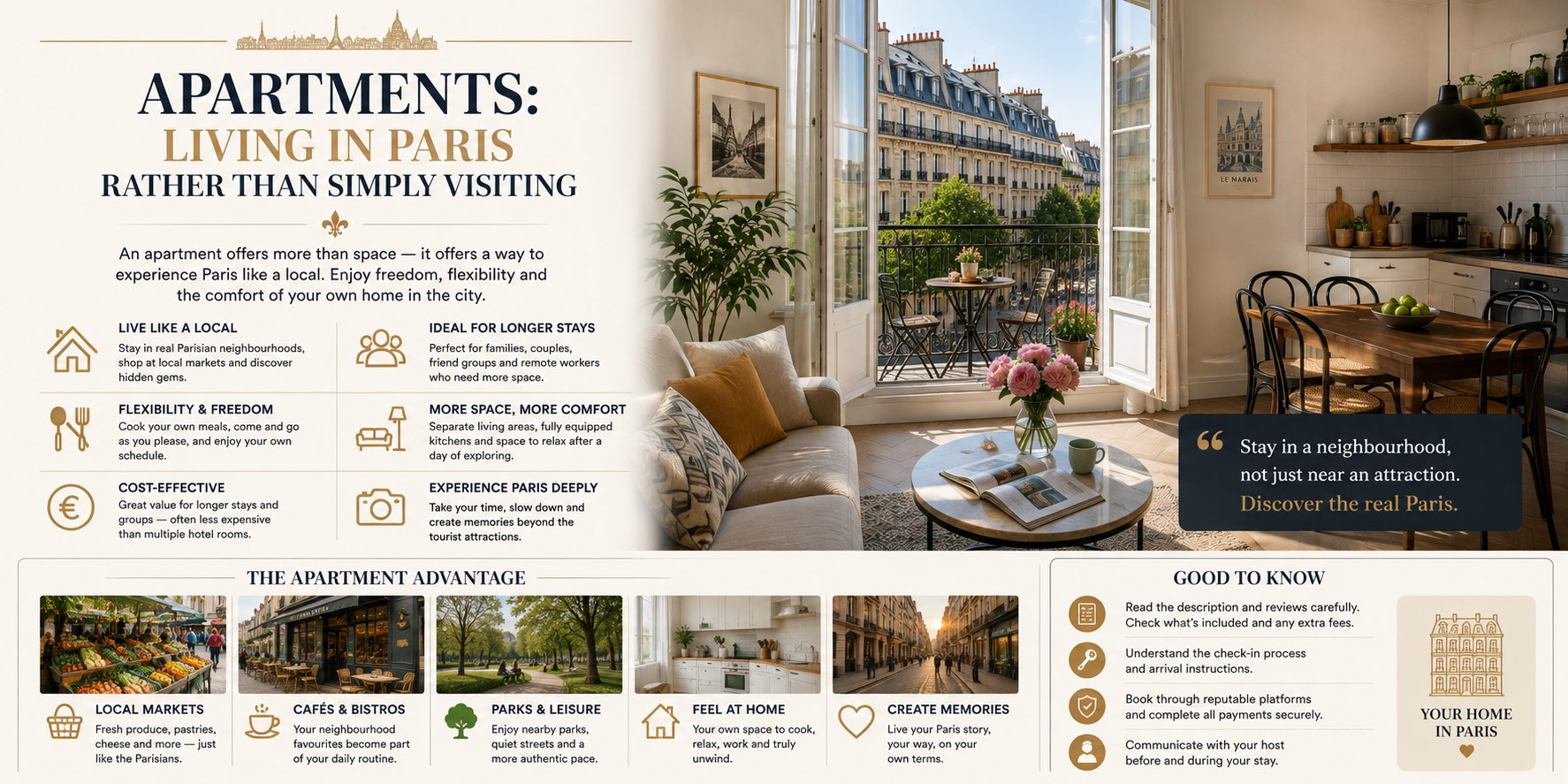
For many travellers, renting an apartment is about much more than saving money or having extra space. It is about experiencing Paris differently. Hotels allow you to visit the city comfortably. Apartments allow you to become part of it, even if only for a few days.
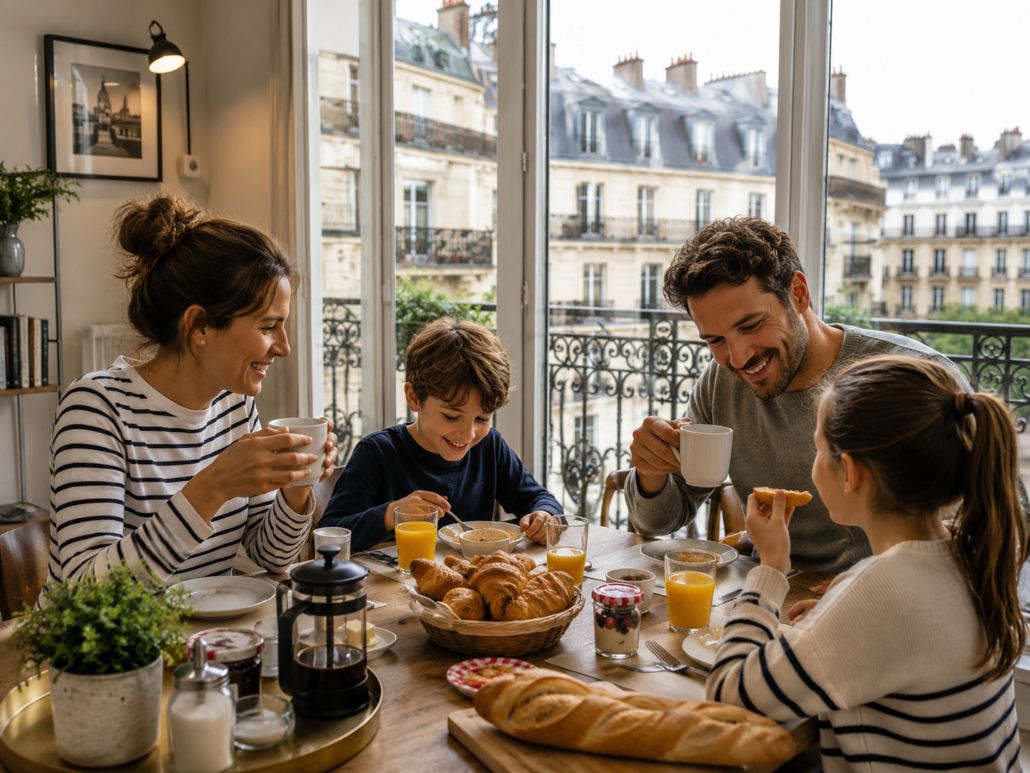
Instead of beginning your morning in a hotel lobby, your day starts like that of many Parisians. You leave your building, walk to the neighbourhood bakery, buy a fresh baguette and warm croissants, perhaps stop at the local market for fruit or cheese, and slowly watch the city wake up around you.
These simple routines often become some of the most memorable moments of a holiday. Many visitors tell us afterwards that what they remember most is not necessarily the Eiffel Tower or the Louvre, but the small bakery they visited every morning, the florist on the corner or the café owner who recognised them after only a few days.
That feeling of familiarity is one of the greatest advantages of choosing an apartment.
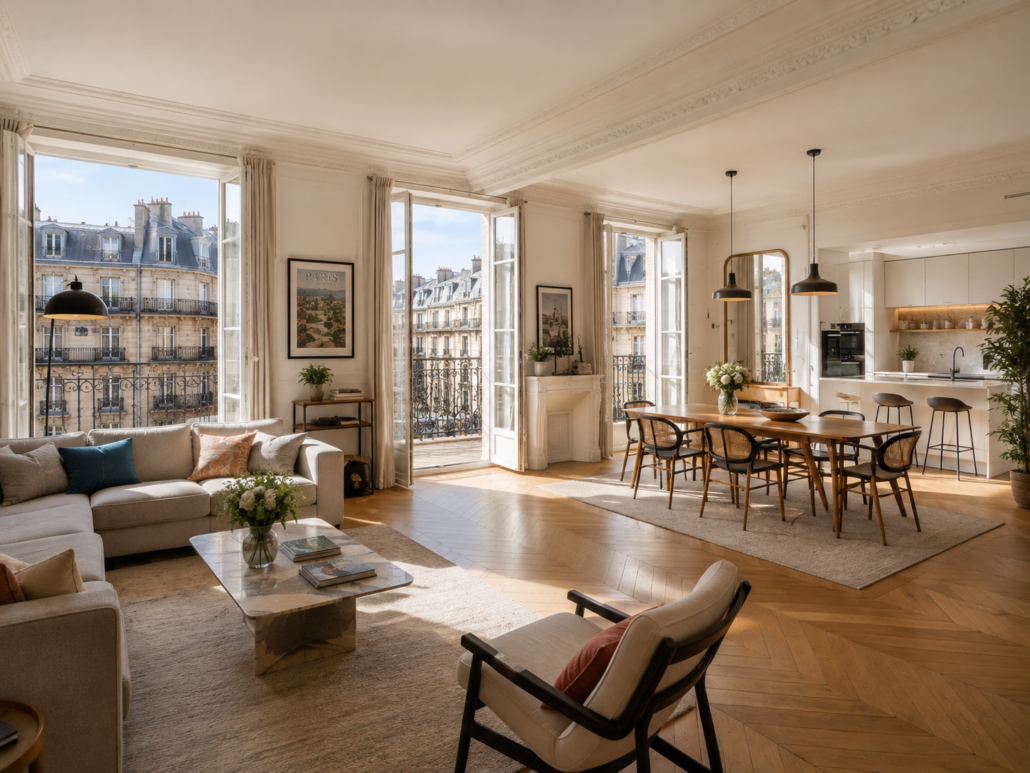
One of the first things travellers notice is the additional space. Unlike many hotel rooms in central Paris, apartments usually include a separate living area, a fully equipped kitchen and, in many cases, more storage space.
For a couple staying only two or three nights, this may not make a significant difference. However, once your stay extends beyond five or six days, extra space quickly becomes much more valuable. Suitcases can finally be unpacked properly.
Shopping bags no longer occupy the floor. There is somewhere comfortable to sit and relax without lying on the bed. Families often appreciate having separate bedrooms. Parents can continue reading, planning the next day’s itinerary or simply relaxing once young children have gone to sleep. It is a level of comfort that many standard hotel rooms simply cannot provide.
Read More
Transport costs can also add up surprisingly quickly. A late-night taxi after dinner, additional Metro journeys, or deciding to use a ride-hailing service simply because you are too tired to take public transport all become part of the real cost of your accommodation.
Time is another hidden expense that many travellers overlook. Losing one or two hours every day travelling between your apartment and the places you want to visit may not seem significant at first. Over the course of a five-day holiday, however, it can easily represent the equivalent of an entire day that could have been spent discovering Paris instead of sitting on public transport.
For this reason, we always encourage visitors to look beyond the headline price. A slightly more expensive apartment in a lively, central neighbourhood may ultimately offer far better value than a cheaper property located far from the areas you plan to explore.
When comparing accommodation, ask yourself one simple question:
“How much are my time, comfort and convenience worth during this holiday?”
Very often, the answer is worth far more than the difference in the nightly rate.