Public Transport in Paris
Everything You Need to Know Before Your First Journey


1.Why Public Transport Is One of Paris’ Greatest Advantages
One of the first questions visitors ask before arriving in Paris is whether they should rent a car. The answer is almost always the same: for the vast majority of travellers, a car is unnecessary and often becomes more of a disadvantage than a convenience. Paris has one of the most comprehensive public transport networks in the world, allowing visitors to reach almost every monument, museum, shopping district and residential neighbourhood quickly, safely and at a relatively low cost. Once you understand how the system works, moving around the city becomes surprisingly simple.
Unlike many large international cities where attractions are spread over vast distances, Paris has a remarkably compact historic centre. Many of its most famous landmarks are located within walking distance of one another, while the public transport network fills the gaps whenever distances become too great. This combination of walking and public transport is one of the reasons why millions of visitors manage to explore so much of Paris without ever needing a car.
Read More
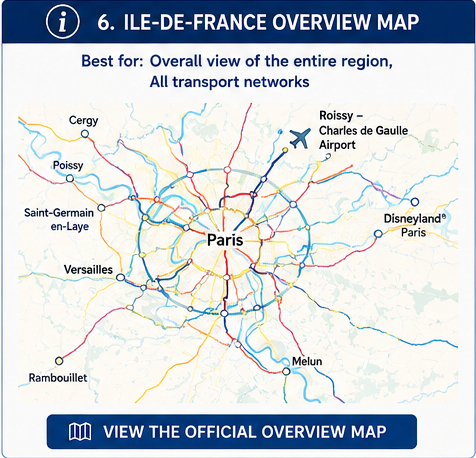
The public transport system is operated mainly by RATP and Île-de-France Mobilités, providing extensive coverage not only within Paris but throughout the surrounding region. Whether you want to admire the Eiffel Tower, visit the Louvre, spend a day at Versailles, travel to Disneyland Paris or simply enjoy dinner in Montmartre before returning to your hotel, there is almost always an efficient public transport option available.
Another major advantage is frequency. Metro trains generally arrive every two to four minutes during the day, buses operate throughout the city from early morning until late evening, while the RER network connects central Paris with airports, major railway stations and many destinations outside the capital. Night buses also continue operating after the Metro has closed, allowing visitors to travel safely even after a late evening.
Public transport is also considerably more economical than relying entirely on taxis. Depending on your itinerary, a single travel pass may cover dozens of journeys over several days, making it possible to explore the city without constantly thinking about transport costs. For visitors staying several days, this flexibility becomes particularly valuable because plans often change. You may decide to visit another museum, stop for dinner in a different neighbourhood or spend an extra hour walking along the Seine before heading back to your hotel. The transport network allows this freedom without requiring extensive planning.
Of course, no transport system is perfect. Some Metro stations involve long corridors, certain lines become crowded during rush hour and buses can occasionally be delayed by traffic. Nevertheless, after welcoming international visitors for more than twenty years, we remain convinced that Paris possesses one of the easiest and most efficient public transport systems for tourists anywhere in Europe. The key is not learning every line by heart, but understanding which type of transport is best for each situation.
Once you know the difference between the Metro, the RER, buses, trams and the various ticket options, travelling around Paris becomes almost second nature. That is exactly what this chapter is designed to help you achieve.
One of the reasons some visitors initially find Paris transport confusing is that several different systems operate side by side. Although they often connect with one another, each has a different purpose. Understanding these differences before your first journey will make travelling around Paris much easier.
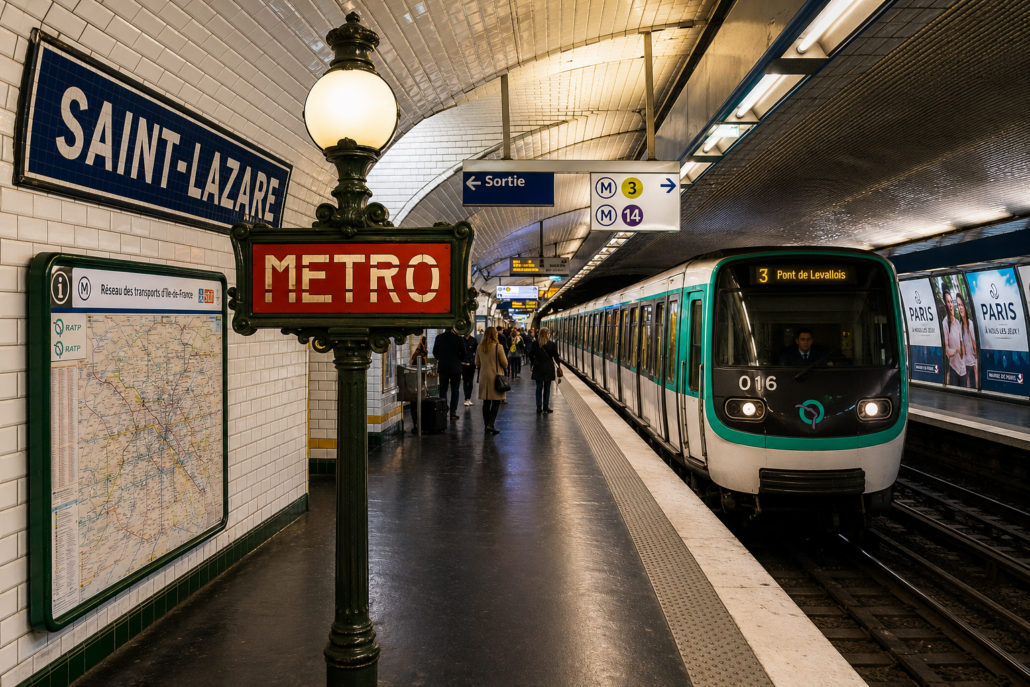
Metro
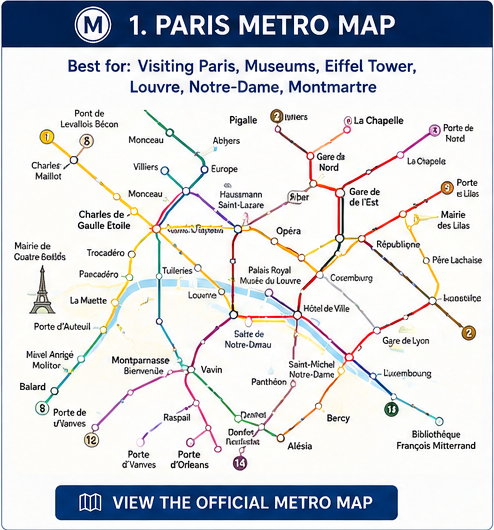
The Paris Metro is the backbone of the city’s transport system and the option most visitors use every day. With sixteen lines serving more than 300 stations, it provides fast connections between almost every major tourist attraction inside Paris. The Metro is ideal for travelling from one neighbourhood to another. It avoids road traffic, operates frequently and usually offers the fastest journey within the city.
Best for: Visiting museums and monuments, Crossing Paris quickly, Daily sightseeing
Advantages: Very frequent service, Extensive network, Inexpensive, Easy to use
Disadvantages: Stations may have many stairs, Some interchanges involve long walks, Very busy during rush hour

Bus
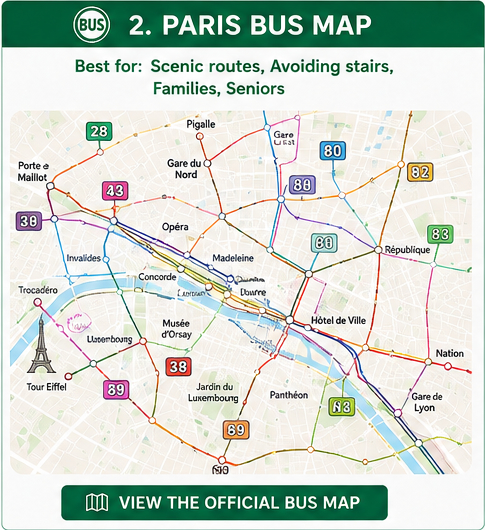
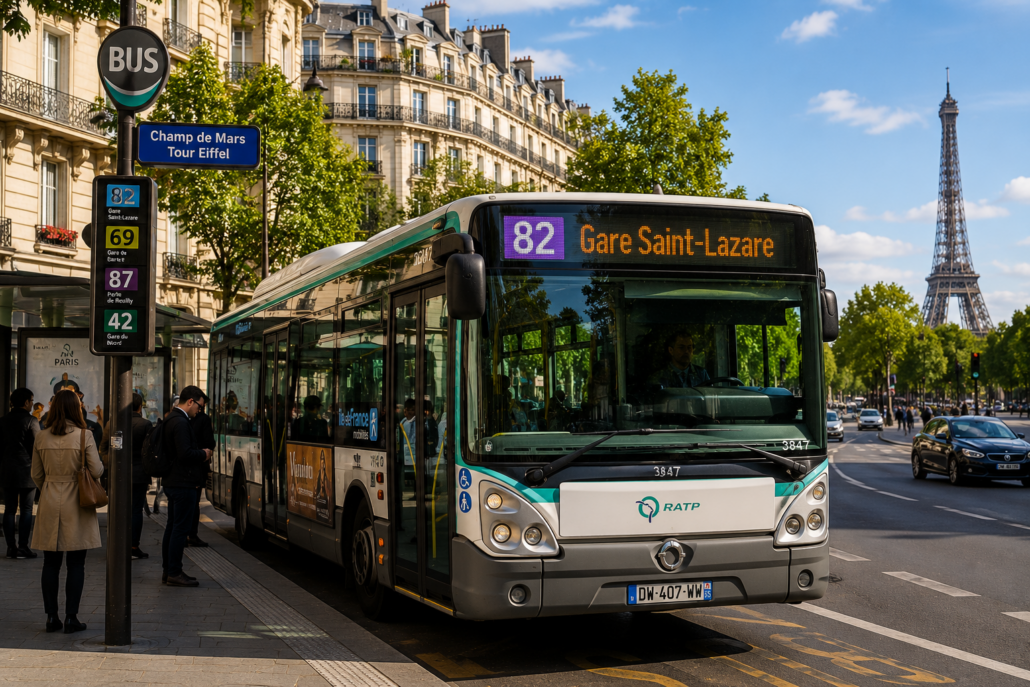
Many experienced visitors actually prefer the bus to the Metro. Instead of travelling underground, buses allow you to admire the city throughout the journey. They pass famous monuments, elegant boulevards, charming cafés and residential streets that many tourists never see from the Metro. Although buses are usually slower than the Metro because of traffic, they offer one enormous advantage: the journey itself becomes part of the sightseeing experience.
Best for: Scenic journeys, Short and medium distances, Relaxed sightseeing
Advantages: Excellent city views, Easier with luggage, Comfortable, Good accessibility
Disadvantages: Traffic delays, Slower during busy periods
RER
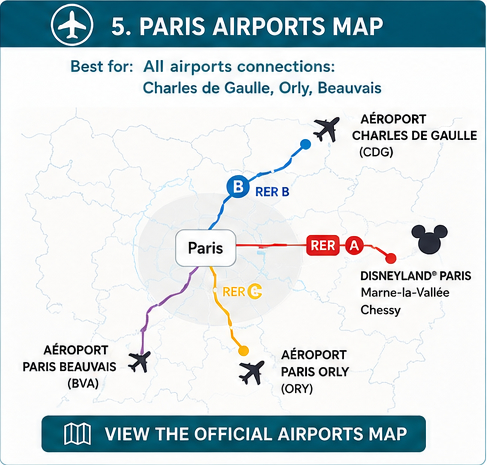
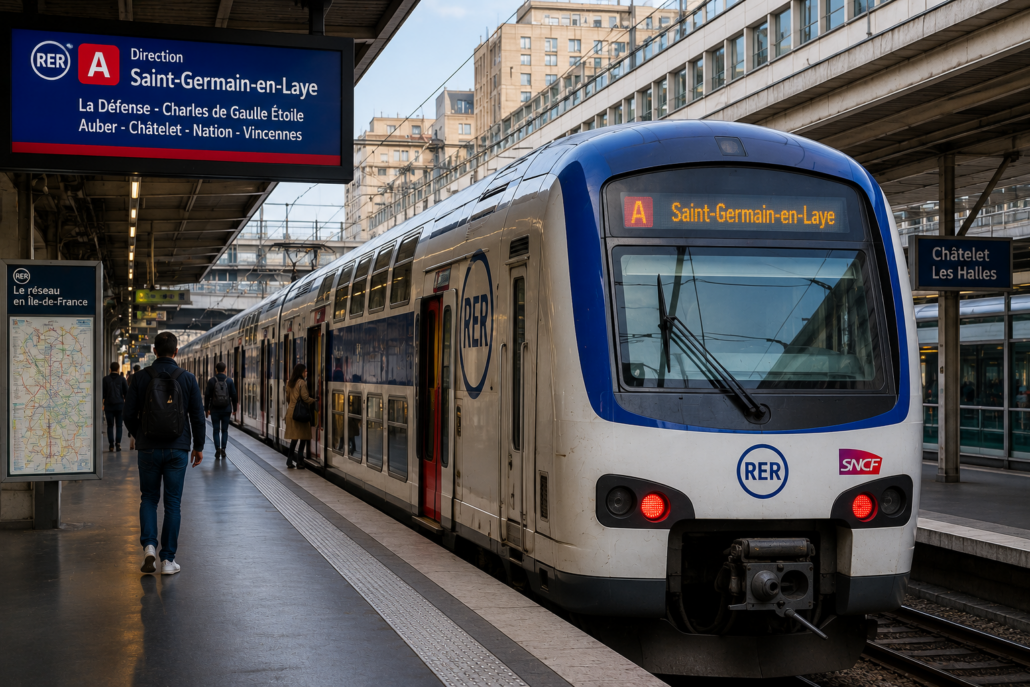
The RER looks similar to the Metro but serves a different purpose. Rather than connecting neighbourhoods within Paris, the RER links the capital with destinations throughout the Île-de-France region.
Most tourists use the RER for: Charles de Gaulle Airport, Disneyland Paris, Palace of Versailles, La Défense, Saint-Germain-en-Laye. Inside central Paris, RER trains stop less frequently than the Metro, making them faster over longer distances.
Best for: Airports, Day trips, Longer journeys
Advantages: Fast, Comfortable, Excellent for destinations outside Paris
Disadvantages: Different ticket rules may apply, Stations are farther apart, Less convenient for short journeys
Tramway
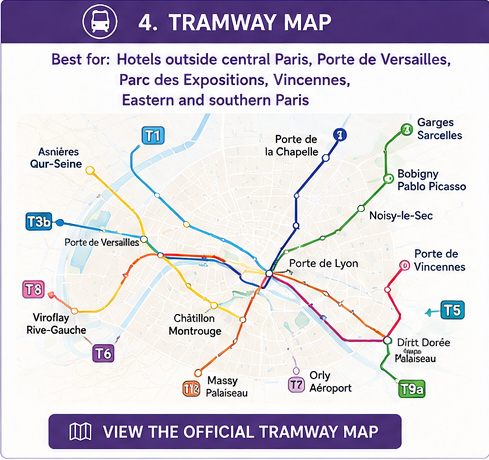
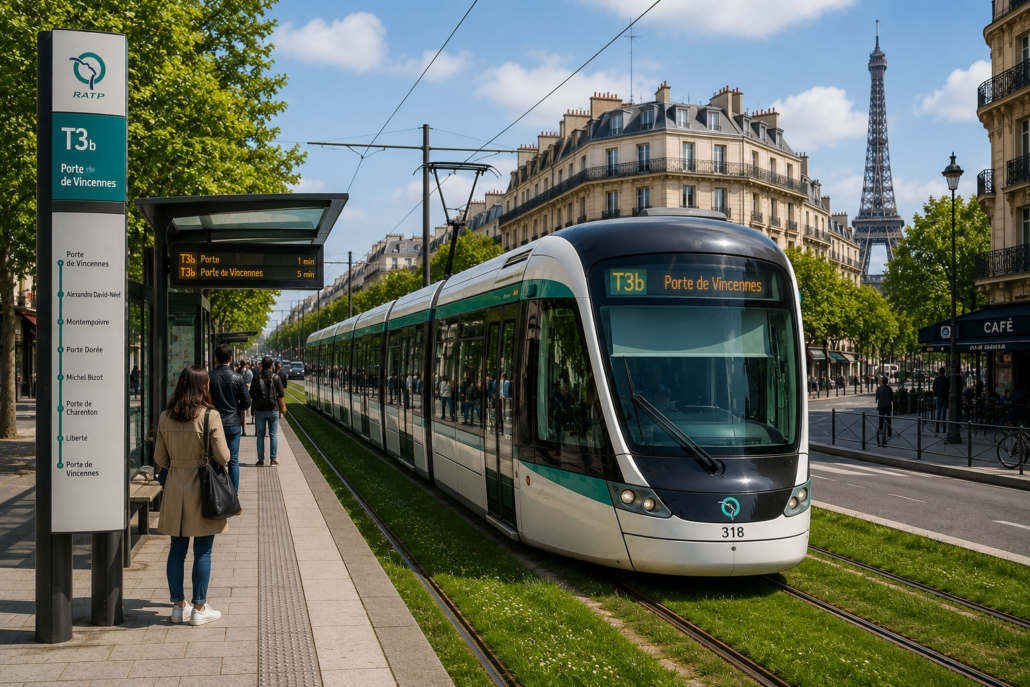
Paris also has an extensive tram network, although relatively few visitors use it because most tram lines operate around the edge of the city rather than through the historic centre.
Unless your hotel is located outside central Paris, you may never need the tram during your stay.
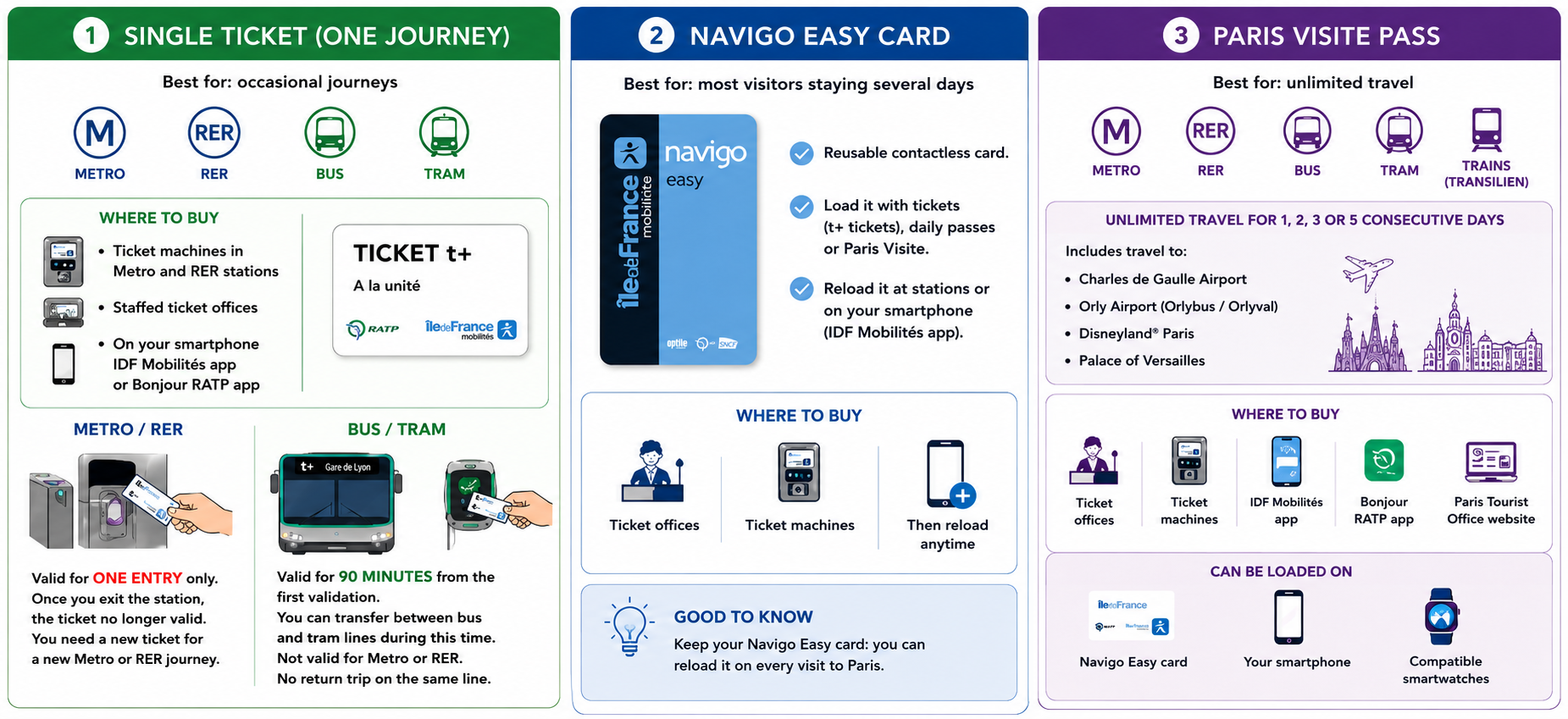
Before taking your first journey, you need to choose the transport ticket that best matches your visit. Fortunately, most tourists only need to understand three main options.
Read More
Single Ticket
A single ticket is the simplest option if you only expect to make a few journeys.
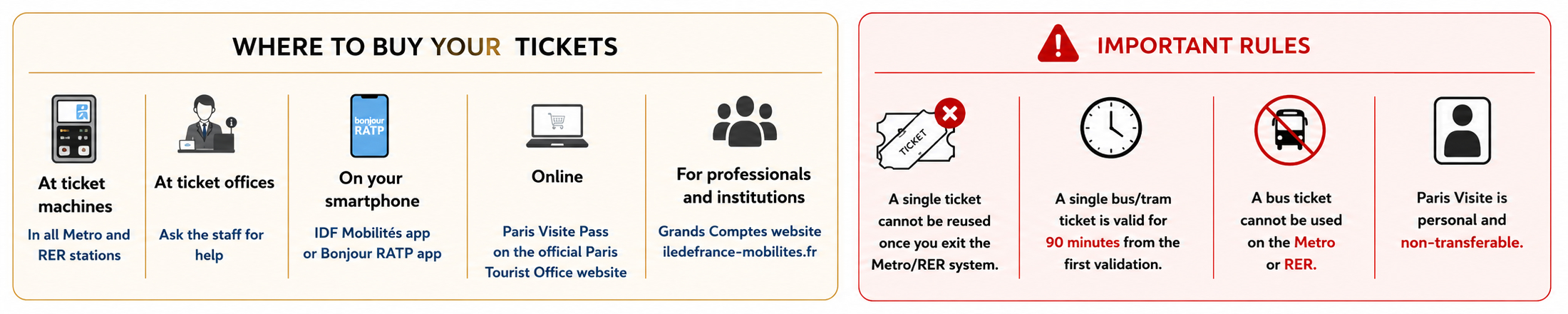
It can be purchased:
Metro & RER
A single ticket is valid for one entry into the Metro or RER system.
Important: Once you leave the station through the exit gates, the ticket cannot be used again. If you wish to make another Metro or RER journey later, you will need another valid ticket or a travel pass.
Bus & Tram
For buses and trams, the rules are different.
A validated ticket remains valid for 90 minutes from the first validation.
During those 90 minutes, you may transfer between different bus and tram lines.
However:
Navigo Easy Card
The Navigo Easy is the option we recommend to most visitors.
It is a reusable contactless card onto which you load your tickets.
Instead of carrying paper tickets, everything is stored on the card.
You can:
For visitors staying several days, this is usually the easiest and most convenient solution.
Paris Visite Pass
The Paris Visite Pass is designed for visitors planning to use public transport frequently.
It offers unlimited travel for:
The pass covers:
It also includes journeys to:
The pass can be loaded onto:
If using a Navigo Easy card, remember that the pass is personal and your name must be written on the back of the card.
For visitors making numerous journeys every day or planning excursions outside Paris, the Paris Visite Pass can be one of the most convenient options.
The Paris Metro is the easiest and fastest way to travel around the city once you understand a few basic rules. Although the network may look intimidating on a map, most visitors become comfortable using it after only one or two journeys. The key is not memorising every line but knowing how to read the signs and follow the correct direction.
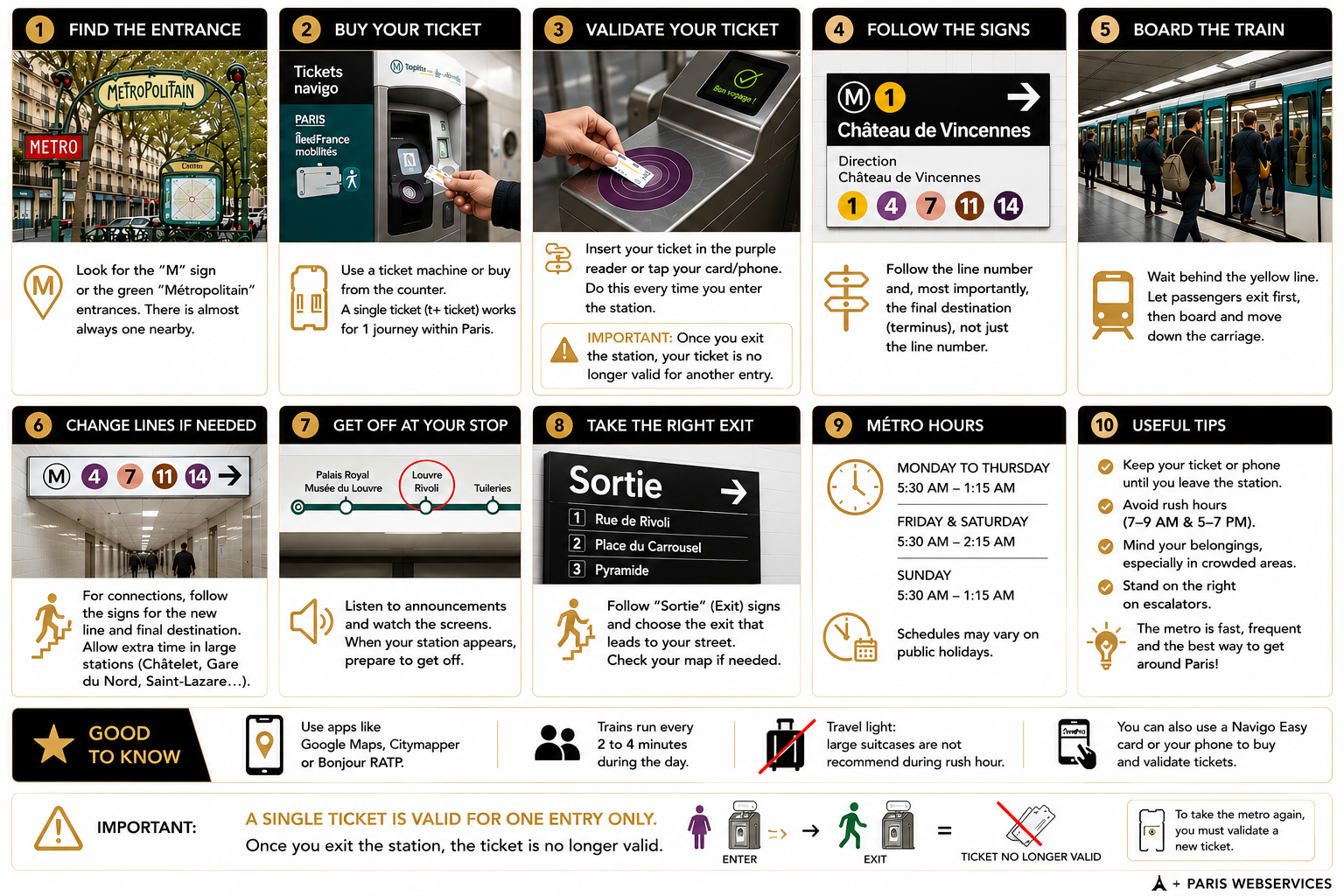
Step 1 – Find the Station
Metro stations are easy to identify by the large “M” sign or the famous green Métropolitain entrances. Almost every major attraction is within a short walk of a Metro station.
Read More
Step 2 – Buy Your Ticket
Before entering, you will need:
Tickets can be purchased at ticket machines or ticket offices in every Metro station.
Step 3 – Validate Your Ticket
Insert your paper ticket into the gate or tap your Navigo Easy card or smartphone.
The gates will open automatically.
Always keep your ticket until the end of your journey.
Step 4 – Follow the Correct Line
Every Metro line has:
Always follow both the line number and the terminus shown on the signs.
For example:
Line 1 → Château de Vincennes
or
Line 1 → La Défense
The terminus tells you which direction the train is travelling.
Step 5 – Change Lines
If your journey requires another line, simply follow the Correspondance signs.
Some stations, such as Châtelet–Les Halles, Montparnasse-Bienvenüe or Saint-Lazare, are very large, so allow extra time for walking between platforms.
Step 6 – Exit the Station
When your station appears, leave the train and follow the Sortie signs.
Many stations have several exits.
Google Maps or Citymapper will often recommend the best exit for your destination.
Good to Know
Many visitors overlook the Paris bus network, yet it is one of the most enjoyable ways to travel around the city. Unlike the Metro, the bus allows you to admire Paris throughout the journey, making transport part of the sightseeing experience. It is also an excellent option for visitors who prefer avoiding stairs or travelling with luggage or a stroller.
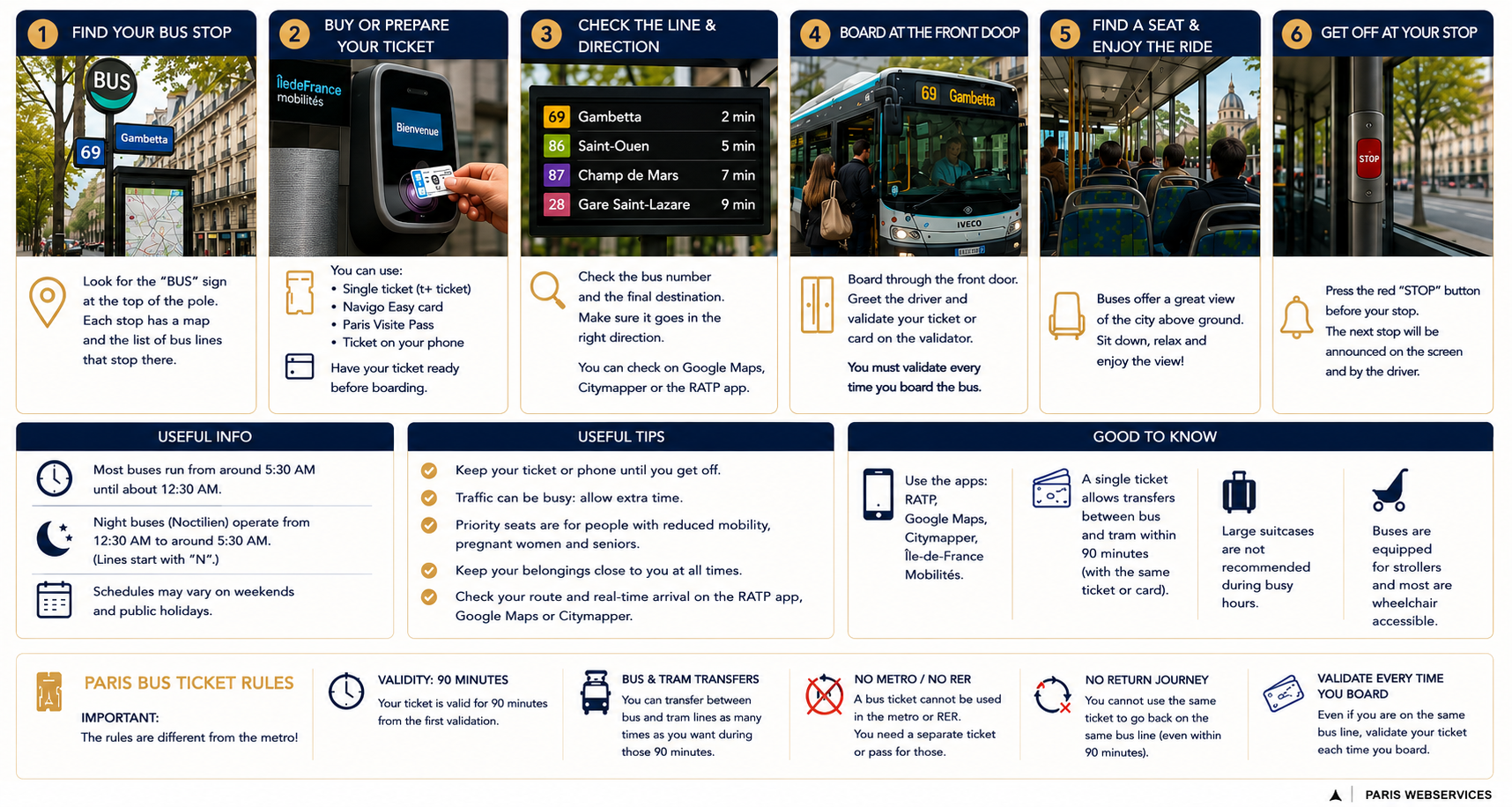
Step 1 – Find the Correct Bus Stop
Use: Google Maps, Citymapper, Bonjour RATP
Read More
These apps will tell you:
Electronic displays at many bus stops show the waiting time until the next bus arrives.
Step 2 – Buy or Prepare Your Ticket
You can travel using:
Have your ticket ready before boarding.
Step 3 – Board the Bus
Enter through the front door, unless signs indicate otherwise.
Validate your ticket or tap your card immediately after boarding.
Step 4 – Enjoy the Journey
Unlike the Metro, the bus allows you to enjoy beautiful views of Paris while travelling.
Many routes pass famous landmarks, elegant boulevards and charming neighbourhoods.
Step 5 – Request Your Stop
Press the STOP button before your stop.
The driver will stop at the next bus stop.
Step 6 – Leave Through the Rear Door
Most passengers leave through the rear doors, making boarding easier for new passengers.
Good to Know
Many first-time visitors think the RER is simply another Metro line. Although the trains look similar inside central Paris, the RER is actually a regional express network designed for faster journeys both within Paris and to destinations outside the city. You will probably use the RER if you are travelling to Charles de Gaulle Airport, Disneyland Paris, Versailles, La Défense or many other destinations in the Île-de-France region.
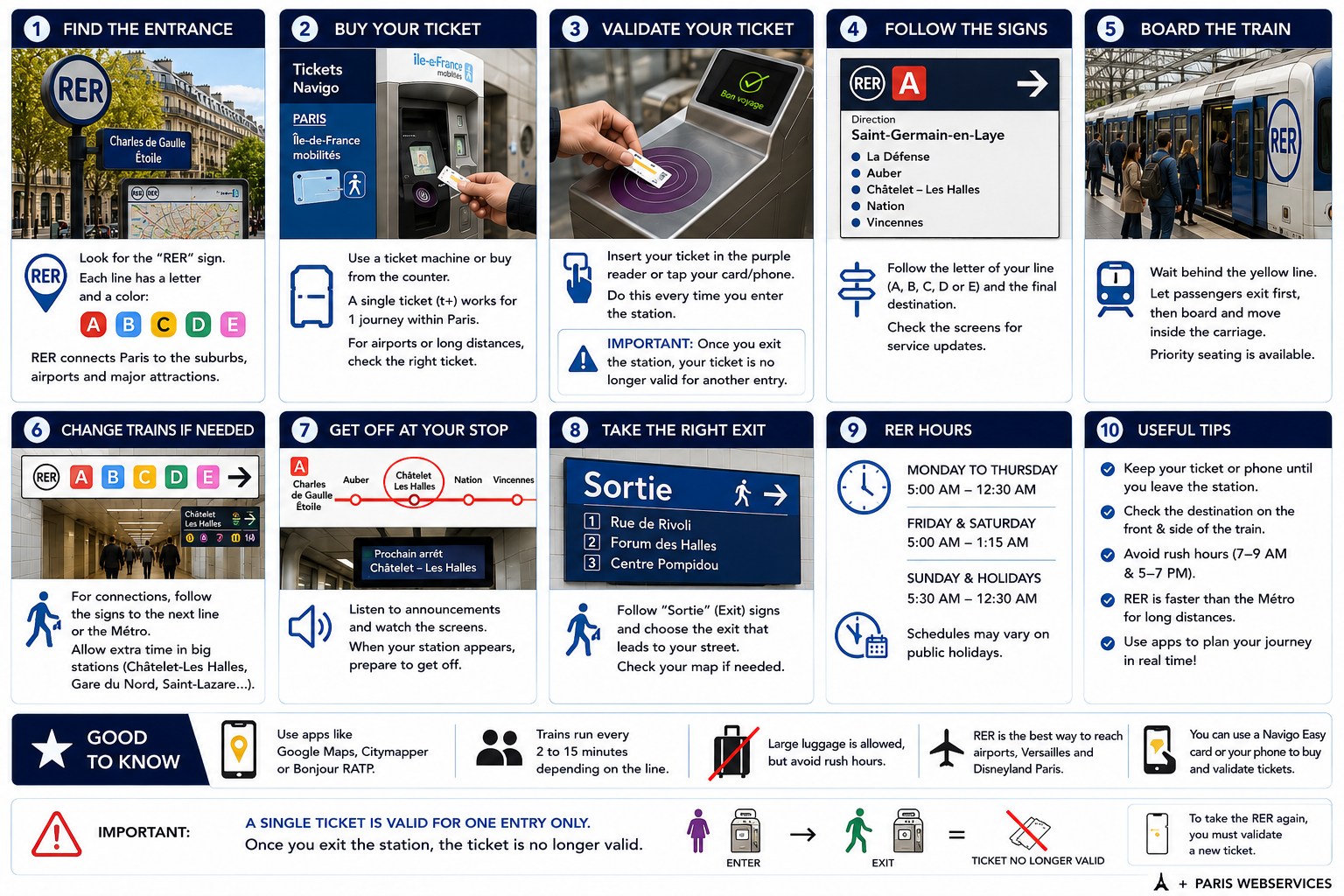
Step 1 – Check That You Need the RER
The RER has five lines: Line A, Line B, Line C, Line D, Line E
Each serves different destinations.
Read More
Step 2 – Buy the Correct Ticket
Unlike the Metro, some RER journeys require special tickets, particularly when travelling outside central Paris.
Always check your destination before buying your ticket.
Step 3 – Find the Correct Platform
As with the Metro, follow:
Some RER lines divide into several branches outside Paris, so always check that your train stops at your destination.
Step 4 – Board the Train
Validate your ticket before entering.
Electronic displays on the platform indicate:
Step 5 – Leave at Your Destination
Keep your ticket with you throughout the journey.
Unlike the Metro, many RER stations require you to use your ticket again to leave the station, particularly outside central Paris.
Good to Know
The RER is usually the best choice for:
Inside central Paris, the Metro is generally more convenient because it has more stations and shorter distances between them. Use the RER when travelling longer distances or leaving the city centre.
For many first-time visitors, the Paris Metro appears confusing simply because the signs look different from those used in other countries. In reality, the system follows a very logical structure. Once you understand a few common French words and symbols, navigating the network becomes surprisingly straightforward.
The most important thing to remember is that every Metro journey is based on two pieces of information: the line number and the terminus, or final destination of the train. Many visitors make the mistake of following only the line number. Since every line operates in two directions, this can easily lead to boarding the wrong train. Always check the name of the final station shown on the signs and compare it with the route suggested by your navigation app.
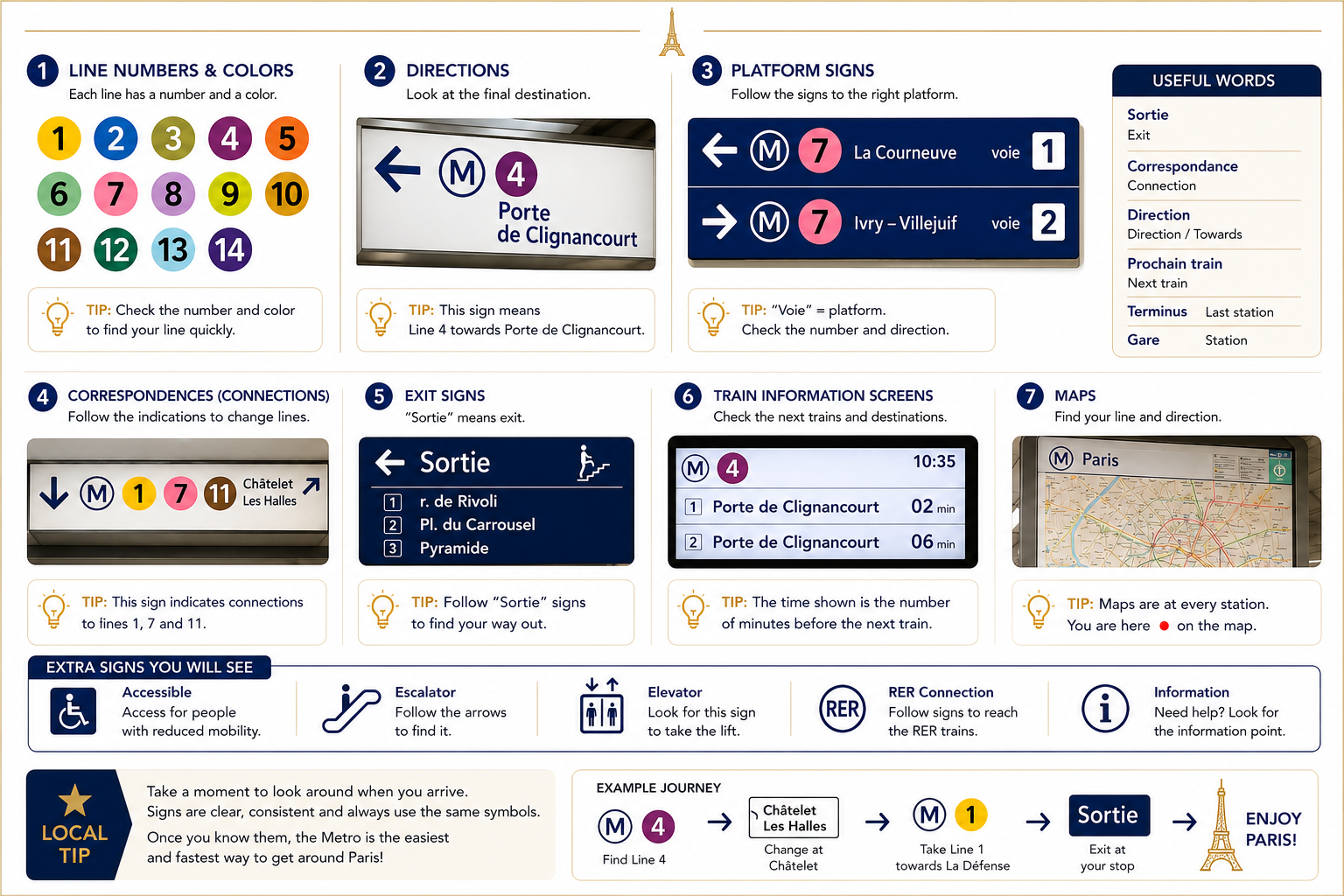
Another word you will see everywhere is Correspondance, which simply means “connection.” These signs guide passengers towards other Metro, RER or tram lines without leaving the station. Some connections require only a short walk, while others, particularly at stations such as Châtelet–Les Halles or Montparnasse-Bienvenüe, may involve several minutes of walking through underground corridors.
Read More
When it is time to leave the station, simply follow the signs marked Sortie, the French word for “Exit.” Larger stations often have several exits leading to different streets, so choosing the correct one can save considerable walking. Most navigation apps indicate which exit is closest to your destination.
You may also notice signs displaying Quai, meaning “platform,” together with the line number and terminus. Electronic displays above the platforms show the destination of the next train and the estimated waiting time. On modern trains, route maps inside each carriage indicate the next station and announce it both visually and by audio.
Although the language may initially seem unfamiliar, the signs rely heavily on colours, numbers and universally recognised symbols. After only a few journeys, most visitors discover that navigating the Paris Metro is much easier than they expected.
Modern navigation apps have made travelling around Paris easier than ever. Rather than studying transport maps before every journey, visitors can simply enter their destination and receive step-by-step directions in real time. Although several excellent applications are available, each offers different advantages depending on how you like to travel.
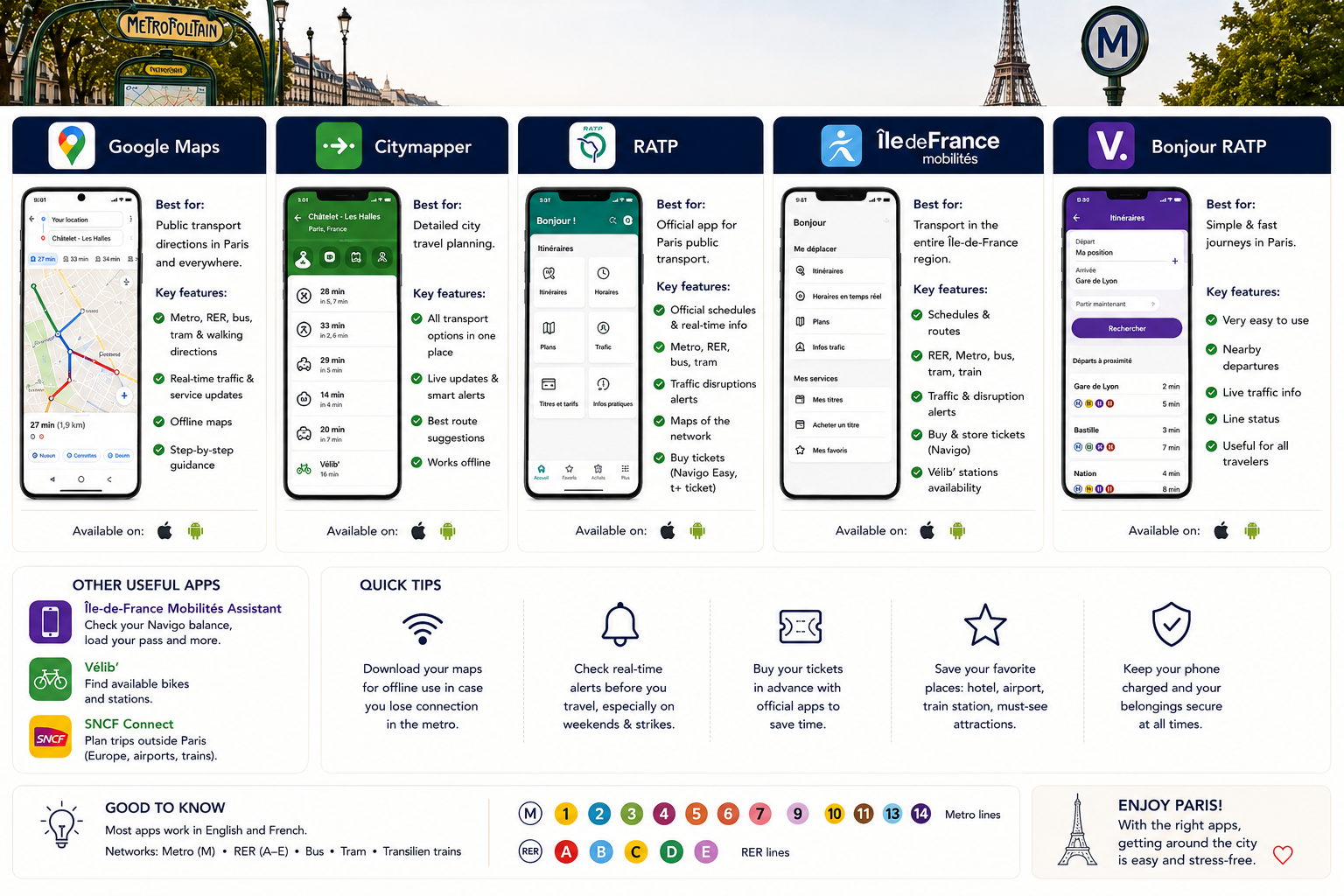
Google Maps
Google Maps remains the most popular choice for many visitors because it combines public transport, walking, cycling and driving directions within a single application. It is particularly useful for showing the walking distance between attractions, recommending the nearest Metro station and estimating journey times. It also suggests the most convenient station exits, helping you avoid unnecessary walking once you reach your destination.
Read More
Best for:
Citymapper
Many frequent travellers consider Citymapper the most accurate public transport application available for Paris. It provides detailed step-by-step instructions, including the correct Metro entrance, the best carriage to board for easier transfers and real-time disruption information. If you expect to rely heavily on public transport during your stay, Citymapper is an excellent companion.
Best for:
Bonjour RATP
Developed by the company operating much of Paris’ transport network, Bonjour RATP offers official journey planning, real-time service information and ticket purchasing for compatible smartphones. It is particularly useful for checking service disruptions, engineering works or delays affecting the Metro, buses and trams.
Best for:
Île-de-France Mobilités
The official regional transport application allows visitors to plan journeys, purchase tickets and manage digital travel passes. If you intend to store tickets directly on your smartphone, this is one of the most useful applications to install before arriving.
Best for:
Our Recommendation
If you only install one application, Google Maps will comfortably meet the needs of most visitors.
If you plan to use public transport extensively, combining Google Maps with Citymapper or Bonjour RATP provides the best overall experience.
Read More
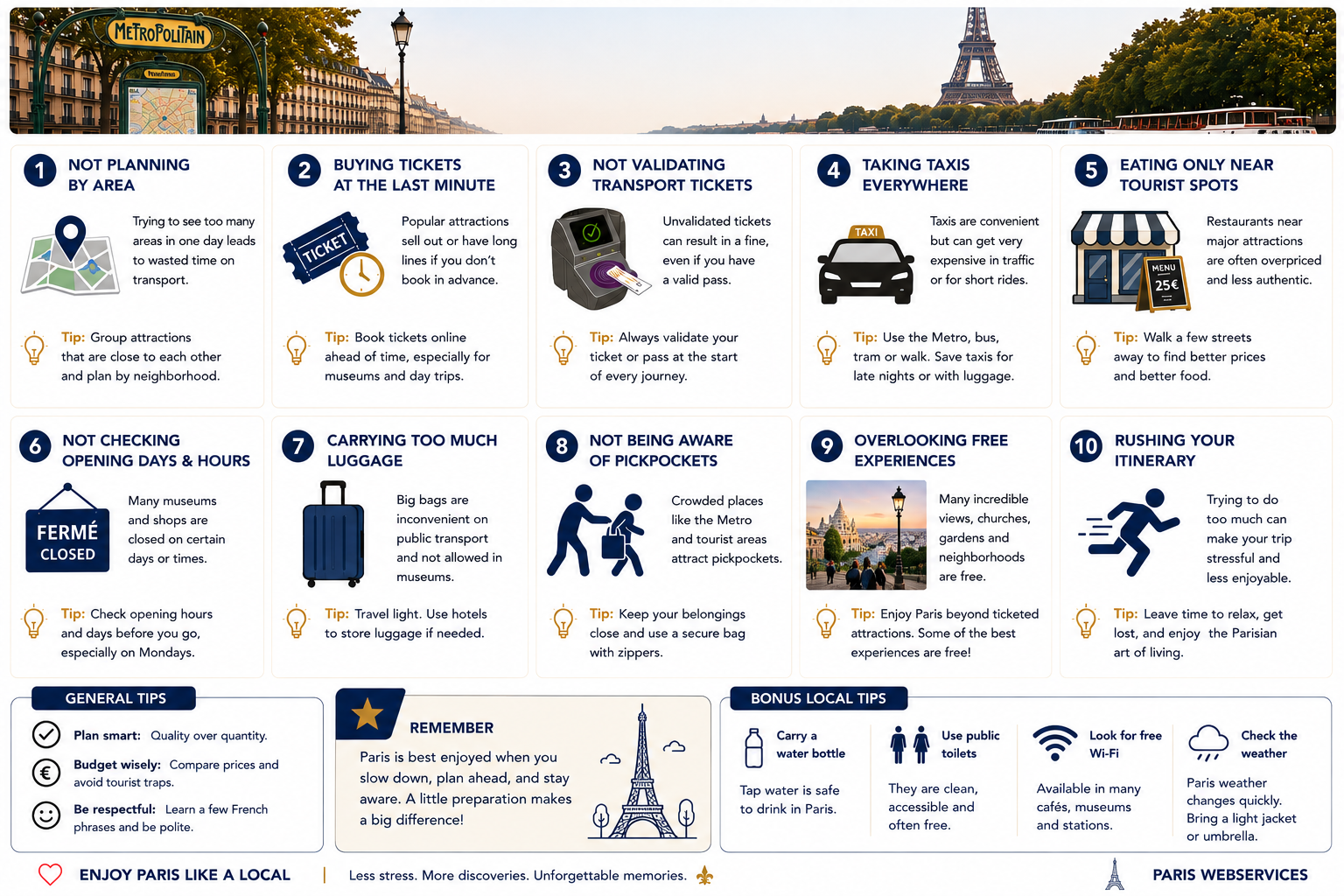

Paris has one of the busiest public transport networks in Europe, carrying millions of passengers every day. For the overwhelming majority of visitors, travelling on the Metro, buses and RER is perfectly safe. Thousands of tourists use the network daily without experiencing any problems. Nevertheless, as in London, Barcelona, Rome or New York, busy transport hubs naturally attract opportunistic pickpockets. Knowing a few simple precautions will help you travel with confidence throughout your stay.
The most important advice is to remain aware of your surroundings, particularly during busy periods. Pickpockets generally target distracted travellers rather than using force. Visitors consulting maps, taking photographs or carrying luggage are naturally more vulnerable because their attention is focused elsewhere. Keeping your phone, passport and wallet inside a zipped bag or an inside pocket is usually sufficient to avoid most problems.
Read More
Backpacks deserve particular attention. When trains become crowded, especially during rush hour, we recommend carrying your backpack in front of you rather than on your back. This simple habit not only protects your belongings but also creates more space for other passengers inside the carriage.
If someone unexpectedly bumps into you, asks you to sign a petition, drops coins on the floor or attempts to distract you with unusual questions inside a station, remain cautious. These situations are uncommon, but distraction is one of the oldest techniques used by pickpockets in large cities.
Travelling early in the morning or during the middle of the day is generally the most comfortable time to use public transport. Weekday rush hours, approximately 7:30 to 9:30 a.m. and 5:00 to 7:30 p.m., are naturally much busier because of commuters. If your schedule is flexible, visiting museums after the morning rush often results in a more pleasant journey.
If you are travelling with luggage, avoid carrying several large suitcases on the Metro whenever possible. Many stations have numerous staircases and long corridors, making taxis or Uber a far more comfortable option between airports, railway stations and hotels.
Finally, trust your instincts. If a carriage feels unusually crowded, simply wait for the next train. Metro services are so frequent that another train usually arrives within just a few minutes.
Following these basic precautions allows most visitors to enjoy Paris’ excellent public transport system without any concerns.
Paris has made significant progress in improving accessibility across its transport network, but visitors should remember that much of the Metro system was built more than one hundred years ago. As a result, accessibility varies considerably depending on the station and the type of transport you choose.
For travellers with reduced mobility, buses generally provide the easiest experience. Most modern buses feature low floors, dedicated wheelchair spaces and ramps, allowing passengers to board with much less effort than in many Metro stations. Trams are also fully accessible and offer spacious interiors suitable for wheelchairs, pushchairs and luggage.
The Metro presents a different situation. Although some stations have lifts or escalators, many still require passengers to climb several flights of stairs. Large interchange stations such as Châtelet–Les Halles, Montparnasse-Bienvenüe and Saint-Lazare may also involve long underground walks between platforms. If you are travelling with heavy luggage, these stations can quickly become tiring.

Read More
Families travelling with young children should also consider these practical aspects. A lightweight folding stroller is usually much easier to manage than a large pushchair, particularly when using older Metro stations without lifts. Many families choose to combine buses and occasional taxis with the Metro, creating a much more comfortable experience.
Senior travellers often ask whether the Metro is suitable for them. The answer depends largely on mobility. Many older visitors use the Metro without difficulty, but choosing a centrally located hotel greatly reduces the number of journeys required each day. Walking around one neighbourhood before using public transport to reach another is generally less tiring than repeatedly changing Metro lines throughout the day.
For visitors arriving from Charles de Gaulle Airport or Gare du Nord with several suitcases, we usually recommend taking a taxi or Uber directly to the hotel. Although public transport is less expensive, the additional comfort after a long international flight is often well worth the extra cost.
If accessibility is an important factor when choosing accommodation, selecting a hotel close to the attractions you plan to visit can significantly reduce the need for frequent transport, making your entire stay more enjoyable.

Paris remains a lively city well into the evening. Restaurants, theatres, river cruises and illuminated monuments encourage many visitors to stay out long after sunset. Fortunately, several transport options remain available even after the Metro begins to close.
The Metro generally operates until around 1:15 a.m. from Sunday to Thursday and approximately 2:15 a.m. on Friday and Saturday nights. Before your evening begins, it is always worth checking the departure time of the last train serving your hotel, particularly if you are staying outside the city centre.
After the Metro closes, the Noctilien night bus network takes over. These buses connect central Paris with many districts across the capital and surrounding suburbs throughout the night. Although they operate less frequently than daytime services, they provide an excellent alternative for visitors returning to their accommodation after midnight.
Read More
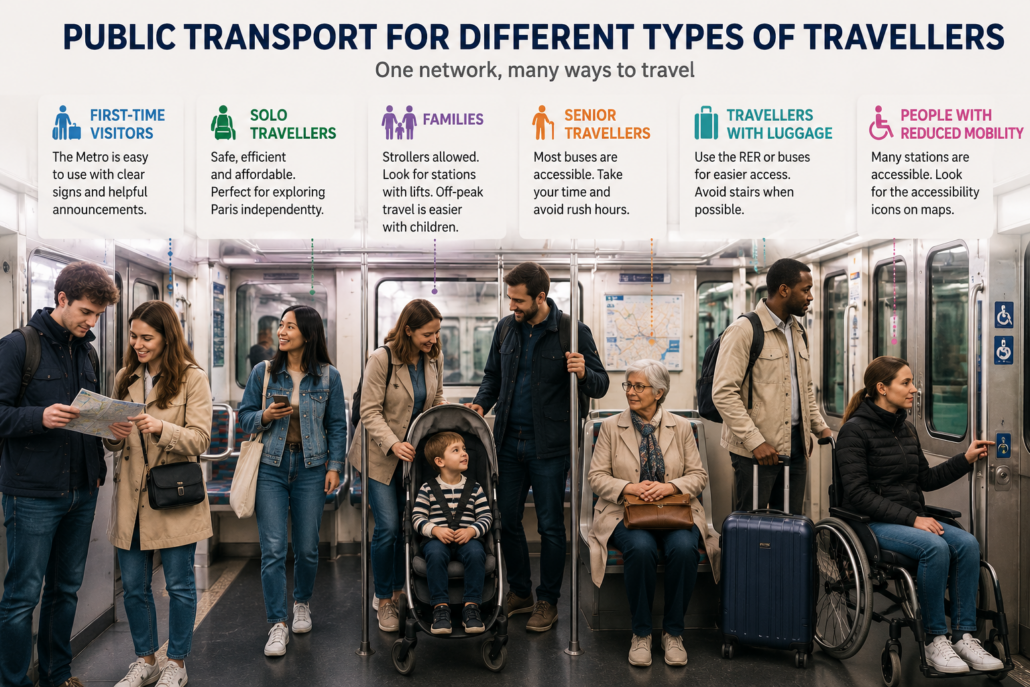
One of the advantages of Paris is that there is no single “correct” way to get around the city. The best choice depends entirely on the type of trip you are planning. A couple enjoying a romantic weekend will not use public transport in the same way as a family with young children or someone visiting Paris for business. Understanding which option suits your travel style will help you save time, reduce stress and enjoy the city much more.
If this is your first visit to Paris, we recommend combining walking and the Metro.
Spend each day exploring one neighbourhood on foot, then use the Metro to reach another part of the city. This approach allows you to experience both the famous landmarks and the atmosphere that makes Paris unique.
The Paris Bus is also an excellent option during your first few days because it helps you understand the city’s layout while enjoying the scenery.
Read More
Couples
Couples often discover that walking becomes their favourite form of transport.
Paris is one of the world’s most romantic cities, and many unforgettable moments happen while strolling along the Seine, crossing historic bridges or discovering quiet streets away from the busiest tourist areas.
Use the Metro for longer journeys and taxis or Uber after dinner if you prefer not to worry about the last train home.
Families
Families usually benefit from combining several forms of transport.
The Metro is fast but can become challenging with strollers during busy periods because some stations have many stairs.
Buses are often more comfortable for shorter journeys, while taxis can be particularly convenient when travelling with young children or after a long day of sightseeing.
Choosing a centrally located hotel will also reduce the amount of travelling required each day.
Senior Travellers
Many senior visitors are surprised by how much walking they comfortably manage in central Paris.
Rather than changing Metro lines several times, we generally recommend exploring one neighbourhood at a time and using public transport only when travelling between districts.
Buses are often easier than the Metro because they avoid long underground corridors and staircases.
Solo Travellers
Paris is an excellent city for solo travellers.
The Metro, buses and RER make it easy to explore independently, while navigation apps remove much of the uncertainty associated with public transport.
As in every major city, simply remain aware of your surroundings and keep your belongings secure in crowded areas.
Business Travellers
Business travellers often place greater importance on speed than sightseeing.
The Metro and RER usually provide the quickest connections between hotels, railway stations and business districts such as La Défense.
When travelling with luggage or working to a tight schedule, taxis and Uber remain the most comfortable option.
Returning Visitors
Visitors returning to Paris for the second or third time often use public transport differently.
Rather than travelling quickly between famous monuments, they explore quieter residential neighbourhoods, local markets and districts beyond the traditional tourist areas.
The bus network becomes particularly valuable because it offers a completely different perspective of the city.
Is the Paris Metro difficult to use?
Not at all. Once you understand how to follow the line number and the final destination (terminus), the Metro is one of the easiest underground systems in Europe.
Which transport is best for sightseeing?
Walking remains the best way to discover Paris.
For longer distances, combine walking with the Metro or the bus.
Is the Metro safe?
Yes.
Millions of passengers use the Metro every day without problems.
Simply take the same precautions you would in any large city by keeping your belongings secure and remaining attentive in crowded places.
Can I use the same ticket all day?
No.
A single Metro ticket is valid for one entry into the Metro system.
A bus ticket is valid for 90 minutes after validation for bus and tram transfers only.
For unlimited travel, choose a Navigo Easy (loaded with appropriate tickets) or a Paris Visite Pass, depending on your travel plans.
Which transport is best from Charles de Gaulle Airport?
The RER B provides the fastest public transport connection to central Paris.
If you have several suitcases or are travelling as a family, a taxi or Uber may be more comfortable.
Should I buy a Paris Visite Pass?
It depends on your itinerary.
Visitors planning numerous journeys every day, airport transfers or excursions to Versailles or Disneyland Paris often find it worthwhile.
Those making only a few journeys may spend less by purchasing individual tickets.
Is Google Maps enough?
For most visitors, yes.
Google Maps works very well throughout Paris.
Many frequent travellers also appreciate Citymapper for its detailed public transport information.
After helping international visitors discover Paris for more than twenty years, one recommendation comes up again and again: start your trip as comfortably as possible.
Paris has one of the world’s best public transport systems, and once you are familiar with it, travelling around the city becomes quick, affordable and remarkably efficient. However, many first-time visitors underestimate how demanding their very first journey can be, especially after a long international flight or while carrying heavy luggage.
Although the RER is an excellent way to reach central Paris, it is not always the easiest option for newcomers. After hours of travelling, finding the correct platform, understanding the ticket system, navigating large stations and changing between lines can quickly become overwhelming.
Read More
At Night
The same advice applies throughout your stay.If you are returning to your hotel late after dinner, a concert, the theatre or an evening cruise on the Seine, we generally recommend using an official Paris taxi or a pre-booked private transfer, particularly if you are unfamiliar with the city.Official Paris taxis are easy to recognise by the illuminated “TAXI PARISIEN” roof sign. They are licensed, regulated and available throughout the city at official taxi ranks or by reservation. They offer a simple, direct journey to your destination without the need to walk through unfamiliar streets or wait on public transport late at night.Private transfers provide the same comfort while offering the reassurance of knowing your driver and vehicle in advance.Ride-hailing services are also available across Paris. However, during late evenings, weekends or busy periods, waiting times, pickup locations and vehicle availability may vary. For visitors who do not know Paris well, we believe that an official taxi or a pre-arranged private transfer is often the simplest and most reassuring solution.Whether you are travelling with family, carrying shopping bags, returning with luggage or simply ending a long day of sightseeing, a direct door-to-door journey allows you to finish your day comfortably and safely.Ultimately, our advice is simple: use public transport to explore Paris, but choose comfort whenever the situation calls for it.Walk whenever the weather is pleasant. Take the Metro to cross the city quickly. Use the bus to enjoy the scenery. Choose the RER for longer journeys. And don’t hesitate to use an official taxi or a private transfer when arriving, travelling with luggage or returning late in the evening.Paris is one of the easiest capitals in the world to explore without a car. With a little preparation and the right balance between walking, public transport and occasional door-to-door services, your visit will be smoother, more enjoyable and far less stressful from beginning to end.
MAPS