THE LOUVRE PYRAMID GUIDE
Understanding the Louvre Through Its Most Controversial Landmark

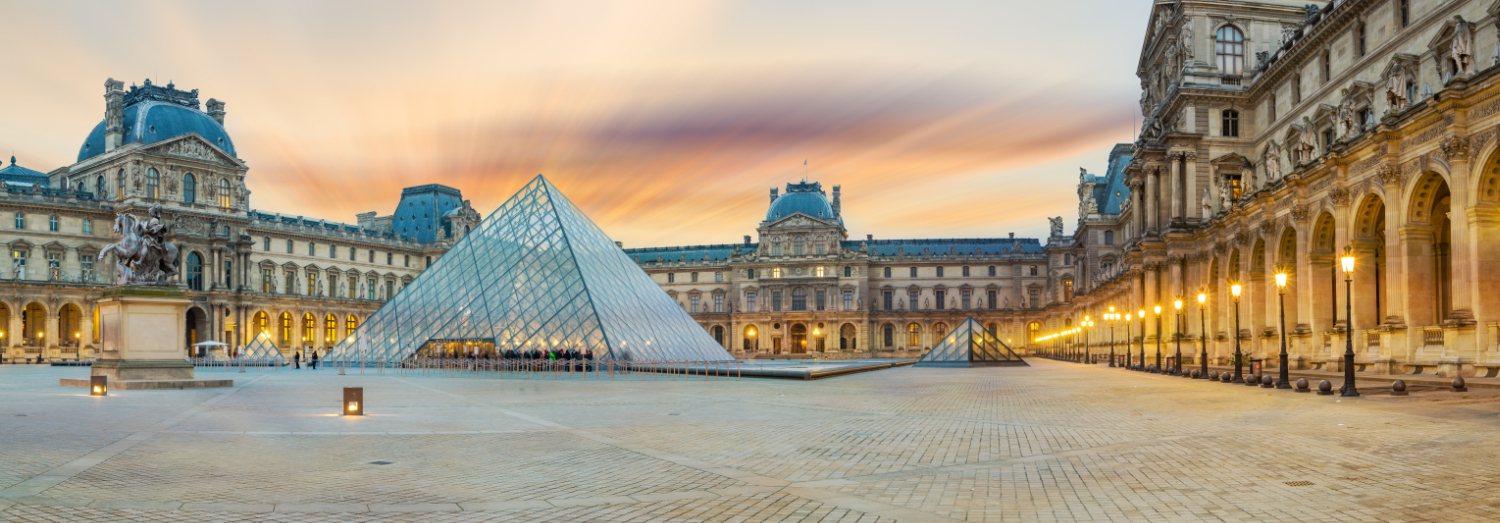
Before most visitors descend beneath the glass, they see only the image. The Louvre Pyramid feels familiar. Photographed. Recognised. Almost obvious.
But what is it really? A symbol? A gesture? Or something else entirely?
At first glance, the pyramid appears detached from the museum it stands in front of. Clean. Geometric. Modern. Almost too simple for a palace built over centuries.
And yet, it was never meant to be decorative.
It was designed to solve a problem. A very concrete one. How do you welcome millions of visitors? How do you orient them? How do you guide them through a museum spread across three vast wings, without overwhelming the historic structure above?
That is where the pyramid becomes interesting. It is not just an object. It is an entrance. A system. A point where everything begins to make sense.
A museum without a true centre
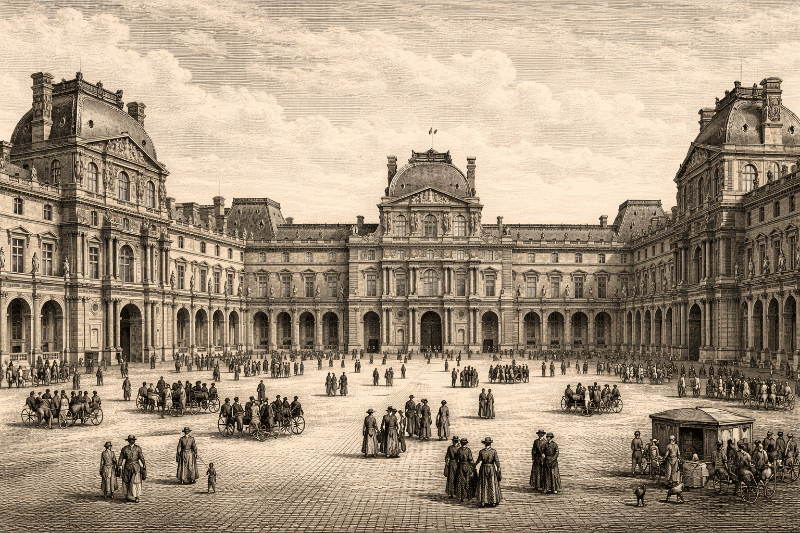
Before the Grand Louvre renovation, the museum had no single entrance. Visitors arrived from different sides, through Denon, Sully, or Richelieu. The palace absorbed them, but never really gathered them. The system belonged to another time. It worked when the Louvre was smaller. It became strained as the museum grew.[2]
What did that feel like? Arrival without orientation. Movement without clarity. There was no shared threshold. No place to pause, to understand, to prepare the visit. The experience began in fragments.
Why the old system no longer worked
By the late twentieth century, the pressure had become visible. Lines formed along the façades. Entrances filled unevenly. Services were dispersed across the building. Visitors entered, but they did not yet know where they were.[2]
Was it only a question of comfort? No. Something more structural was at stake. The museum lacked a centre. It lacked a point from which the whole could be understood before being experienced.
The underground solution
When François Mitterrand launched the Grand Louvre project and commissioned I. M. Pei in the early 1980s, the problem was clearly defined. Create a single entrance. Do it without disturbing the balance of the palace above.[1]
Pei’s answer was direct. Do not compete with the architecture. Do not add another façade. Move the solution below ground. Create space where none was visible.[1]
The pyramid is not the solution itself. It is the sign of it. It marks the point where everything converges. Where movement is organised. Where the museum finally begins to make sense.
| Before the palace teaches scale, the pyramid gives direction. |
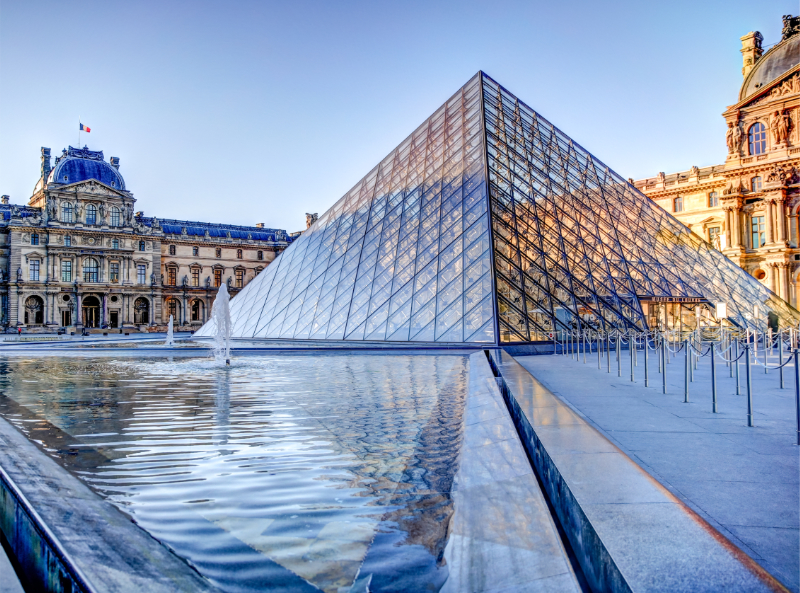
A form that could hold its own
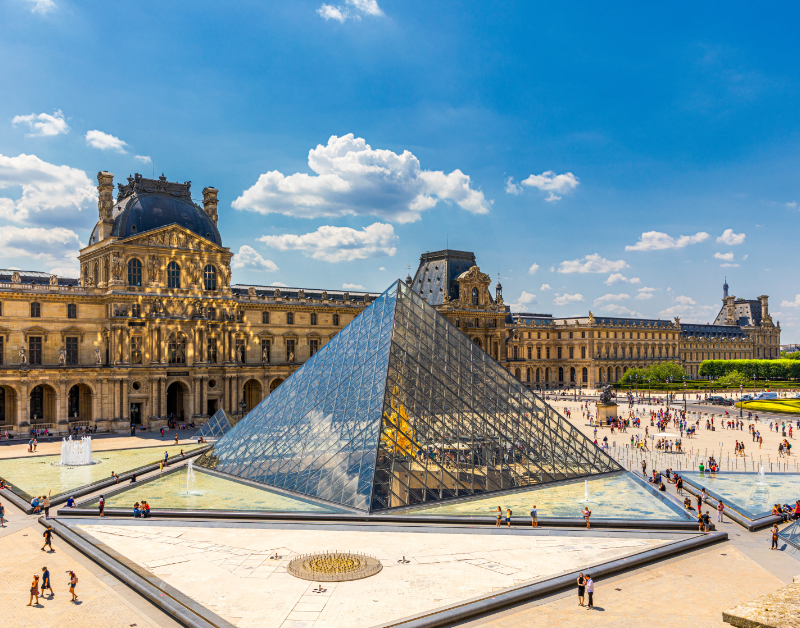
Why a pyramid? The question seems obvious, and it was the first point of criticism. The answer, however, is less symbolic than it appears. Pei did not choose the pyramid for effect. He chose it because the form works.[1]
A pyramid can span a large glazed volume without relying on a dense forest of columns. It holds itself. It distributes weight efficiently. At the same time, its sloping sides reduce its apparent mass. The structure is present, but it does not dominate. The palace remains visible. The balance is maintained.
Could another form have worked? Possibly. But few would have achieved this equilibrium between structure, transparency, and restraint.
The numbers behind the object
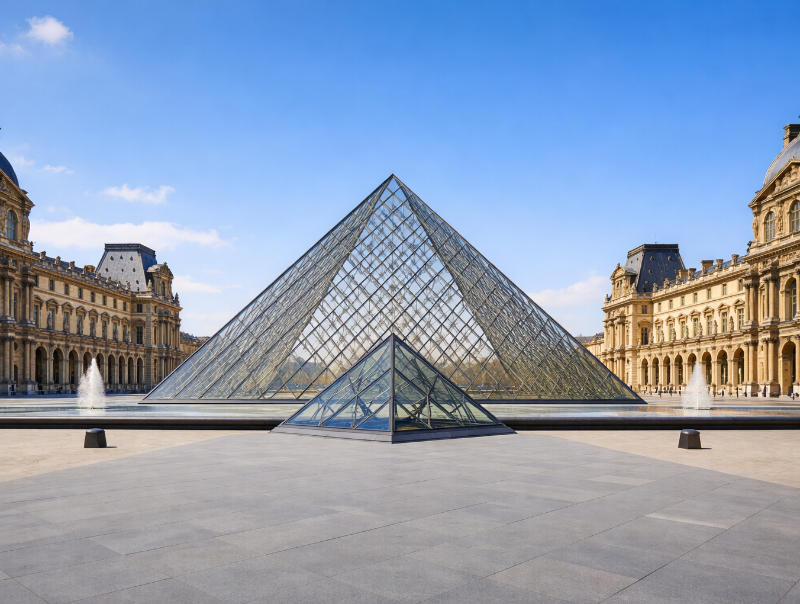
The pyramid rises 21.6 metres high and measures 34 metres across at its base. Its surface is composed of 603 rhombus-shaped panes and 70 triangular panes, all set within a precise steel framework.[1]
These numbers are not decorative details. They define the object. They show that the pyramid is not an abstract gesture. It is a controlled construction. Measured. Calculated. Nothing is left to improvisation.
The importance of the glass
The material itself posed a problem. Standard float glass carries a slight green tint, especially at this scale. That tint would have altered the perception of the structure. It would have distorted reflections. It would have interfered with the relationship between glass and stone.
How do you build transparency? By removing what distorts it. Pei’s team worked with Saint-Gobain to develop a low-iron glass. Clear. Neutral. Almost invisible. A material designed not to impose itself, but to disappear.[1]
Once that is understood, the pyramid changes. It no longer appears arbitrary. It reads as a precise response. A structure that solves a problem while remaining in dialogue with what surrounds it.
| Once the geometry becomes clear, the pyramid stops being an image and becomes a solution. |
A modern object in a historic court
The announcement of Pei’s project in the 1980s triggered immediate opposition. Why such a strong reaction? Because the object seemed out of place. Too modern. Too foreign. Too abrupt for the centre of Paris.[2]
The contrast was undeniable. A glass pyramid placed in the middle of a classical courtyard. The objections were not only aesthetic. They were political. Symbolic. The project quickly became more than architecture.
Why the debate became so intense
The Louvre is not a neutral site. It carries history. Power. Memory. Any intervention there is immediately amplified. It is not judged as a simple design choice, but as a statement about heritage itself.[2]
What was really being debated? Not just the pyramid. But the place of modernity in a historic setting. The role of the state. The limits of transformation. The question was simple, but difficult: how far can one change what already defines a city?
How the reaction changed
Mitterrand did not retreat. The project moved forward. The pyramid opened in March 1989. And something shifted.
What had been seen as an intrusion began to be accepted. Then recognised. Then adopted. Within a short time, the pyramid became one of the most identifiable images of the museum.[2]
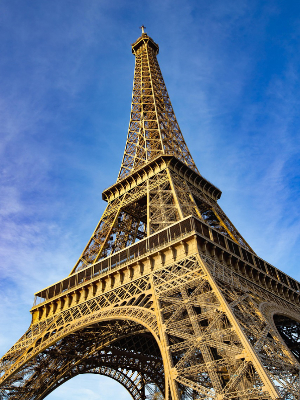
Is this surprising? Not entirely. Paris has often resisted new forms before integrating them. The Eiffel Tower followed the same path. Rejection first. Acceptance later.
The Louvre Pyramid fits this pattern. What once appeared as a rupture now reads as continuity. Not because it imitates the past, but because it reorganises it.
| What first looked like a rupture now feels inseparable from the identity of the place. |
The real heart of the project
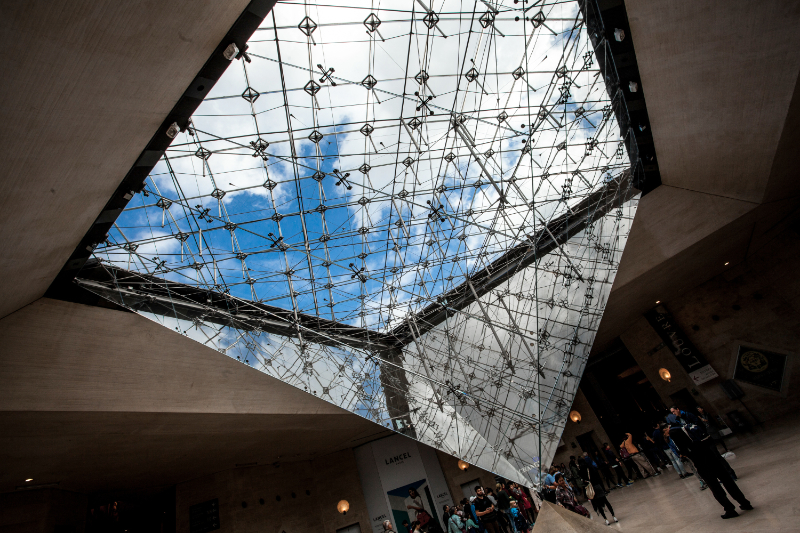
If the pyramid is what everyone sees, the Hall Napoléon is where the project truly begins. What happens once you pass beneath the glass? The answer lies below.
Under the courtyard, the museum reorganises itself. Ticketing, information, cloakrooms, shops, circulation. Everything converges here. This is not a secondary space. It is the operational centre of the modern Louvre.[1]
What the palace never had, this space provides. A place to arrive. To pause. To understand. Before moving further.
A new point of orientation
From the Hall Napoléon, the museum becomes legible. Denon to the south. Richelieu to the north. Sully to the east. The complexity of the palace does not disappear. But it is finally organised.
Is that a minor change? Not at all. This clarity is the real achievement of the project. The pyramid does not simply provide an entrance. It gives the museum a structure that can be understood before it is experienced.[1]
The view that explains everything
There is a moment where everything becomes clear. Stand at the base of the main staircase and look up. What do you see?
Sky above. Glass filtering the light. The stone façades framing the space. The courtyard, the pyramid, and the palace aligned in a single composition.
At that point, the project explains itself. The pyramid is no longer an object placed in the courtyard. It becomes a point of orientation. A centre. A way of reading the museum as a whole.
| Seen from below, the pyramid stops being a form and becomes a direction. |
Author’s note: This text was written with the intention of sharing and transmitting knowledge, not as an academic work. Its author is not a historian. Some details or interpretations may not reflect current historiographical consensus. For a rigorous approach, please refer to the sources listed at the end of this document
[1] I. M. Pei, Louvre Pyramid, New York, The Monacelli Press, 2000.
[2] Jean-Marie Pérouse de Montclos (dir.), Le Grand Louvre, Paris, Éditions du Moniteur, 1989.
[3] Andrew Ayers, The Architecture of Paris: An Architectural Guide, Stuttgart, Edition Axel Menges, 2004.
[4] Musée du Louvre, Le Grand Louvre. Histoire d’un projet, Paris, Musée du Louvre.
OUR BEST TOURS