NEAR EASTERN ANTIQUITIES GUIDE
Discovering the Ancient Civilisations That Shaped the Near East

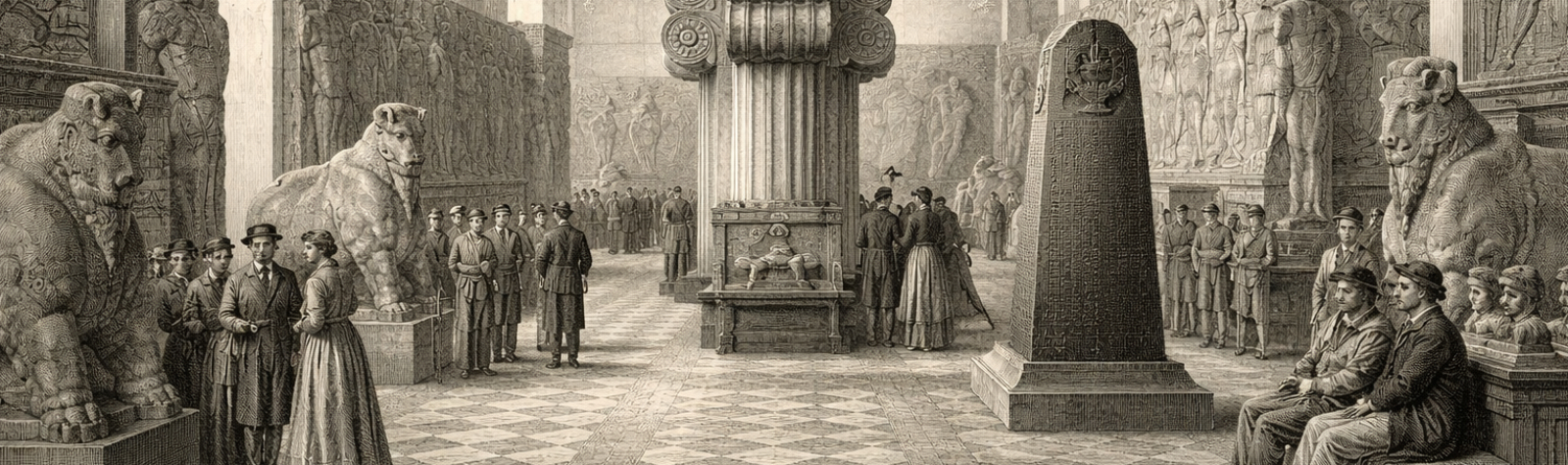
Before entering the Louvre’s Near Eastern galleries, most visitors think they know what to expect. Antiquities. Old objects. Something distant.
But that is not quite what happens.
This is the oldest department in the museum. It does not feel like the rest of the Louvre. It feels earlier. More direct. Less about art, more about systems.
Mesopotamia. Iran. The Levant. The Arabian Peninsula. These are not just regions. They are starting points.
The timeline is long. Around 7000 BCE to the 7th century CE. Hard to visualise. Easier to feel once inside.
Cities begin here. Writing begins here. Power takes shape. Law becomes visible.
The objects are not isolated. They belong to systems. To structures. To worlds that once functioned.
The Code of Hammurabi is often the focus. It makes sense. It is clear. It is structured.
But it is only one point. Around it, everything else begins to connect.
Mesopotamia: The World’s First Civilisations
The Mesopotamian galleries form the intellectual core of the department. Why start here? Because this is where the Louvre brings Sumer, Akkad, Babylon, and Assyria together. Not as isolated names, but as successive civilisations shaped by the Tigris and Euphrates.[1][4]
This is not just a collection. It reads as a sequence. A world building itself over time. Cities. Empires. Systems of power. All rooted in the same geography.[2]
The Louvre’s understanding of this world begins in the nineteenth century. In the 1840s, Paul-Émile Botta excavated Khorsabad, the Assyrian capital of Sargon II.[1] What did he uncover? Not fragments. An architecture. Not isolated objects. A complete visual system.
The objects sent to Paris changed the museum. They did not just expand it. They redefined it. For the first time, Assyrian monumental art entered European collections at scale.[1]
The Khorsabad lamassu
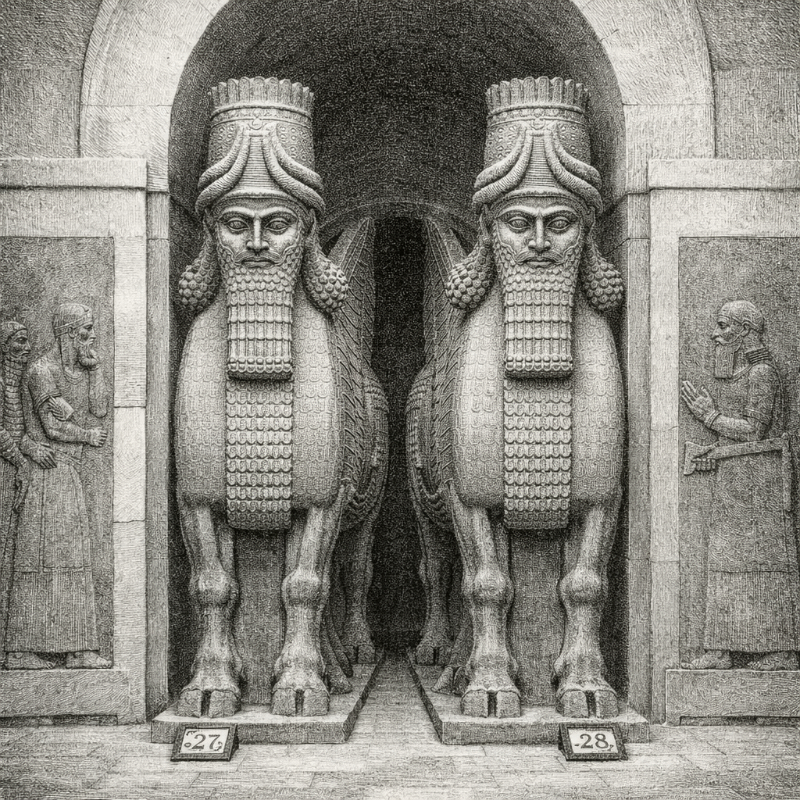
In Rooms 4 and 5 of the Richelieu wing, the lamassu dominate the space. Winged bulls. Human heads. Guardians placed at the edge of power.[1]
Each rises to more than four metres. Several tonnes of carved alabaster. Impressive, yes. But scale alone does not explain their effect.[1]
Stand in front of them. They appear still. Move to the side. They advance. Five legs. A contradiction? No. A deliberate construction.[1]
This is not decoration. It is control. Space is structured. Movement is guided. Perception is directed.[1]
Placed at thresholds, these figures do more than guard. They organise passage. Outside to inside. Ordinary to imperial.[2]
| Before law, before writing becomes visible, Mesopotamia establishes scale, order, and presence. |
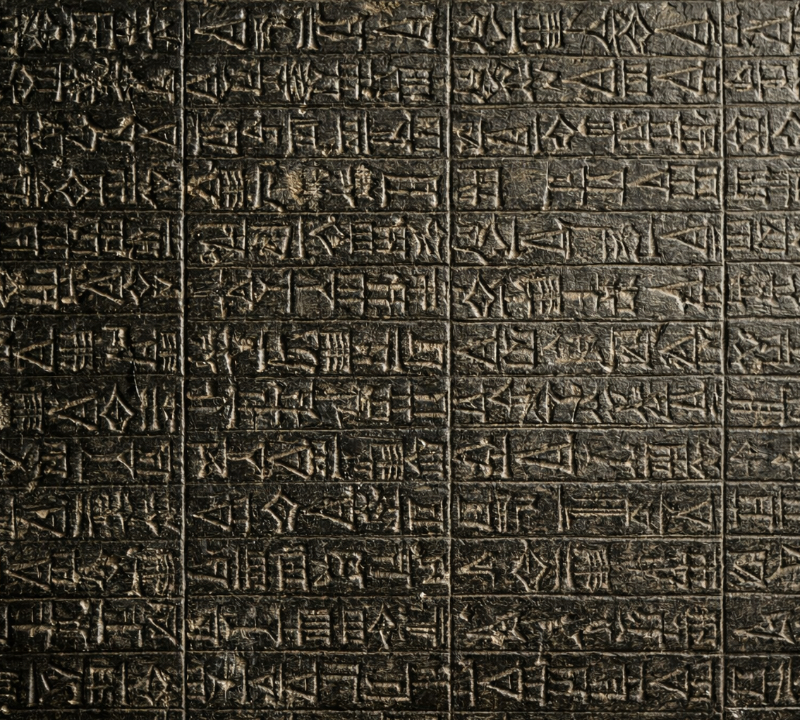
Few objects in the Louvre carry more historical weight than the Code of Hammurabi. Why is it so central? In Room 3 of the Sully wing, the black diorite stele rises to over two metres. Across its surface, 282 laws are carved in Akkadian cuneiform, dating to around 1750 BCE, under Hammurabi, king of Babylon.[3]
At the top, the scene sets the tone. Hammurabi stands before the seated sun god Shamash. The god extends the rod and ring. Authority. Justice. Legitimacy.[2]
Why does that image matter? Because it frames everything below. These are not just rules. They are grounded in a higher order. Law is not only written. It is sanctioned.[2][3]
Why it still matters
The text covers daily life. Property. Trade. Family. Agriculture. Labour. Crime. The principle often summarised as “an eye for an eye” appears here in a structured form.[2][3]
But is that what defines the stele? Not really. Its importance lies elsewhere. This is not a set of scattered customs. It is a system. Law presented as ordered. Coherent. Public.[2]
Who was meant to read it? Very few. And yet, it stands upright. Visible. Monumental. It asserts something else. That law exists. That it can be fixed. Displayed. Made durable.
Excavated at Susa in 1901–1902 by Jacques de Morgan, the stele remains one of the clearest documents of how ancient states defined justice.[3] It is not simply ancient. It is structural.
| If one object can make antiquity feel suddenly modern, it is this one. |
After Mesopotamia and Babylon, the atmosphere changes. What shifts here? Power is no longer carried by mass alone. It moves to the surface. To repetition. To colour.[1][4]
The effect is different. Lighter, perhaps. But still controlled. Still imperial. Authority does not disappear. It changes form.
The key works are the glazed brick panels from the palace of Darius I at Susa, around 510 BCE.[1] In Rooms 10 and 11 of the Sully wing, the frieze of archers once lined a royal reception space.
Each figure stands at around 160 centimetres. Turquoise. Yellow. Brown. Set against a pale ground. The materials shift. The impact remains.
Why the archers matter
What do they represent? Not individuals. Not portraits. What appears instead is repetition. Order. A visual rhythm that extends beyond a single figure.
The colours remain vivid. More than expected. Standing in front of them, the effect is immediate. Controlled. Ceremonial.[1]
This is not simple decoration. It is a system. Power translated into pattern. Authority made continuous.[2]
The experience changes here. The collection becomes atmospheric. The Louvre does not just preserve Susa. It reconstructs, in fragments, how Persian power presented itself.[4]
By the time colour returns in Susa, the narrative has moved from the first cities to the first empires. |
Tips for the Near Eastern Antiquities Galleries
A successful visit here depends as much on order and pacing as on the objects themselves. The department rewards attention, but it rewards structure first.
Go to the Code of Hammurabi first
Room 3 of the Sully wing’s ground floor is the clearest place to begin. Arriving around 9:15 AM on a weekday gives you the best chance of seeing the stele before the main tour groups gather. Read the panel. The age of the object matters, but the actual content of the laws matters just as much.
Give the lamassu more time than most people do
The Khorsabad lamassu in Rooms 4 and 5 of the Richelieu wing deserve ten to fifteen minutes rather than a quick walk past. Stand between a pair. Look at the faces at eye level. Then count the legs. Each figure has five, so that it appears at rest from the front and in motion from the side.
Do not rush the Susa rooms
The frieze of archers in Rooms 10 and 11 of the Sully wing is almost always easier to see without crowding. Allow ten minutes here. The preservation of the glazed brick technique, and the quality of the surviving colour after twenty five centuries, needs a little time.
| The best visits here do not move quickly. They move in the order that allows the ancient world to become legible. |
Author’s note: This text was written with the intention of sharing and transmitting knowledge, not as an academic work. Its author is not a historian. Some details or interpretations may not reflect current historiographical consensus. For a rigorous approach, please refer to the sources listed at the end of this document
[1] Dominique Collon, Ancient Near Eastern Art, London, British Museum Press, 1995.
[2] Jean Bottéro, Mésopotamie. L’écriture, la raison et les dieux, Paris, Gallimard, 1987.
[3] Béatrice André-Salvini, Le Code de Hammurabi, Paris, RMN / Louvre, 2003.
[4] Georges Roux, Ancient Iraq, London, Penguin Books, 1992.
OUR BEST TOURS