THE LOUVRE PAINTINGS GUIDE
How to Navigate One of the Greatest Painting Collections in the World

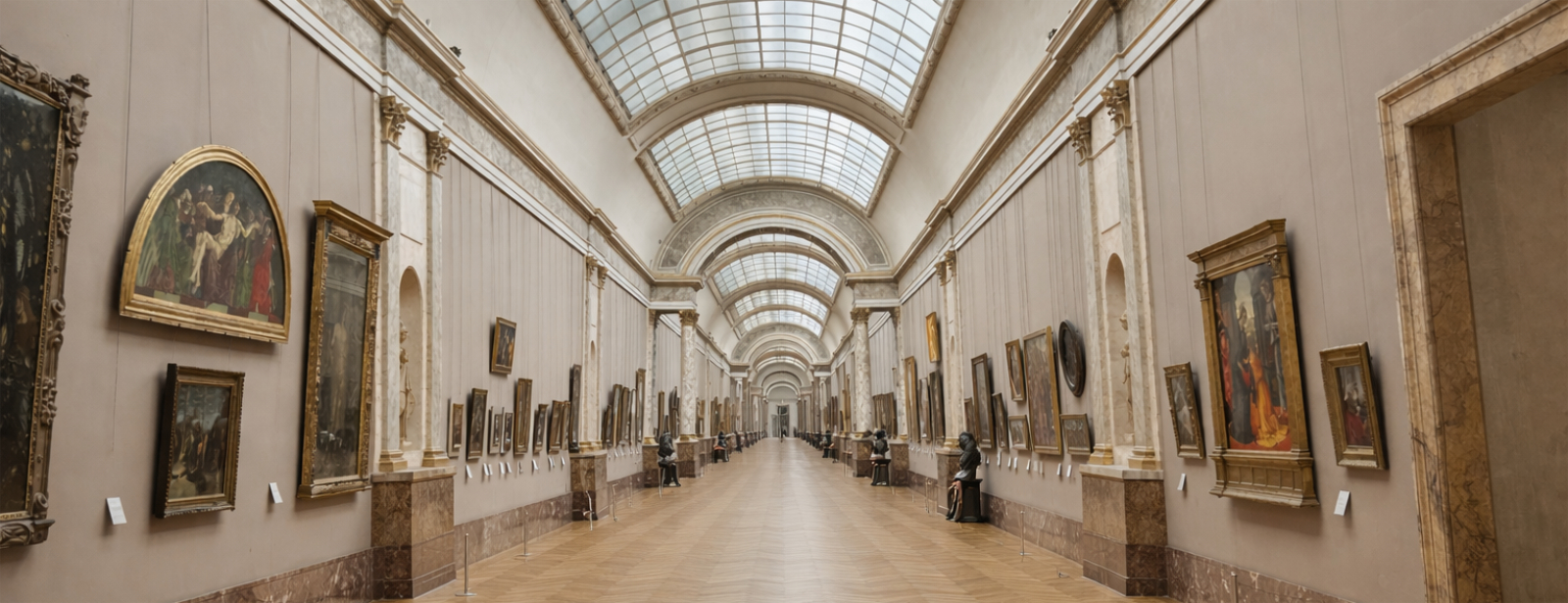
Most visitors arrive at the Louvre with one painting in mind: the Mona Lisa.
That is understandable. But it also creates a problem. The Louvre’s painting collection is far too rich to be reduced to one famous face behind glass.
So what paintings should you really see at the Louvre once you look beyond Leonardo?
This guide focuses on seven works that change the visit: paintings that fill entire walls, lower the volume, stage power, question beauty, expose disaster, or turn political ideas into unforgettable images.
The point is not to see everything. It is to choose paintings that make the Louvre feel larger, stranger, and more alive than the usual route to the Mona Lisa.
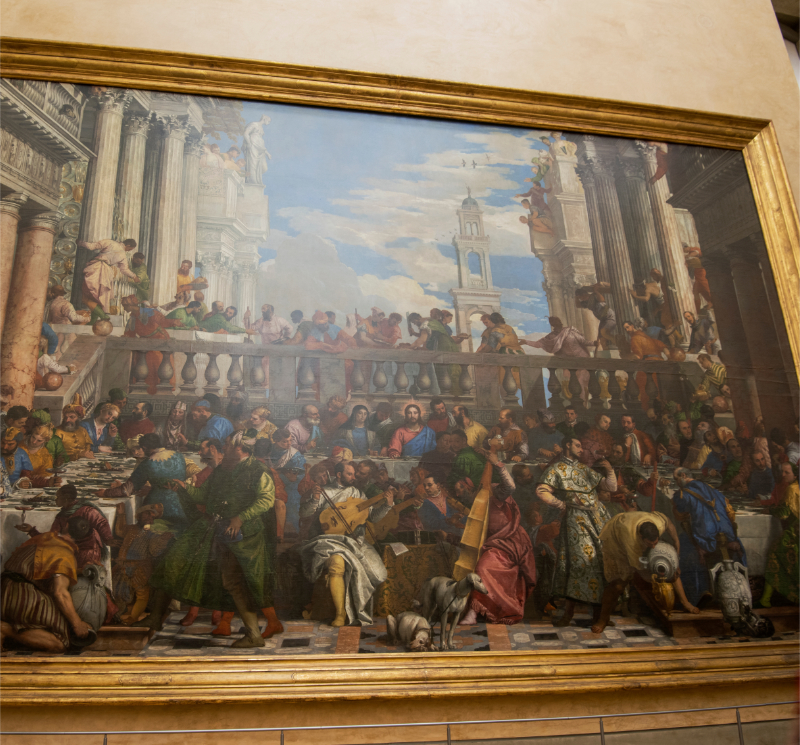
There is something almost comic about the placement of The Wedding Feast at Cana.
Visitors enter the Salle des États, move toward the Mona Lisa, take their photos, wait their turn, look for a few seconds and then many of them leave. Yet just behind them, facing Leonardo’s small portrait, is one of the most spectacular paintings in the entire Louvre.
Veronese’s canvas is enormous. It does not whisper; it spreads. It fills the wall with architecture, guests, servants, musicians, dogs, fabrics, dishes, gestures and color. The biblical story is simple: Christ turns water into wine at the wedding at Cana. But Veronese does not paint it as a quiet miracle. He turns it into a Venetian feast.
That is what makes the painting so generous. It gives more than the subject requires. It gives society, luxury, music, noise, elegance, appetite. The miracle is there, but it is hidden inside the fullness of the world.
And that is precisely the lesson.
The Mona Lisa draws the eye inward. It asks for concentration, almost secrecy. Veronese does the opposite. He opens the room. He lets the eye wander. He tells us that painting can be a world large enough to walk through.[1]
| This is why I would begin here. Not because the painting is bigger, but because it teaches a different way of looking. At the Louvre, the obvious masterpiece is sometimes the one people forget to see. |
2. Rubens, The Disembarkation of Marie de’ Medici at Marseille when power learns to perform
Rubens is never shy. That is part of his greatness.
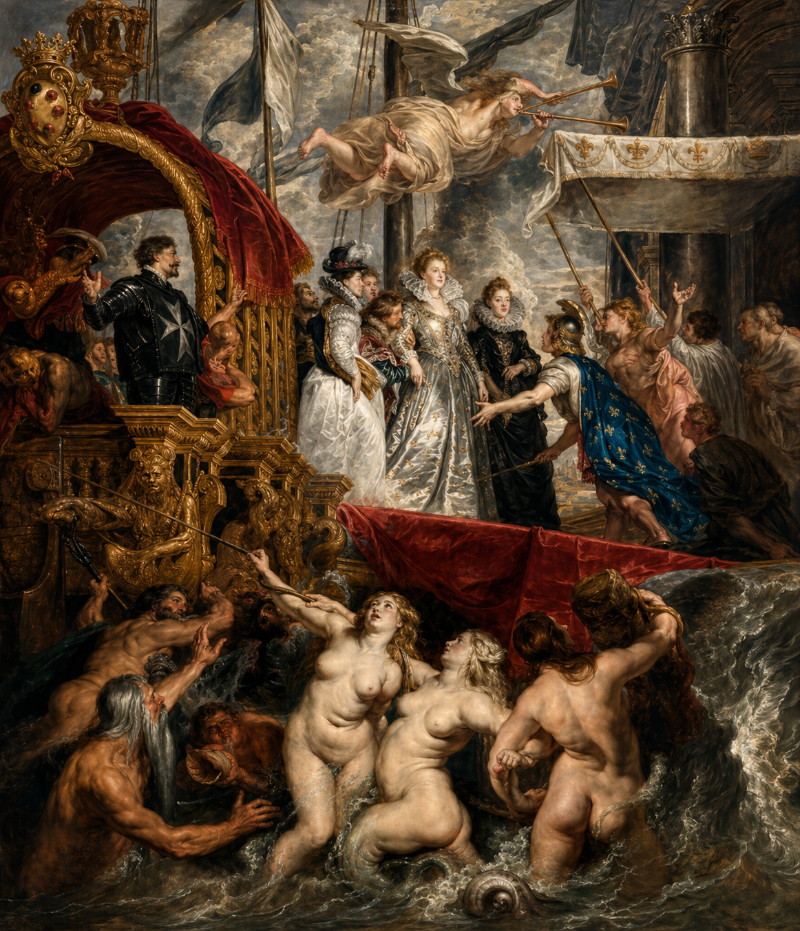
In The Disembarkation of Marie de’ Medici at Marseille, he does not simply show a queen arriving in France. He turns her arrival into a spectacle. Marie de’ Medici steps into the painting as if she were stepping into destiny. Around her, allegorical figures welcome her. Below, sea gods twist and rise from the water. Draperies move, bodies swell, colors burn.
Everything is a little too much and that is exactly the point.
Rubens understands power better than many political writers. He knows that power needs images. It needs ceremonies, symbols, bodies, movement, grandeur. A queen does not only want to arrive; she wants her arrival to look inevitable, glorious, almost mythological.[2]
The painting is beautiful, but it is also intelligent. It knows what it is doing. It does not pretend to be neutral. It is not a private memory. It is a public construction of prestige.
That makes it strangely modern. Today, power still stages itself. It still chooses angles, settings, symbols, costumes, backgrounds. In the seventeenth century, Marie de’ Medici had Rubens.
What matters here is not only the queen. It is the entire machinery around her. The bodies, the gods, the colors, the movement, everything works to make her larger than life.
Rubens turns biography into theatre. And in that theatre, politics becomes unforgettable.
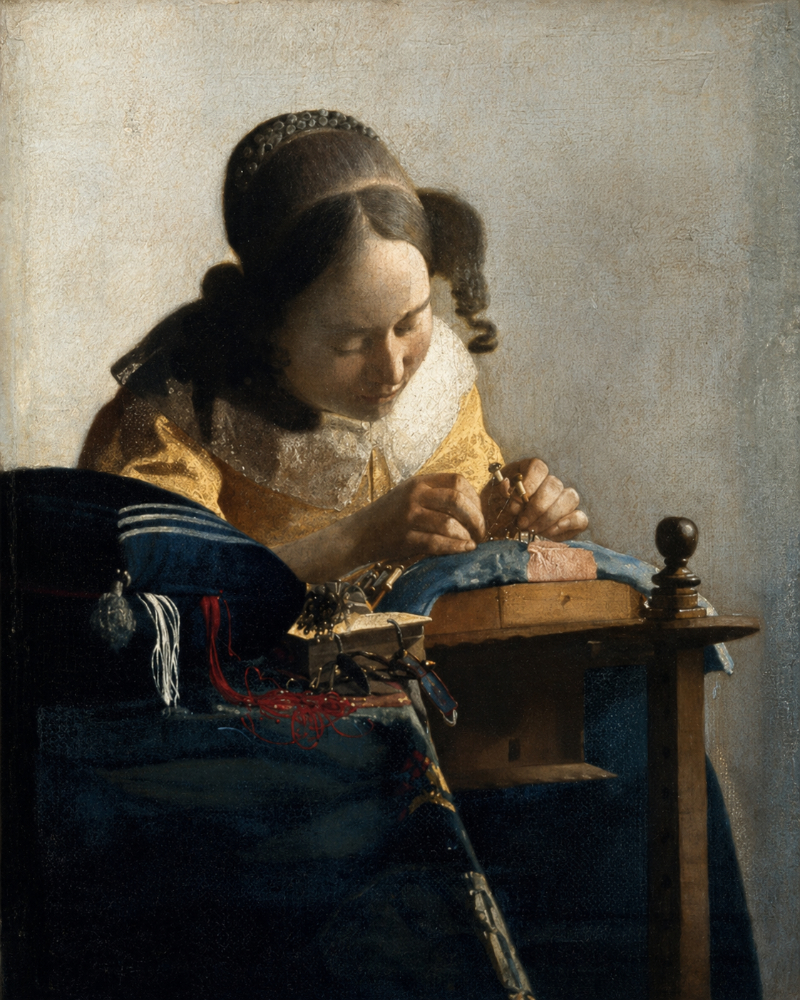
3. Vermeer, The Lacemaker the painting that lowers the volume
After Veronese and Rubens, one needs quiet.
That is why The Lacemaker matters so much.
It is small. Almost modest. It does not fight for attention in the same way as the great historical canvases. It does not show a sovereign, a miracle, a shipwreck or a revolution. It shows a young woman making lace.
Nothing more.
But that “nothing more” is the whole point.
Vermeer paints concentration. The woman is absorbed in her work. Her hands are busy, her head bends forward, the world seems to have withdrawn around her. There is no drama here, but there is intensity. A silent intensity.
This painting changes the rhythm of the Louvre. It interrupts the visitor’s instinct to keep moving. It asks for a slower kind of attention. One cannot conquer Vermeer. One has to approach him.
What is remarkable is that the painting feels small without feeling minor. It has the authority of silence. In a museum filled with grandeur, it reminds us that intimacy can be just as powerful as spectacle.[1]
There is something deeply moving in that. A simple gesture, a private moment, a small area of light, and suddenly the painting holds its own against emperors, queens and revolutions.
The Louvre is not only a palace of noise. It also knows how to whisper.
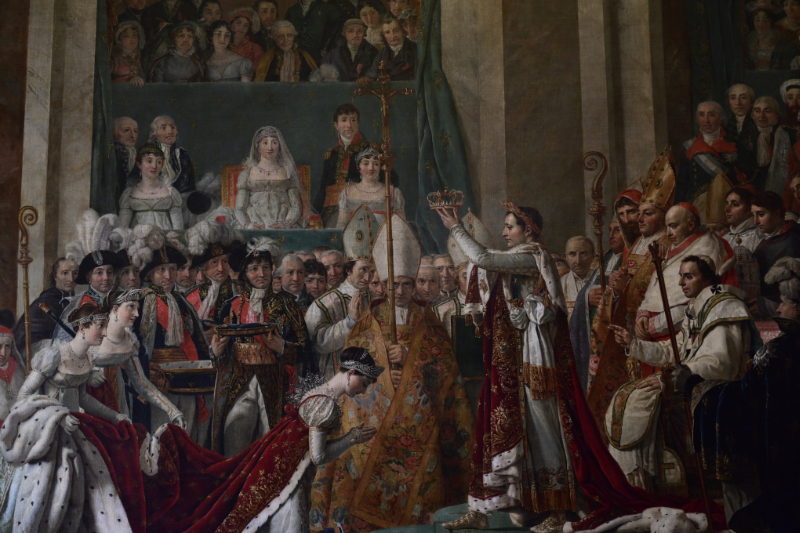
4. David, The Coronation of Napoleon the image power wanted to leave behind
The Coronation of Napoleon looks, at first, like history.
That is what makes it so effective.
The scene is grand, precise, ceremonial. Napoleon, Joséphine, the pope, the court, the family, the dignitaries, everyone is there, placed with theatrical clarity. The eye accepts the image almost immediately as a record of what happened.
But David is not merely recording. He is arranging.
This is not history as it occurred. It is history as power wanted it to be remembered.[3]
The painting gives the Empire a face, a rhythm, a hierarchy. It fixes Napoleon at the center of a world that seems to revolve around him.
That is why the work remains so fascinating. It is not only a painting of a ceremony. It is a painting about the control of memory.
Everything in the image has a role. Joséphine kneels. The pope is present. The court watches. The architecture rises. The costumes shine. Each detail contributes to the same message: this is authority made visible.
There is no need to reduce David to propaganda. The painting is more complex than that. It is magnificent, disciplined, brilliantly composed. But its brilliance serves a political purpose.
And this is where it speaks directly to us. We still live surrounded by official images. Leaders still stage themselves. Ceremonies still produce memory. Power still tries to decide how it will be seen.
David understood that perfectly.
Before this painting, the real question is not simply: what happened?
It is: who owns the image of what happened?
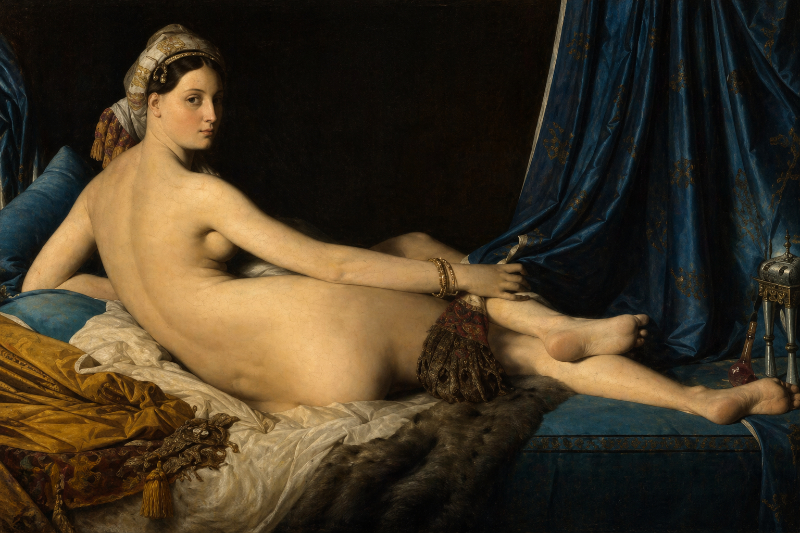
5. Ingres, La Grande Odalisque the body that refuses to be real
At first, La Grande Odalisque seems calm.
A woman lies before us, turned away, her face looking back. The surface is smooth. The colors are cool. The line is elegant. Everything appears controlled, almost detached.
Then the body starts to trouble the eye.
The back is too long. The form is stretched. The anatomy is not quite believable. Something does not fit, and yet the painting does not collapse. On the contrary, it becomes more fascinating.
That is the secret of Ingres.
He is not trying to give us a body as it exists. He is giving us a body as line, as curve, as controlled desire. Reality is not his master here. Form is.
This is why the painting is so memorable. It seduces, but it also resists. Its beauty is not natural; it is constructed. It has been lengthened, purified, made strange. The result is not a mistake, but an invention.
Ingres belongs to the world of line, discipline and precision. But one should not mistake discipline for coldness. There is something almost obsessive in the way he bends the body to his ideal.[4]
That is what gives the painting its power. It is beautiful, but not comfortable. It invites admiration, then doubt.
And perhaps that is one of the best lessons painting can offer: beauty is not always the same as truth. Sometimes painting becomes unforgettable precisely because it dares to depart from the real.
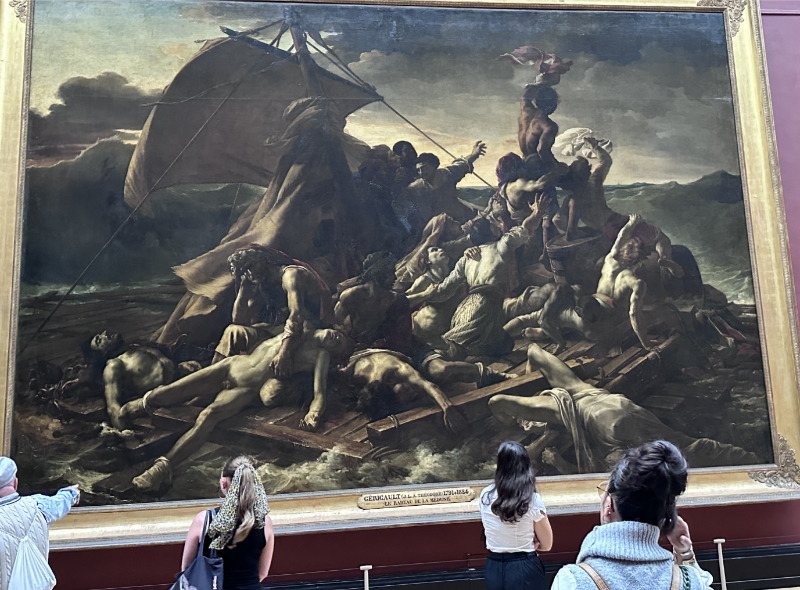
6. Géricault, The Raft of the Medusa when the museum stops being polite
Some paintings change the atmosphere around them.
The Raft of the Medusa does that.
After the feast, the queen, the quiet room, the imperial ceremony and the ideal body, Géricault brings us to a raft. Men are abandoned at sea. Some are dead. Others are barely alive. A few still hope. The painting does not flatter. It confronts.
The story is real. The French frigate Méduse was wrecked in 1816. Survivors were left on a raft. Most died. Géricault takes this recent disaster and gives it the scale of history painting.[3]
That choice is radical.
Instead of ancient heroes, he gives us modern victims. Instead of glory, exhaustion. Instead of triumph, scandal. The bodies are heavy, damaged, desperate. The sea is not a noble setting; it is a threat.
The composition is extraordinary. At the bottom, death. In the middle, struggle. At the top, a gesture toward a distant ship, perhaps salvation, perhaps illusion. The whole painting rises toward hope, but hope remains painfully small.
This is not an easy masterpiece. It is not meant to please in a simple way. It asks the viewer to look at suffering without turning it into decoration.
That is why it still feels so modern. Géricault makes painting responsible. He forces history painting to face contemporary disaster.
Before The Raft of the Medusa, admiration is not enough. One has to be disturbed.
And sometimes, that is exactly what great art should do.
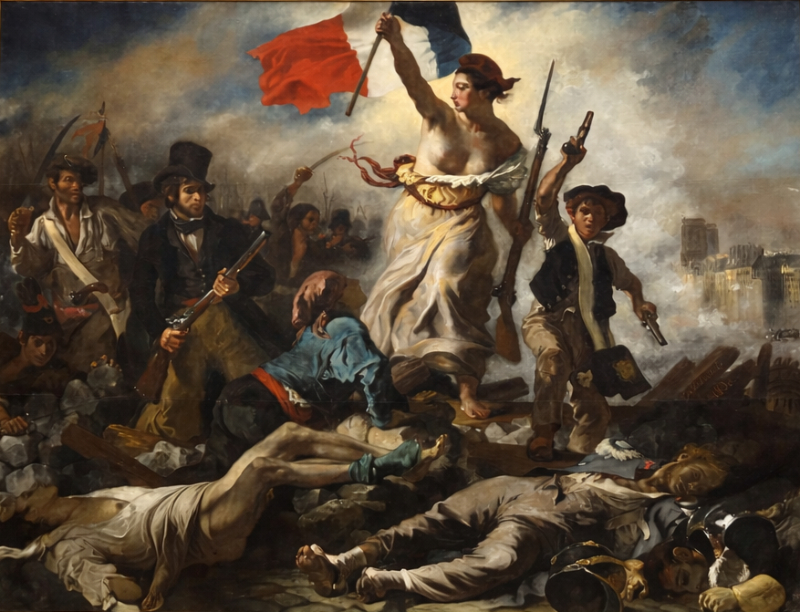
7. Delacroix, Liberty Leading the People when an idea starts walking
Liberty Leading the People is almost too famous for its own good.
Its image has circulated everywhere: textbooks, posters, political references, popular culture. Many people feel they know it before they have really looked at it.
But seen properly, it remains astonishing.
At the center, Liberty advances. She carries the tricolor. She is not a real woman, but an allegory. Around her, however, everything is brutally physical: smoke, weapons, corpses, dust, bodies in motion.
That is the strength of the painting. It gives flesh to an idea.
Delacroix does not paint liberty as a clean concept. He paints it as something that moves through violence, confusion and death. The figure is symbolic, but the ground beneath her is real. Liberty advances, but she does not float. She steps over bodies.
This is what separates the painting from a simple patriotic image. It is not just a celebration. It is also a warning. Freedom is beautiful, but it is not painless.
After Ingres, Delacroix feels like a release. The line is less controlled, the color more urgent, the movement more unstable. The painting trembles. It burns. It refuses to stand still.[4]
That is why it makes such a strong ending to this route. Veronese gave us abundance. Rubens gave us glory. Vermeer gave us silence. David gave us power. Ingres gave us constructed beauty. Géricault gave us catastrophe. Delacroix gives us an idea in motion.
A painting can become a symbol. But when it is truly great, it remains a painting first: color, bodies, smoke, rhythm, tension.
Here, liberty is not explained. It appears.
Author’s note: This text was written with the intention of sharing and transmitting knowledge, not as an academic work. Its author is not a historian. Some details or interpretations may not reflect current historiographical consensus. For a rigorous approach, please refer to the sources listed at the end of this document
[1] Germain Bazin, La Peinture au Louvre, Paris, Somogy, 1990.
[2] Édouard Michel, La Peinture au Musée du Louvre. École flamande, Paris, L’Illustration, 1928.
[3] Louis Hautecœur, La Peinture au Musée du Louvre. École française. XIXe siècle. Première partie, Paris, L’Illustration.
[4] Paul Jamot, La Peinture au Musée du Louvre. École française. XIXe siècle. Deuxième partie, Paris, L’Illustration.
OUR BEST TOURS