DECORATIVE ARTS GUIDE
Exploring the Louvre Beyond the Paintings

Before the Louvre impresses through painting, it often impresses through objects.
Furniture. Jewels. Tapestries. Ceramics. Ivories. Gilded rooms. Ceremonial objects. Materials made to shine, to persuade, to display rank.
The Louvre’s Decorative Arts department is one of the museum’s richest and most overlooked collections. Spread across the Richelieu and Sully wings, it brings together thousands of works of European applied art, from the Middle Ages to the nineteenth century.
What makes these rooms so compelling is not only their beauty. It is what they reveal. Taste is never neutral here. Luxury becomes a language. A way of showing power, hierarchy, ceremony, craft, and memory.
That is why Napoleon III’s apartments, the French Crown Jewels in the Galerie d’Apollon, and the Islamic Arts galleries deserve more than a quick glance. They show another Louvre. Less expected, often quieter, but sometimes even more immersive.
For visitors who come mainly for paintings and sculpture, these spaces can be a real surprise. Here, decoration is not just decoration. It is history arranged through objects.
THE APARTMENTS OF NAPOLEON III
If one space at the Louvre proves that decoration can be theatrical without becoming superficial, it is here.
A complete Second Empire interior
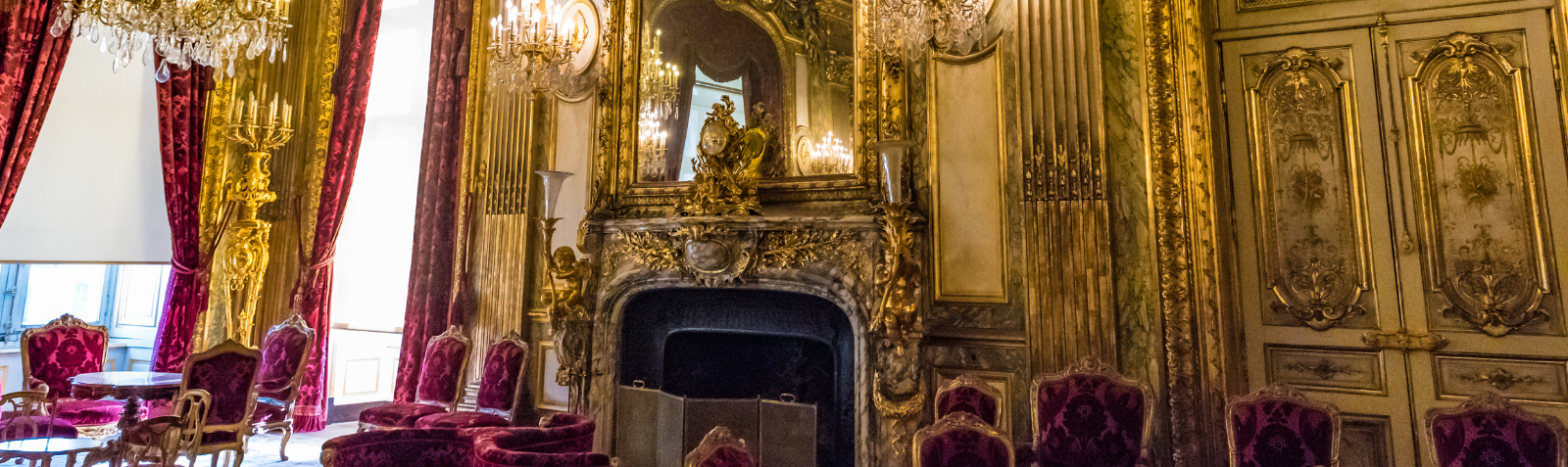
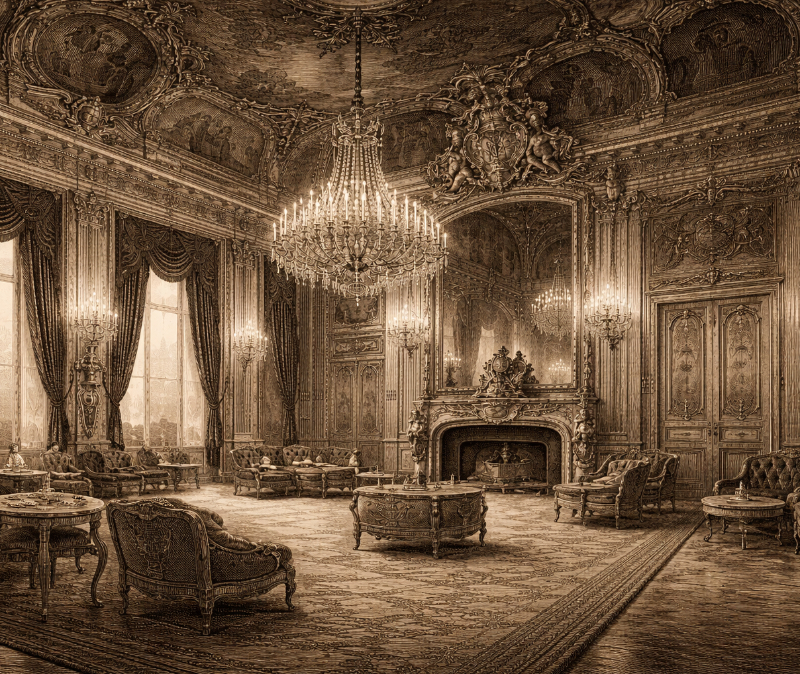
The Apartments of Napoleon III are among the most spectacular interiors open to the public in France. They occupy a suite of official reception rooms in the northern range of the Richelieu wing, decorated between 1856 and 1861 for the Minister of State under Napoleon III.[1][2]
The effect is immediate. Gilded carved ceilings. Crimson and gold silk damask. Savonnerie carpets. Crystal and gilt-bronze chandeliers. Mirrors. Heavy furniture. Every surface participates.
Nothing here tries to be discreet.
And that is exactly the point.
These rooms do not simply show luxury. They show official luxury. A kind of decoration designed to produce authority before anyone has even spoken. The Second Empire understood interiors as political theatre, and these apartments preserve that language almost at full volume.[1][2]
The grand dining room
The sequence reaches its height in the grand dining room. The scale is striking. Around 400 square metres. A vast table. Imperial service. Centrepieces. Chandeliers. Red, gold, reflection, repetition.[2]
But scale alone does not explain the room.
What matters is control. This was not just a place to eat. It was a place to arrange rank, movement, attention, and hierarchy. Guests did not simply enter a dining room. They entered a system of display.
That is why the room works so quickly on the visitor. It does not need much explanation. The message is already built into the materials.
Gold speaks. Mirrors multiply. Fabric softens the space while increasing the sense of ceremony. Furniture becomes part of the performance.
For anyone trying to understand how the nineteenth century transformed ceremony into interior architecture, this room gives the answer almost immediately.
Why the rooms survived
Their survival is part of the story. After the fall of the Second Empire, the Ministry of Finance occupied these interiors from 1871 to 1989. That long administrative use could have erased them. Instead, it helped preserve much of their character.[2]
The rooms opened to the public in 1993, when the Richelieu wing became part of the modern Louvre experience.[2]
They still surprise many visitors.
Perhaps because people come to the Louvre expecting paintings, sculpture, antiquities. Not a complete theatre of nineteenth-century official power.
That is what makes these apartments so important. They remind us that decorative arts are not secondary. They are not just ornament around history. They are history, arranged as space.
| After the Apartments of Napoleon III, the decorative arts stop feeling ornamental. They start feeling historical. |
THE FRENCH CROWN JEWELS IN THE GALERIE D’APOLLON
Here, treasure and architecture compete for attention. Neither quite loses.
The Regent Diamond
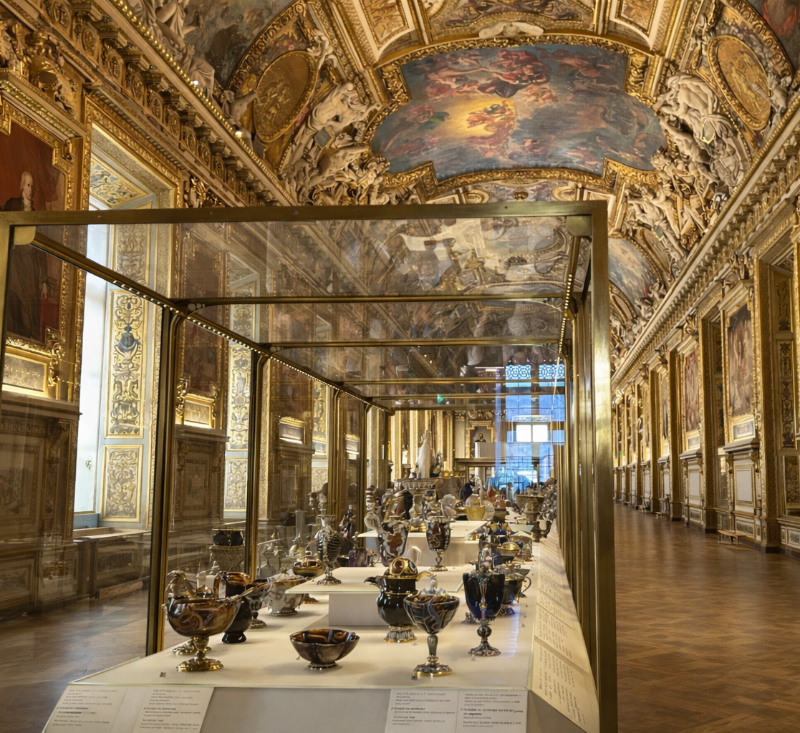
The Galerie d’Apollon houses the surviving French Crown Jewels and the historic gem collections of the French monarchy.[3]
At the centre of that display stands the Regent Diamond.
It is not simply a large diamond. It is a political object. A stone that passed through monarchy, empire, and museum history.
Acquired in 1717, the Regent Diamond weighs 140.64 carats. It is usually admired for its size, but also for the exceptional quality of its cut, colour, and clarity.[3]
Why does it matter so much? Because it concentrates dynastic prestige in a single object.
It appeared in Napoleon’s sword hilt at his coronation in 1804. It was also used in royal crowns associated with Louis XV and Louis XVI.[3]
Few objects in the Louvre make power feel so compressed. One stone. Several regimes. Centuries of symbolic weight.
The gallery itself
But the room is never just a backdrop.
That is the mistake many visitors make. They enter, move toward the cases, look at the jewels, and forget to look up.
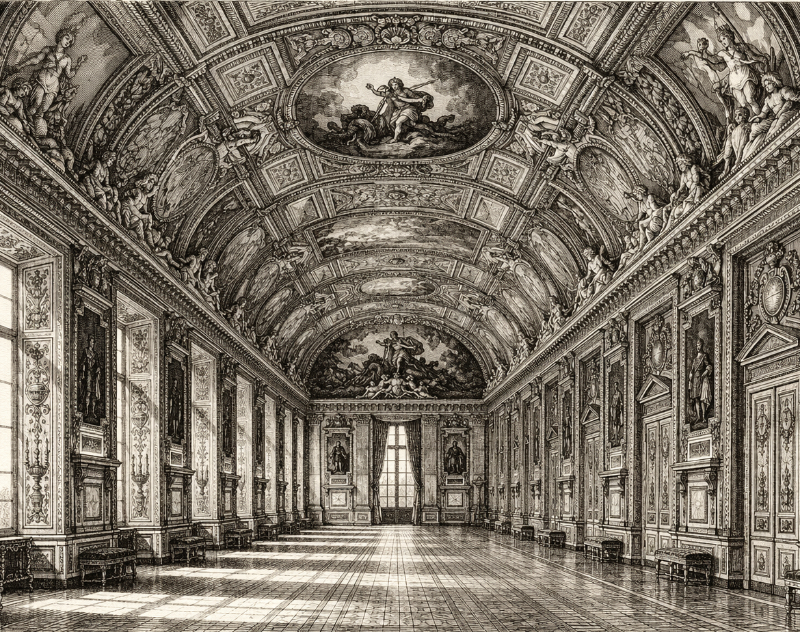
The Galerie d’Apollon is itself one of the great interiors of the Louvre. Approximately 60 metres long, it was designed as a space of royal magnificence, where painting, gilding, sculpture, architecture, and light all work together.[3]
The central ceiling oval was completed by Eugène Delacroix in 1850 and 1851 with Apollo Vanquishing Python.[3]
That detail matters. The gallery is not the product of one single moment. It carries the long memory of royal display, later restored, completed, and transformed into museum space.
The jewels matter. Of course they do.
But the room matters just as much.
How to read the space
The best way to experience the Galerie d’Apollon is not to choose between the jewels and the architecture.
Look at both.
The eye should move between object and ceiling. Between diamond and painting. Between gold, glass, carved decoration, and light.
That movement reveals the real logic of the place. Value is not isolated in the stone. It spreads through the whole setting.
The Regent Diamond shows royal wealth as an object. The gallery shows royal power as an environment.
That is why this room belongs fully to the decorative arts. It is not only a place where treasures are displayed. It is a place where display itself becomes the subject.[1][3]
| In the Galerie d’Apollon, magnificence is not contained in the jewels alone. It is built into the entire room. |
THE ISLAMIC ARTS COLLECTION
This is the part of the department that surprises visitors twice: first through the objects, then through the space around them.
A new gallery below the Cour Visconti
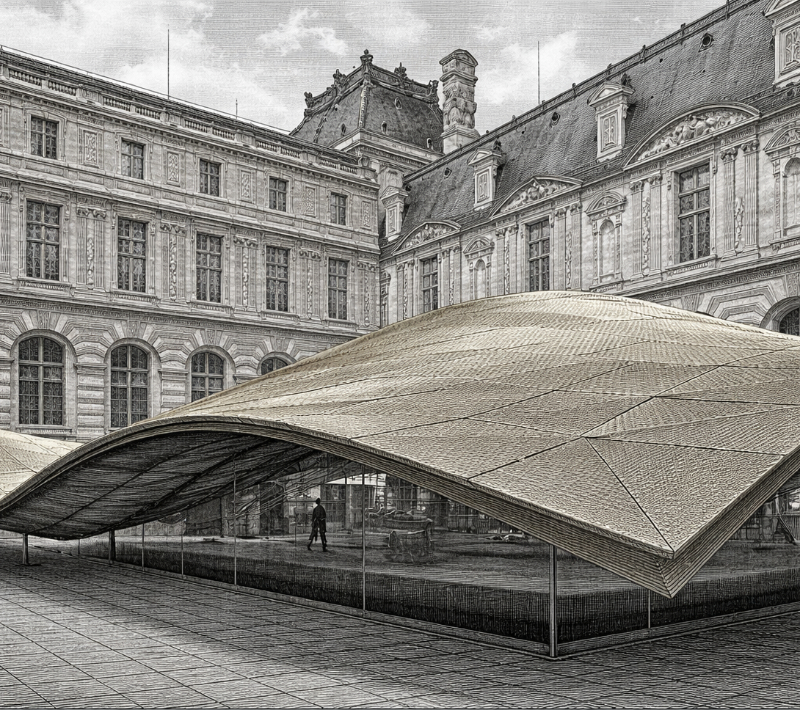
The Islamic Arts collection reopened in 2012 in a purpose-built space beneath the Cour Visconti, in the Richelieu wing.[4]
The setting matters immediately. This is not a traditional gallery. It feels lower, more protected, almost suspended between archaeology and contemporary architecture.
Around 3,000 objects were brought together in the new installation: ceramics, metalwork, textiles, manuscripts, architectural fragments, carved ivories, and glass from a world stretching from Andalusia to Central Asia.[4]
The geographical range is immense. So is the visual range.
This is what makes the section so important. It widens the decorative arts beyond French court culture. It shows another history of luxury, skill, geometry, writing, colour, and surface.
The Ricciotti-Bellini roof
Above the inner courtyard stretches the undulating glass and metal canopy designed by Rudy Ricciotti and Mario Bellini, with Renaud Piérard.[4]
It is often described through its golden, flowing surface. But what matters most is how it changes the visit.
The roof filters daylight. It softens the courtyard. It creates a contemporary space inside the historic palace without trying to imitate it.
That balance is difficult. Too much contrast, and the architecture would overwhelm the collection. Too much discretion, and the new space would disappear.
Here, the exchange works. Visitors often arrive for the collection and remember the roof. Just as often, they arrive for the roof and stay for the objects.
Why this section matters
The importance of these rooms lies in more than novelty.
They show how the Louvre can present decorative arts across civilisations without reducing them to a single idea of ornament.
A ceramic bowl, a carved ivory box, a metal basin, a textile, a manuscript page: each object carries technique, belief, trade, taste, and movement.[4]
That is why the Islamic Arts galleries feel both distinct and fully integrated. They belong to another visual world, but they also deepen the Louvre’s larger story of materials, power, and display.
At the time of writing, the Louvre’s Cour Visconti page is marked “currently closed.” For planning a visit, it is therefore best to check the museum’s official schedule of open rooms before going.[4]
| By this point, the decorative arts no longer look like a side route. They become one of the clearest ways to understand what the Louvre really contains. |
A good visit to the decorative arts depends less on speed than on order. Once the sequence is right, the department becomes far easier to read.
Start with Napoleon III
Go first to the apartments of Napoleon III in the Richelieu wing. They are directly accessible from the Richelieu corridor in the Hall Napoléon and are usually at their quietest in the first hour after opening. Give the suite at least 30 to 45 minutes if you want the rooms to register as more than visual shock.
Starting here sets the tone for the rest of the department.
Look up in the Galerie d’Apollon
When you reach the Galerie d’Apollon, give the ceiling as much time as the jewel cases. Most visitors do the opposite. Delacroix’s ceiling is easiest to read from approximately the centre of the gallery, where the whole room begins to hold together.
The jewels reward attention. The room rewards patience.
Do not skip the Islamic Arts galleries
Even visitors with no prior interest in Islamic material culture should enter the galleries beneath the Cour Visconti. The Ricciotti-Bellini roof alone justifies the detour. In practice, however, the architecture almost always leads visitors back to the objects.
This is one of the best examples in the Louvre of a contemporary intervention that actually improves the reading of a collection.
Give medieval material real time
Finally, allow at least 30 minutes for the medieval applied arts rooms on the first floor of the Richelieu wing if enamels, goldsmiths’ work, or Gothic ivories interest you at all. These rooms are consistently under-attended relative to the quality of what they contain, and that often makes them among the most rewarding.
Quiet rooms are sometimes where the Louvre becomes most generous.
| The decorative arts do not ask for less attention than the museum’s famous departments. They simply reward a different kind of looking. |
Author’s note: This text was written with the intention of sharing and transmitting knowledge, not as an academic work. Its author is not a historian. Some details or interpretations may not reflect current historiographical consensus. For a rigorous approach, please refer to the sources listed at the end of this document
[1] Daniel Alcouffe, Les objets d’art du musée du Louvre, Paris, Musée du Louvre / Réunion des musées nationaux.
[2] Daniel Alcouffe, Anne Dion-Tenenbaum and Amaury Lefébure, Le mobilier du musée du Louvre, Paris, Musée du Louvre / Réunion des musées nationaux.
[3] Musée du Louvre, La Galerie d’Apollon, Paris, Musée du Louvre Éditions.
[4] Sophie Makariou, Les arts de l’Islam au musée du Louvre, Paris, Musée du Louvre Éditions.
[5] Musée du Louvre, Le département des Arts de l’Islam, Paris, Musée du Louvre Éditions.
OUR BEST TOURS