
Please note that the reflections, observations, and cultural insights shared here are drawn from lived experience and long-term familiarity with Paris. They are not intended to define every Parisian, nor to apply to every situation. This perspective is offered as a guide for curious travelers, not as a rulebook, and aims to encourage understanding rather than generalization.
Parisian Style
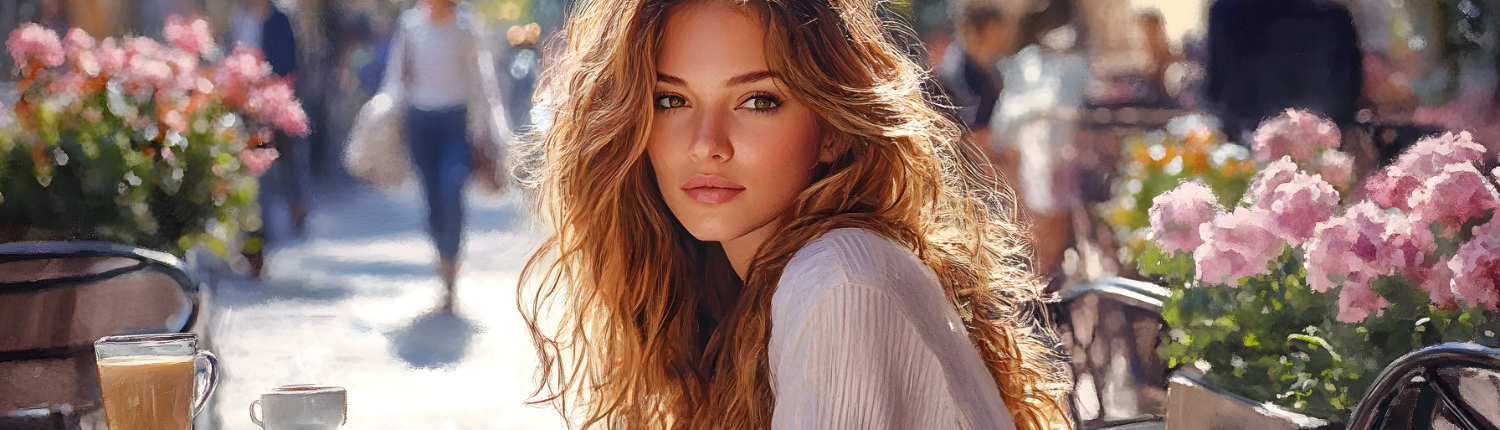
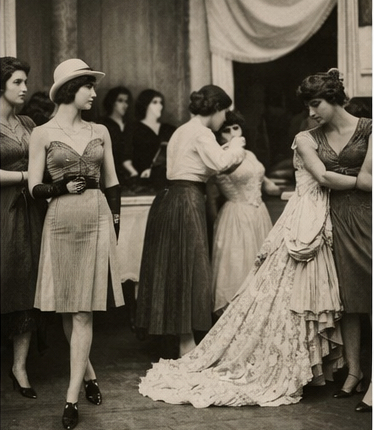
To understand Parisian style, one must return to the history of dress, because Paris did not merely follow fashion; it shaped it. From the nineteenth century onward, the capital became a laboratory where new silhouettes and new relationships to the body were invented. What was at stake was not appearance alone, but freedom of movement.
It was in Paris that skirts began to shorten, cautiously at first and then more decisively. This shortening was not conceived as provocation, but as an adaptation to modern life. It accompanied women who walked, worked, circulated, and lived within the city. It was also in Paris that the dress gradually ceased to function as a rigid social armor and became a garment designed for a real body. Parisian fashion moved away from fixed costume and toward the idea of style as something more mobile, more personal, and more everyday.
At the turn of the twentieth century, Paul Poiret played a decisive role by freeing women from the corset and introducing softer lines. He proposed higher waists, new volumes, and a radical vision: clothing should accompany the person, not constrain them. Poiret did not merely change the dress; he changed the way elegance itself was conceived. In his wake, other designers continued this quiet revolution. Madeleine Vionnet developed the bias cut, Gabrielle Chanel introduced a functional elegance, and later Yves Saint Laurent gave women access to codes of power through clothing. At every period, Paris did not seek spectacle. It sought what felt obvious, durable, and integrated into life.
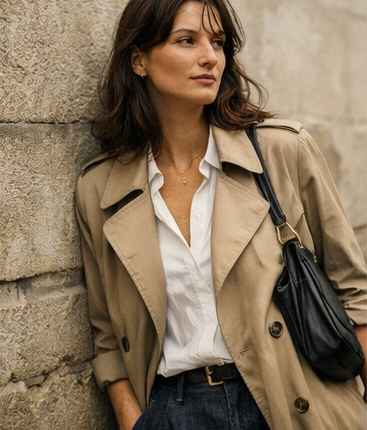
Parisian elegance rests on three fundamental values: restraint, measure, and harmony. It is not a demonstrative style, but a silent language. It draws more inspiration from literature, painting, and cinema than from runways or fleeting trends. The Parisian does not dress to be watched, but to feel right. Right within the city, right in the moment, right with oneself.
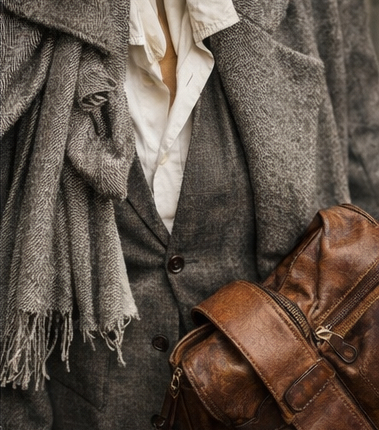
Clothing is there to accompany an attitude, never to dominate it. This is why discreet details are preferred to anything flashy. A scarf in a fine material, an impeccable cut, an accessory chosen without ostentation all matter. Here, the person always comes before the garment. One does not wear fashion; one inhabits it. Style is not an accumulation of pieces, but a coherent whole, sometimes almost invisible.
Behind an outfit that appears natural, there is often precise thought. The right coat for the season, the correct length of trousers, the exact shade of denim, the shirt opened at the right button all count. Nothing is there to impress, but everything is there to last. This simplicity is often misunderstood by visitors because it does not immediately attract attention. Yet it is precisely this discretion that gives Parisian style its strength.
In Paris, style begins even before one opens a wardrobe. It can be read in the way people walk, hold their bag, sit at a café without spreading out, and move through space without visual noise. A simple outfit can appear elegant if it is worn with ease and naturalness. Conversely, a highly constructed outfit can seem awkward if it forces presence.
Parisians rarely dress for a single occasion, because the city requires continuity in daily life. A well-cut coat is worn to work, to dinner, on walks, sometimes for many years. Clothes that have lived tell a story. Worn shoes, softened leather, and coats whose cut remains right over time express stability and continuity.
There is also a Parisian signature of controlled imperfection. A slightly wrinkled shirt, an open collar, a scarf tied asymmetrically, or a jacket worn open even in cool weather give life to a silhouette. Something too perfect can feel overly calculated and therefore paradoxically less elegant. In the same spirit, brands rarely speak loudly. Visible logos and oversized slogans attract attention but often disrupt coherence. Parisian luxury is perceived rather than announced, through drape, fabric, and cut.
Finally, the Parisian color palette is restrained because the city itself is restrained. Stone, zinc, pavement, and muted greenery dominate. A bright color exists, but usually as a single accent, never as a shout. All of this forms a style that breathes, leaves space, and requires no explanation.
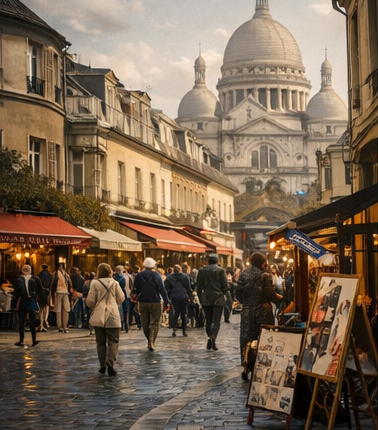
Paris is not a uniform block, and neither is its style. There are variations of neighborhoods, social environments, ages, and rhythms of life, and therefore of silhouettes. In the Marais, one sees more creativity and subtle mixing. In the seventh or sixteenth arrondissement, style is often more classic, discreet, and institutionally composed. In the northeast, the city feels rougher, freer, sometimes more experimental and sometimes more functional.
In Montmartre, one encounters more artistic silhouettes, but rarely theatrical ones. In Saint Germain des Prés, there is an intellectual classicism with carefully chosen details. Despite these differences, one rule remains constant: never overplay. Style responds to place; it is never a performance.
This logic is tied to a deeply Parisian sense of respect. In public transport, cafés, and museums, space and rhythm are shared. Clothing should not invade or impose an overly strong message. Elegance is also the ability to coexist. Style becomes a form of silent politeness, a visual savoir vivre. This collective dimension often escapes visitors because it is not explained; it is practiced.
This is not about judging or ranking cultures, but about explaining a misalignment. In many countries, dressing in a colorful or exuberant way is a joyful expression of personality. Clothing becomes a celebration of self, a sign of energy, and sometimes a way of communicating without words.
In Paris, personal expression takes different paths. It is more indirect and subdued. It passes through posture, intonation, the way one walks, a discreet fragrance, the quality of a fabric, or the drape of a coat. These signs are subtle and sometimes imperceptible to an outside eye, but very readable to those who live in the city.
In this context, a very conspicuous outfit can create an involuntary discomfort. Not because it is ugly, but because it seems to break the atmosphere. It may be perceived, rightly or wrongly, as an attempt to be seen rather than simply to be present. Paris values a quiet confidence that does not shout or demand attention. The city is dense and visually rich through its architecture and perspectives. When an outfit takes up too much space, it does not complement the setting; it disrupts it. This is not a matter of snobbery, but of rhythm and harmony. Understanding this mechanism already prevents many misunderstandings.
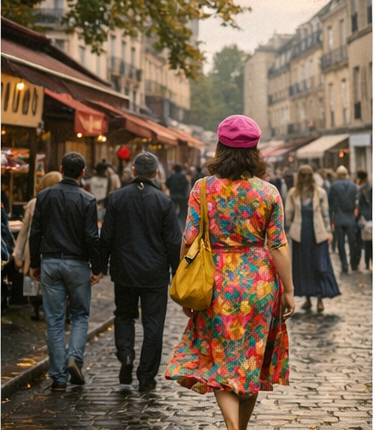
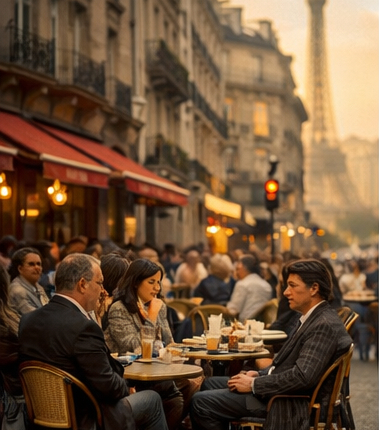
One point many visitors underestimate is that in Paris, clothing is adapted to place, time, and occasion. One almost never dresses outside of context, even unconsciously. This is not a constraint, but a form of politeness toward oneself and toward others.
An outfit that seems charming on a beach or in a resort town can feel incongruous in a restaurant in the seventh arrondissement. An outfit perfect for a picnic by the canal may not be appropriate for a museum, a church, or an institutional setting. Parisians read the city like a stage. Morning light, winter cold, rain, or humid heat all influence choices.
A jacket is adjusted, shoes are changed, layers are added or removed, colors are softened or darkened. Style is built through these micro adjustments that appear natural. An outfit that ignores the weather quickly feels disconnected, even if it is attractive. In the same way, overly sporty clothing worn outside of a sporting context draws attention, not because it is forbidden, but because it does not dialogue with the place. In Paris, one does not try to make an impression; one tries to be right. A successful outfit accompanies the scene rather than stealing it. This ability to listen to a place before appearing in it defines Parisian elegance.
Every day in Paris, one encounters enthusiastic visitors drawn by the enduring aura of the fashion capital. Their intention is almost always sincere. They want to live up to the city, to understand its codes, and sometimes even to blend into it. Many arrive with the idea that Paris is a setting to be fully inhabited, including through clothing. This intention is usually admiring rather than mocking.
Yet admiration can turn into cultural misunderstanding. In trying too hard, some do too much. Accessories accumulate, references multiply, styles are mixed as if something needed to be proven. Clothing becomes a strong message, sometimes even a statement, while Paris operates on a much quieter register. Here, style never seeks to shine; it seeks to breathe.
Paris is a city of nuance. Light stone façades, zinc rooftops, grey pavements, muted gardens, and restrained shop windows create a continuous visual harmony. Even in lively neighborhoods, the palette remains measured. When an outfit introduces fluorescent colors, violent contrasts, excessive volumes, or visible slogans, the contrast is immediate. This is not a matter of personal taste, but of visual rhythm. Like a note played too loudly in a soft melody, the outfit disrupts the balance.
This is where the most common mistakes arise. Oversized bags that take up space, ultra athletic shoes worn all day outside any sporting context, outfits designed for another city or another climate. Technical garments, oversized logos, and humorous or provocative messages draw the eye in a way that feels unusual in Paris. Here, one does not speak through clothing. Clothing accompanies presence.
Avoiding these missteps requires neither a large budget nor deep fashion knowledge. It mainly requires observation. Watching Parisians in the street, at cafés, on public transport, and in museums reveals recurring patterns. Colors are restrained, silhouettes are balanced, accessories are few but carefully chosen. Nothing is spectacular, but everything is coherent.
The solutions are simple. Prioritize quality over quantity. Choose clothes adapted to the season and weather. Think of an outfit as a whole rather than an accumulation. Accept removing an element instead of adding one. In Paris, subtracting is often more elegant than adding.
At the center of all this lies simplicity, but a demanding and thoughtful simplicity, never a naive one. Simplicity is the hardest thing, because it requires renouncing immediate effect. It requires trusting presence rather than appearance. It requires understanding the codes in order to lighten them.
It must also be said that bad taste exists in Paris. Being Parisian does not guarantee permanent elegance. One sees overloaded outfits, proportion mistakes, and poorly digested trends. But extremes remain rare. One almost never sees fully fluorescent silhouettes, ultra sporty outfits worn everywhere, or deliberately excessive accessories in daily life. Not because they are forbidden, but because they break the dialogue with the city too strongly.
Bad taste in Paris therefore rarely takes extreme forms. It is more often a clumsiness than a provocation, and it is corrected over time through observation, through the gaze of others, and through the diffuse awareness that in this city, clothing is part of something larger than oneself.
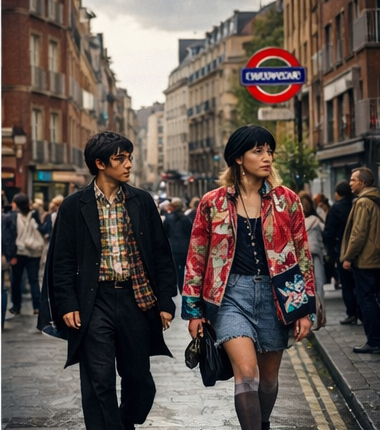
Everything becomes even clearer when looking elsewhere. In London, eccentricity is integrated into urban culture. In Berlin, clothing can be political or radically free. In Milan, style is more demonstrative, more constructed, sometimes more spectacular. Paris stands elsewhere. It prefers continuity over rupture, nuance over contrast, and suggestion over affirmation.
Understanding this does not mean renouncing one’s personality. It means accepting dialogue with a city that speaks softly. Paris does not ask to be copied. It asks to be listened to. And it is often at that moment, when one stops trying too hard, that one truly begins to understand its style.
References :
For readers wishing to explore further, the following works offer valuable insight into the cultural foundations of Parisian style.
Daniel Roche, The Culture of Clothing
Roland Barthes, The Fashion System
Georges Vigarello, A History of Beauty
Valerie Steele, Paris Fashion A Cultural History
Musée Galliera, Palais de la Mode de Paris
Texte : GV Paris Webservices – Photos : Adobe stock and AI-generated images
RECOMMENDED BY