HISTORY OF THE EIFFEL TOWER
From Universal Exposition Project to Global Monument

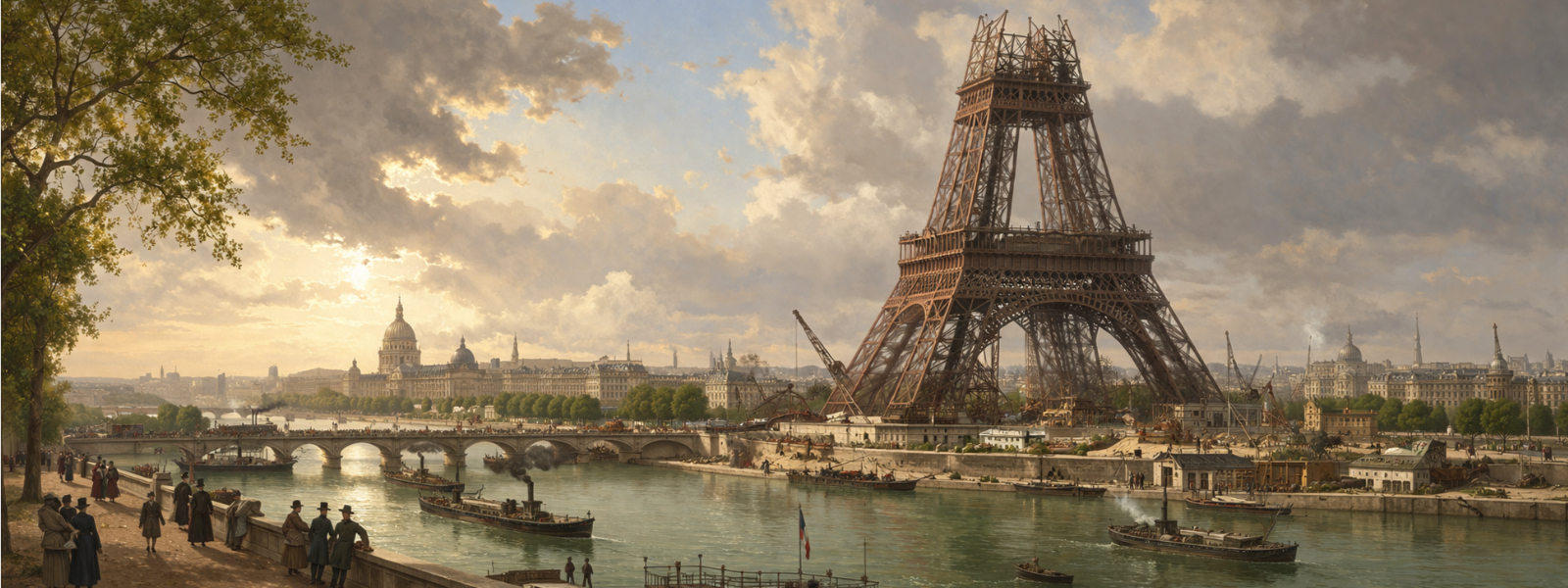
From Universal Exposition Project to Global Monument
Before climbing the Eiffel Tower and feeling Paris open beneath your feet, it helps to understand what you are actually standing on.
The Tower carries behind it more than a century of history. A story that began in the workshop of a Franco-Swiss engineer hunched over a sketch at his kitchen table, that survived a furious campaign of intellectual opposition, that narrowly escaped demolition, and that today draws more than seven million paying visitors a year making it the most visited paid monument on earth.
So how did a temporary iron structure, designed for a single world’s fair, become the most recognised building in the world?
Before there is a tower, there is a need.
In the early 1880s, France is preparing the Exposition Universelle of 1889. The event is meant to celebrate the centenary of the French Revolution and to present the Third Republic as modern, industrial, and powerful. It needs a monument strong enough to define the fair.
The idea of a very tall tower is already circulating. A similar 300-metre project had been considered for the 1876 Philadelphia Exposition, but it was never built. Paris now has the chance to succeed where America did not.
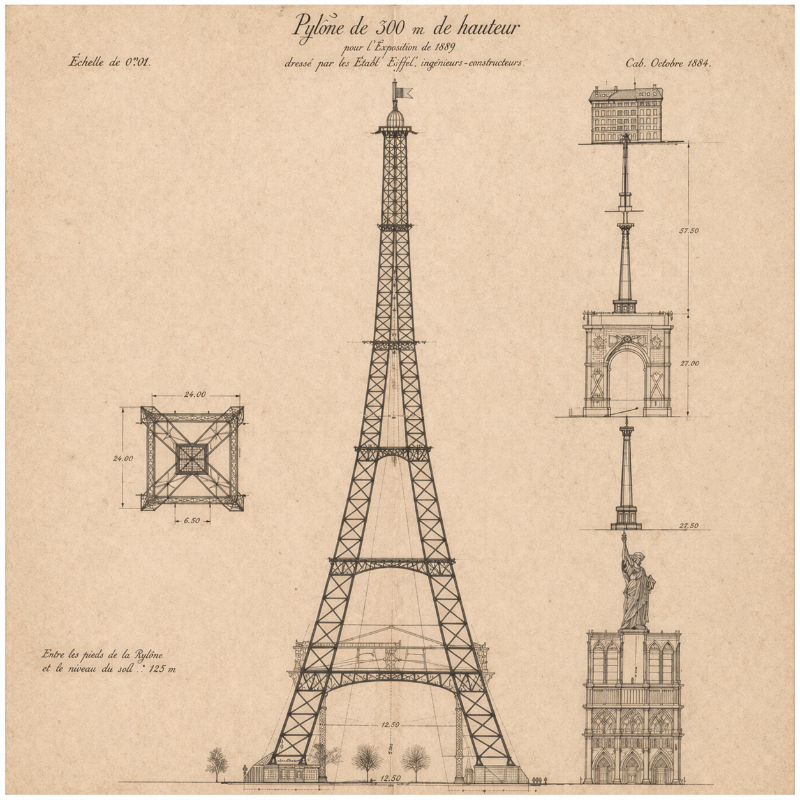
The first real sketch of the Tower is drawn on 6 June 1884 by Maurice Koechlin, chief engineer in Eiffel’s company.
Born in 1856 in Alsace, trained at the Polytechnikum in Zurich under Karl Culmann, Koechlin had already worked on the Garabit Viaduct and on the internal iron framework of the Statue of Liberty.
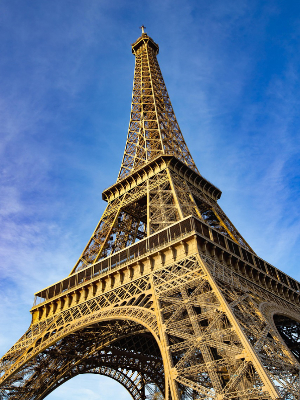
In his Paris apartment, he sketches a 300-metre metal tower. The essential idea is already there: four curved lattice piers, wide at the base, narrowing upward, linked by horizontal levels. The form is not ornamental. It is a structural response to weight and wind.
Koechlin is not alone. The concept is supported by Émile Nouguier, another senior engineer in Eiffel’s firm, born in 1840 and trained at the École Polytechnique and the École des Mines. He will later supervise the assembly of the Tower on site.
At first, Gustave Eiffel finds the design too bare. To refine it, Koechlin and Nouguier turn to architect Stephen Sauvestre, born in 1847, who adds the great arches at the base, glazed pavilions on the platforms, and a more finished summit. He also chooses the Tower’s colour.
The revised design is presented in September 1884. This time, Eiffel is convinced.
A patent is filed under the names of Eiffel, Koechlin, and Nouguier. Eiffel later buys the rights from his two engineers and registers the patent in his own name.
By the end of 1884, the idea is no longer just a sketch. The structure, the appearance, and the ownership are all in place. What remains is to secure official approval and begin construction.
The road from sketch to commission is not direct. It runs through politics.
Édouard Lockroy and the competition
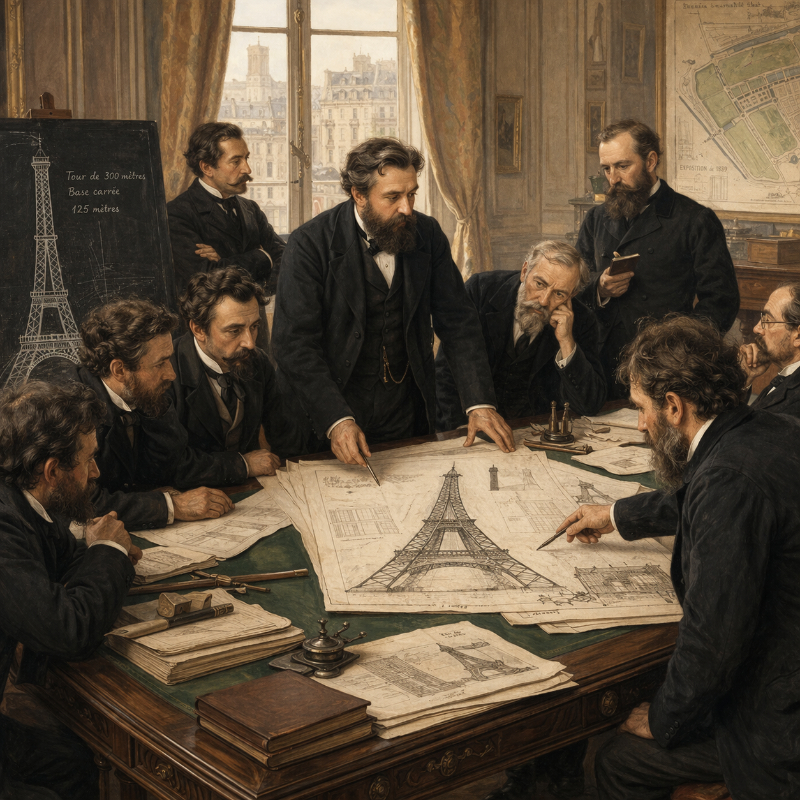
The decisive figure is Édouard Lockroy, appointed Minister of Trade and Industry in 1886. A former journalist, playwright’s son, and convinced republican, Lockroy has been won over to Eiffel’s project in a series of private discussions. On 1 May 1886, he launches a public competition for the 1889 Exposition centrepiece. The terms of the competition are formulated with notable precision: candidates must «study the possibility of erecting an iron tower on the Champ-de-Mars with a square base, 125 metres across and 300 metres tall». The terms effectively describe Eiffel’s project and no other. Of 107 proposals submitted, the examining committee, meeting on 12 May, finds only one both technically rigorous and aesthetically credible. The contract is signed on 8 January 1887.
What the commission establishes is also this: the Tower is to be temporary. It is to stand for twenty years and then be demolished. Nothing in the agreement suggests that what is being built is a permanent monument. The question of permanence will be settled later, by circumstances no one yet foresees.
The rival: Jules Bourdais
Eiffel does not win the competition unopposed. His most serious rival is Jules Bourdais, the architect who had designed the Palais du Trocadéro with Gabriel Davioud for the 1878 Exposition the monument that still occupied the heights opposite the Champ-de-Mars. Bourdais initially proposes a 300-metre tower in granite and porphyry, crowned with a powerful searchlight beacon, which he calls the Sun Tower. When the competition terms require metal, he pivots, replacing stone with iron. His project is eliminated by the committee on the grounds of insufficient technical detail. The victory is clear: iron wins over stone, calculation wins over tradition.
A commission is not yet a tower. The work still had to be done in one of the most audacious feats of industrial construction the world had ever attempted.
Ground is broken on 28 January 1887. What follows is two years, two months, and five days of continuous work a precision operation of unprecedented scale.
The preparation
All 18,038 individual iron components are fabricated off-site at Eiffel’s workshops in Levallois-Perret, north of Paris. Each piece is pre-drilled, numbered, and assigned to a specific position in the assembly sequence before a single component reaches the Champ-de-Mars. Koechlin supervises the production of 5,300 engineering drawings. Every joint, every rivet hole, every angle is calculated in advance. What is assembled on site is less a construction than a very large, very precise puzzle.
On site, the four base piers are built simultaneously, each inclined inward at a carefully calculated angle so that they will converge exactly at the level of the first platform. Hydraulic jacks under each pier shoe allow millimetre-level corrections during assembly. At peak production, the teams complete a new level of the structure every two to three weeks.
The workforce
The construction employs up to 250 workers on site simultaneously and around 300 in the Levallois workshop. Teams of four workers handle the rivets: one heats them in a portable forge at altitude, one catches them with tongs, one positions them, one hammers them home. Of the 2.5 million rivets used in the Tower, approximately 700,000 are driven cold in situ, at height, without scaffolding beneath. The remainder are pre-assembled in the workshop.
One worker dies during construction. He falls from the structure on a weekend visit with his fiancée, outside normal working hours. The absence of further fatalities across a 26-month project involving hundreds of workers at extreme heights was considered remarkable at the time and remains so by modern standards.
The completion
The Tower is topped out on 31 March 1889. Eiffel personally leads a party of officials and journalists to the summit on foot the lifts are not yet operational and plants the French tricolour at the top. Among those who make the ascent is Émile Nouguier, the engineer who had supervised the assembly from below.
The Tower opens to the public on 15 May 1889, the same day as the Exposition Universelle. By the time the fair closes on 6 November, two million visitors have ascended it. Among them, in September, is Thomas Edison, who visits Eiffel in his private apartment at the summit and signs the guestbook. The construction has cost 7.4 million francs and the entrance fees collected during the fair alone amount to 6.5 million. It is, by any standard, an extraordinary commercial and engineering success.
The Tower existed. But from the day it opened, it faced a campaign that had begun two years earlier and that would follow it for decades: the question of whether it deserved to exist at all.
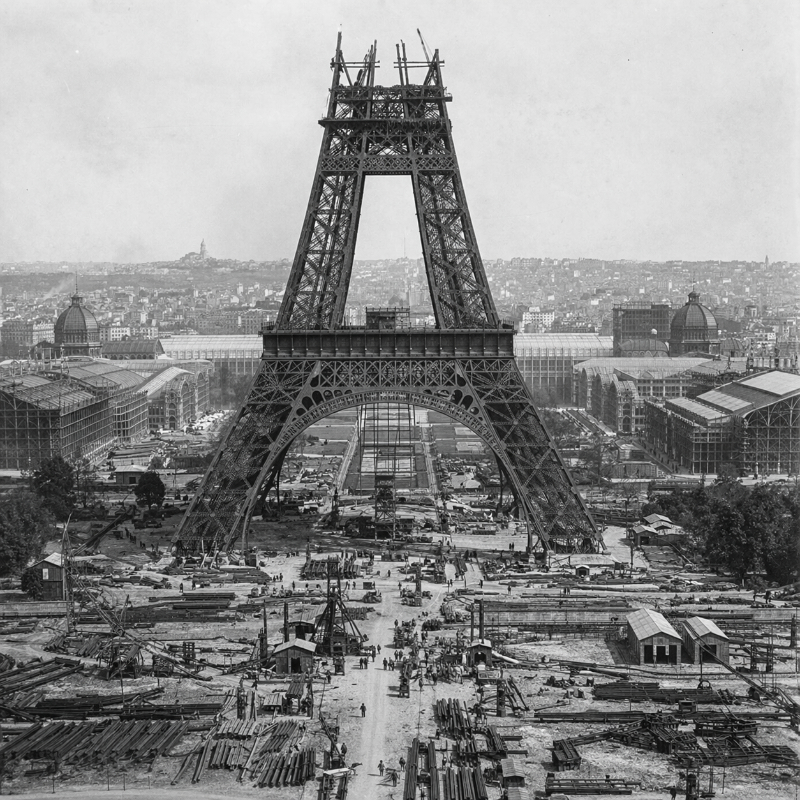
Few buildings in modern history have provoked such immediate and organised hostility from the cultural establishment of their own city.
The Protest of the Artists
On 14 February 1887, before the foundations are even complete, a petition titled «Protestation des artistes contre la tour de M. Eiffel» is published in the newspaper Le Temps. It is addressed to Adolphe Alphand, the commissioner of the Exposition. Signed by Charles Garnier architect of the Paris Opéra the novelist Guy de Maupassant, Alexandre Dumas fils, the composer Charles Gounod, and more than two hundred other figures of French cultural life, the petition attacks the projected structure as a «gigantic black factory chimney», a «hateful column of bolted sheet metal», and predicts that it will «spread its barbaric bulk» over Paris and permanently dishonour the city. The language is not measured. It is intended to wound.
What the petition does not say is that Charles Garnier himself had been a member of the examining committee that had approved Eiffel’s project, and had raised no objection at the time.
Eiffel’s response
Eiffel replies in the same newspaper on the same day. His response is measured and technically precise. He argues that the curves of the Tower’s piers are not arbitrary decoration but the direct expression of structural necessity the optimal form for resisting both vertical load and horizontal wind pressure. He predicts that this structural logic will produce its own form of beauty. The argument anticipates by several decades the central aesthetic principle of architectural modernism: that structural honesty is itself a form of beauty.
Lockroy’s response to the petitioners is more sardonic. He writes to Alphand that «judging by the stately swell of the rhythms and the beauty of the metaphors, one can tell this protest is the result of collaboration of the most famous writers and poets of our time», and notes that the project had been approved months before and construction was already underway. The protest, he concludes, is irrelevant.
Maupassant, for his part, later claimed to lunch regularly at the Tower’s first-floor restaurant on the grounds that it was the only place in Paris from which the Tower itself was not visible.
The conversion
By the time the Tower opens in May 1889, the opposition is already beginning to dissolve. Two years after signing the petition, the poet Sully Prudhomme delivers a public speech in favour of the Tower. Georges Seurat paints it before construction is even finished. Jean Béraud places it in the background of his painting of the Exposition’s opening. The building that had been called a catastrophe is rapidly becoming a symbol.
What had changed was not the Tower. What had changed was the city’s relationship to it.
The opposition had failed. But the Tower’s survival was still not guaranteed. Twenty years after its construction, it faced the demolition that had always been planned.
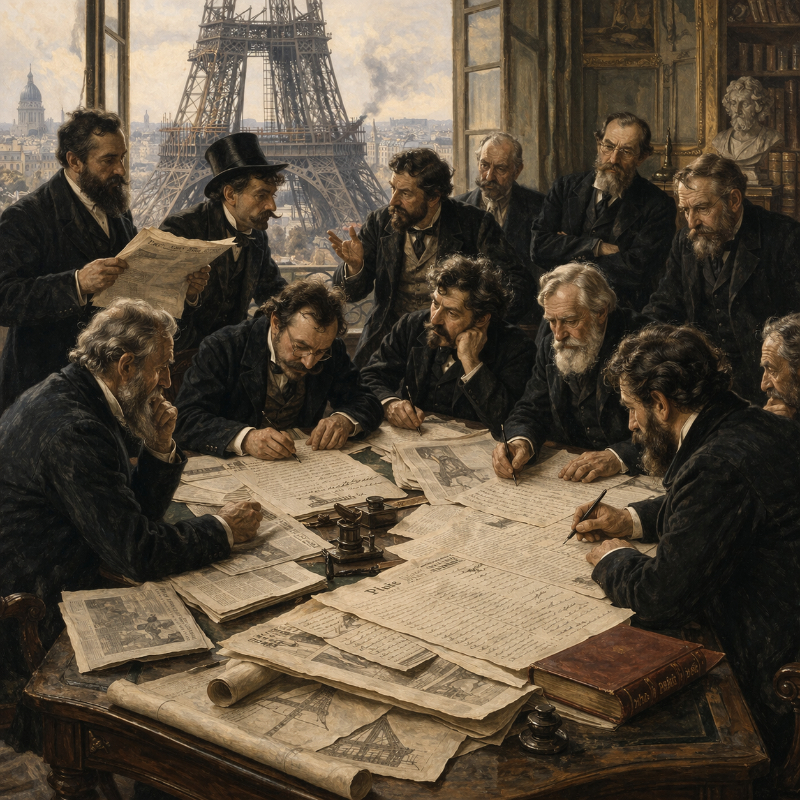
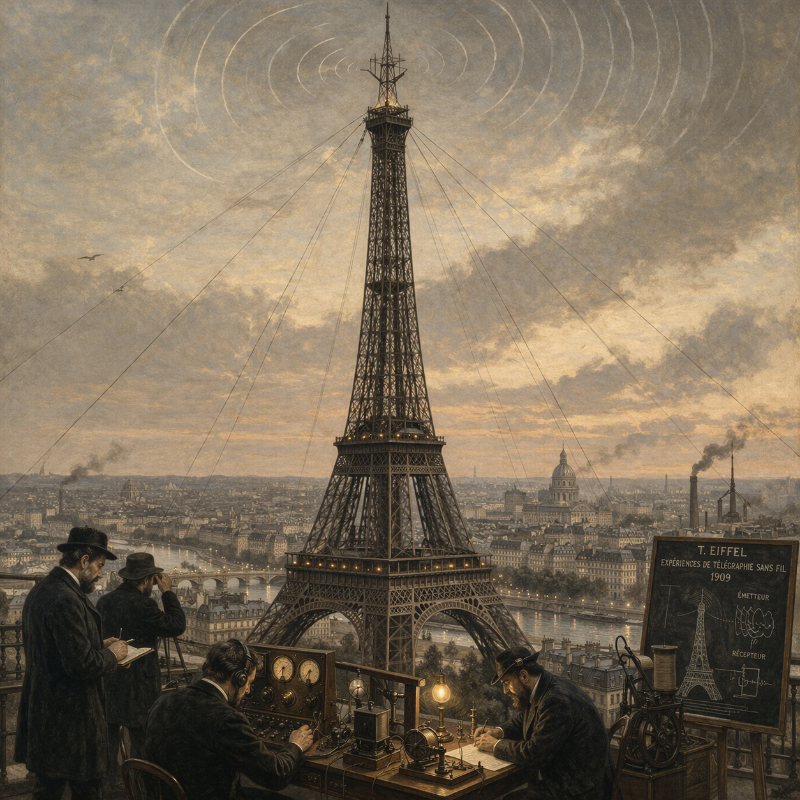
The Tower was built to last twenty years. Its demolition was not a threat it was a contractual obligation.
The scheduled end
The contract of 8 January 1887 stipulates that the Tower will be dismantled twenty years after the close of the Exposition Universelle that is, in 1909. Eiffel’s operating licence expires at that date. The iron, worth a considerable sum, will be sold. The Champ-de-Mars will be returned to its previous condition.
Had this plan been executed, the Tower would have stood for twenty years and been forgotten. What saves it is not sentiment. It is physics.
The radio mast
From 1898 onward, the physicist Eugène Ducretet uses the Tower for early wireless telegraphy experiments, transmitting signals across Paris and then across the country. By 1903, a permanent military radio antenna has been installed at the summit. By 1908, the Tower is transmitting time signals across the continent and intercepting foreign communications. It has become indispensable military and civilian infrastructure.
When Eiffel’s concession formally expires in 1909, the government is confronted with a simple calculation: demolishing the Tower would mean destroying the most effective radio antenna in Europe. The demolition order is cancelled. The Tower is declared a permanent installation of the French state.
During the First World War, this decision proves its worth. The Tower’s radio equipment intercepts German military communications throughout the conflict and plays a documented role in several Allied operations, most notably during the Battle of the Marne in 1914.
Eiffel’s scientific legacy
Eiffel negotiates a 20-year extension of his operating licence in 1909 and continues using the Tower’s summit for aerodynamic and meteorological research until his death in 1923, at the age of ninety-one. In his later years, he constructs a wind tunnel at the base of the Tower one of the first in France and conducts experiments on aircraft design that contribute to the early development of aviation. The summit apartment, still visible today as a reconstruction, is where he received Thomas Edison in 1889 and where he continued working until the end of his life.
Saved from demolition, the Tower enters the twentieth century as a permanent fixture of Paris. What follows is the long story of a monument that continues to change in function, in appearance, and in meaning without ever ceasing to be itself.
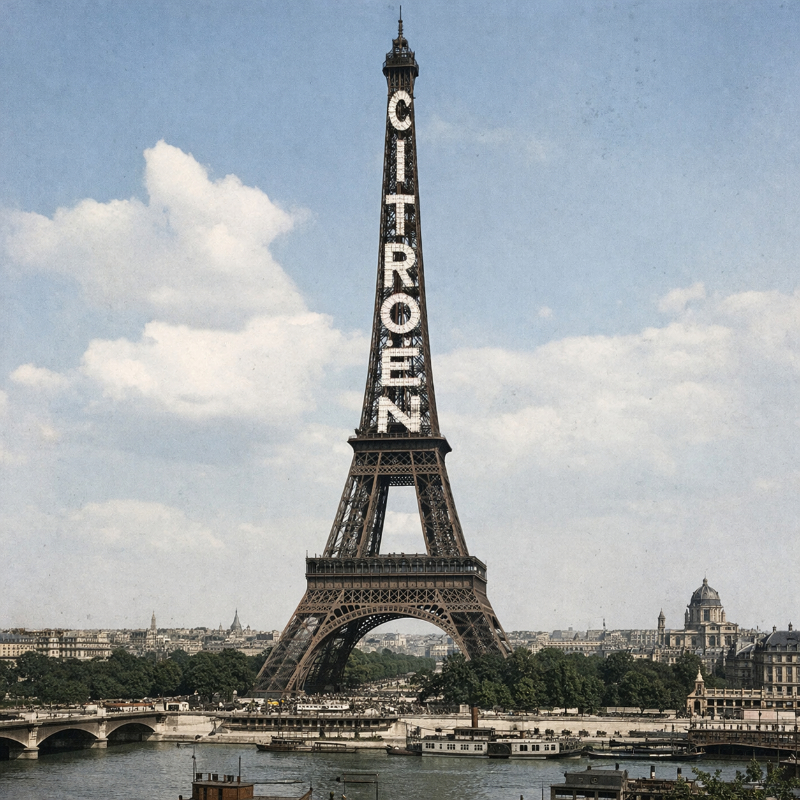
1925: Citroën and the first light show
In 1925, the industrialist André Citroën mounts a publicity illumination of 250,000 coloured light bulbs across the entire face of the Tower, visible from forty kilometres. It is the largest advertising installation in history at that date, and the first time the Tower is deliberately used as a surface for light. The Citroën name blazes from the structure for seven years, until 1934. The relationship between the Tower and illumination which will define its visual identity through the twentieth century and into the twenty-first begins here, with a car manufacturer’s ambition.
1930: the end of a record
For forty-one years, from its completion in 1889 until 1930, the Eiffel Tower is the tallest man-made structure in the world. In April 1930, the Chrysler Building in New York City surpasses it at 319 metres. The Tower, at its original height of 300 metres later 312 metres with its antenna is no longer first. The record passes permanently out of French hands. The Tower does not need it.
1939–1945: the Tower in wartime
When the German army enters Paris on 14 June 1940, the Tower’s lifts are sabotaged on French orders. Hitler, who visits Paris on 23 June 1940 in one of history’s most photographed mornings, does not ascend the Tower. If he wants to reach the summit, his staff are told, he will have to climb. He does not climb. A French tricolour is hung from the summit by resistance workers for as long as the occupation continues.
The Tower’s radio equipment, which had been so decisive in 1914, remains operational throughout the occupation. After the liberation of Paris in August 1944, the French flag is raised at the summit on 25 August the same day that General de Gaulle enters the city.
1985: the current lighting system
In 1985, the lighting artist Pierre Bideau redesigns the Tower’s illumination around a system of amber floodlights powered by 336 projectors, replacing the earlier sodium lighting. The warm golden glow that now defines the Tower’s night-time appearance dates from this installation. Since 2003, the lighting design is protected by French copyright, which is why photographing the Tower illuminated at night and publishing those images commercially requires authorisation from the Société d’exploitation de la Tour Eiffel.
2000: the sparkling lights
For the millennium celebrations on 31 December 1999, 20,000 gold-coloured flashbulbs are installed across the Tower’s structure. The ten-minute sparkling display at the top of every hour, originally designed as a one-night event, proves so popular that it is made permanent from 1 January 2000. It now takes place every hour on the hour from dusk until one o’clock in the morning.
The Tower had survived demolition, two world wars, and a century of changing tastes. In the twenty-first century, it continues to transform not in structure, but in the way it is experienced
The renovation of 2014
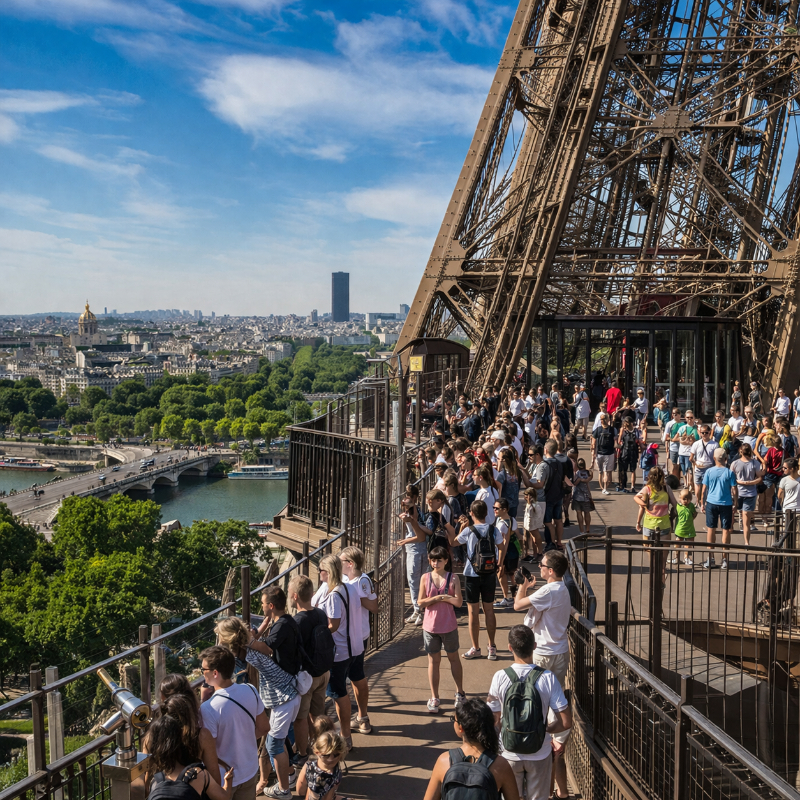
In 2014, following a renovation costing 28 million euros, the first floor is entirely rebuilt. The most dramatic addition is a glass floor installed at 57 metres, allowing visitors to look directly down to the Champ-de-Mars beneath their feet. The CinEiffel immersive experience a projection room covering the Tower’s history is added at the Ferrié Pavilion, included in the standard ticket. The first-floor restaurants are reorganised; Madame Brasserie opens in 2022 under chef Thierry Marx, and Le Jules Verne on the second floor, which has operated as a gastronomic restaurant since 1983, receives its second Michelin star in 2024 under chef Frédéric Anton.
Figures
Today, the Tower stands at 330 metres including its current antenna a figure that has changed several times since 1889 as transmission equipment was added and modified. It weighs 10,100 tonnes. It is repainted entirely in its characteristic brown every seven years, a task requiring sixty tonnes of paint and the work of twenty-five painters using brushes rather than spray guns, in order to control the application on the complex lattice structure. The current colour officially called «brun Tour Eiffel» is slightly different on each level, darker at the base and lighter at the top, to compensate for the effects of atmospheric perspective.
More than 7 million paying visitors ascend the Tower each year. Over 300 million people have visited it since 1889. It is the most visited paid monument on earth a designation it holds not because of a single great masterpiece, a royal history, or a religious function, but because of what it is in itself: a structure whose only purpose is to be looked at, and from which the only purpose is to look.
That was perhaps always what Koechlin’s sketch contained, on the evening of 6 June 1884. Not just a calculation, but an invitation.
Author’s note: This text was written with the intention of sharing and transmitting knowledge, not as an academic work. Its author is not a historian. Some details or interpretations may not reflect current historiographical consensus. For a rigorous approach, please refer to the sources listed at the end of this document
Références : Henri Loyrette, Gustave Eiffel ; Bertrand Lemoine, La Tour de Monsieur Eiffel ; Joseph Harris, The Tallest Tower: Eiffel and the Belle Epoque ; Maurice Koechlin, Applications de la statique graphique ; Tour Eiffel, History and Culture ; Swiss National Museum, Maurice Koechlin, the Swiss magician of iron ; Bureau International des Expositions, Expo 1889 Paris.
OUR BEST TOURS