GUSTAVE EIFFEL: THE MAN BEHIND THE TOWER
Understanding the Engineer Whose Name Became a Monument

Understanding the Engineer Whose Name Became a Monument
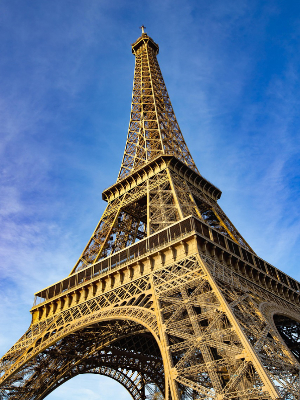
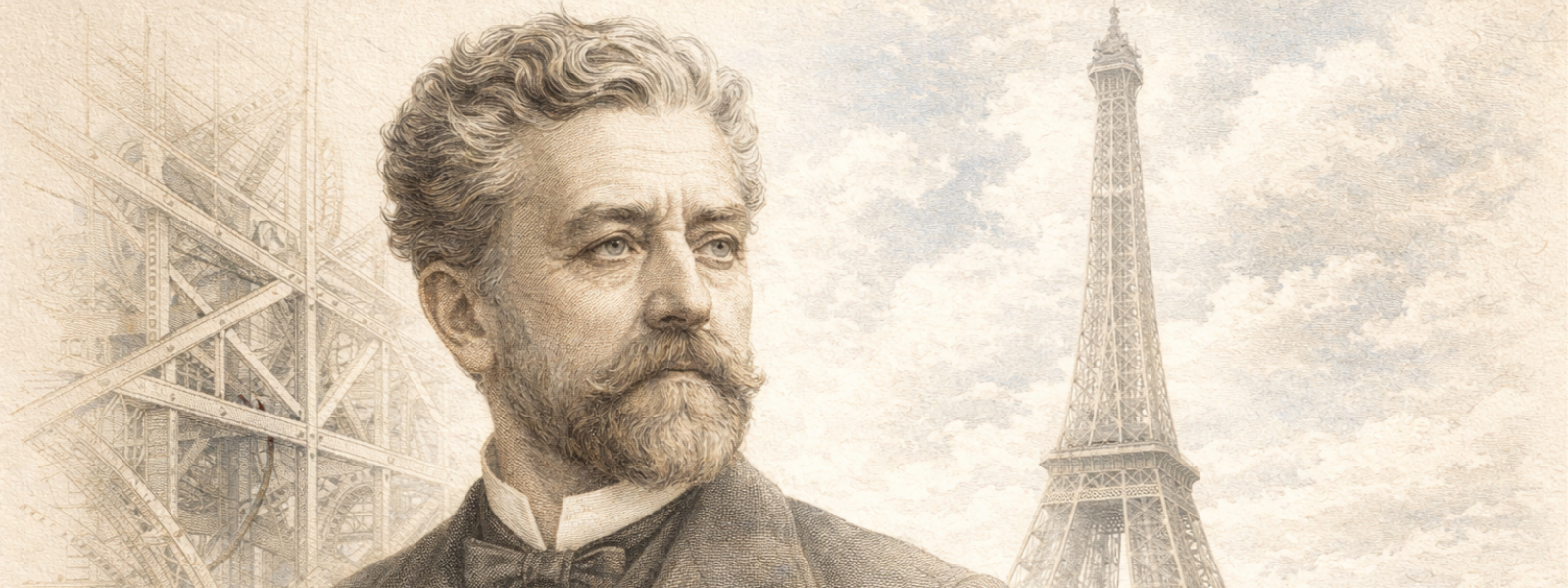
Before the Eiffel Tower becomes a view, a symbol, or a souvenir, it helps to return to the man who made it possible. Gustave Eiffel is often reduced to a single monument. In reality, the Tower stands at the end of a much longer story: a career built through bridges, viaducts, iron structures, and technical precision developed over decades.
The beginning of Eiffel’s career matters because it explains what kind of engineer he became. His first major success did not come from spectacle. It came from solving a difficult problem in a difficult environment.
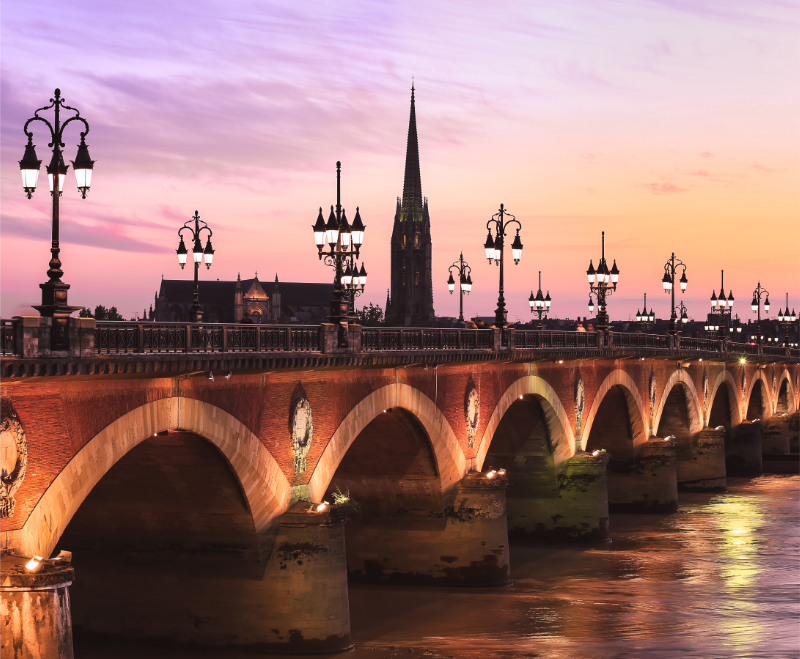
Alexandre Gustave Eiffel was born in Dijon on 15 December 1832. He trained at the École Centrale des Arts et Manufactures in Paris and graduated in 1855 as a chemical engineer. Even so, his professional path turned quickly toward structural work. In 1858 he was appointed to supervise the construction of a metal railway bridge over the Garonne in Bordeaux for the Compagnie du Midi. Completed in 1860, the Bordeaux Bridge established his reputation almost immediately.
What made that commission so important was not simply the bridge itself, but the foundation method it required. The project used compressed-air caisson foundations on a large scale, allowing workers to excavate the riverbed inside pressurised chambers and sink the piers safely to bedrock in a tidal river. Eiffel was only twenty-eight. Yet from this first major work he learned a lesson that would define the rest of his career: the real challenge of large construction is often not the visible structure, but the hostile conditions in which it must be built.
| Before Eiffel built for height, he learned to build against pressure, water, risk, and uncertainty. |
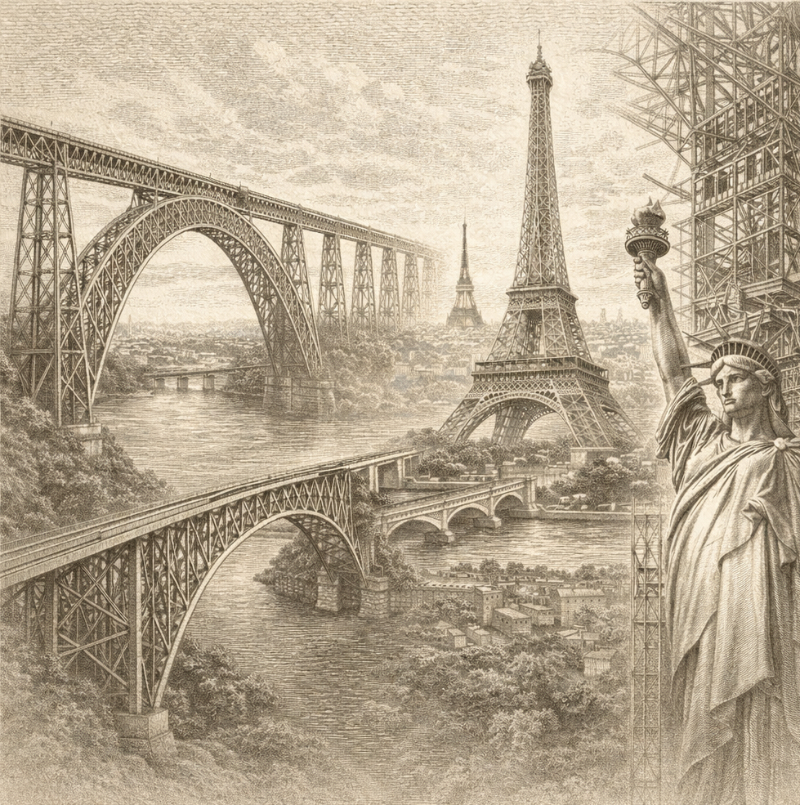
By the time Eiffel proposed his Tower in 1886, he was not an untested dreamer. He was already one of the most experienced iron engineers in Europe, with major structures completed across several countries.
A career built through bridges and viaducts
Over the two decades that followed Bordeaux, Eiffel worked across France, Portugal, South America, and Southeast Asia. Among his most important achievements was the Maria Pia Bridge in Porto, completed in 1877, whose 160-metre arch span was then the longest metal arch in the world. The same year, the Douro Viaduct extended the railway line further into Portugal across terrain that conventional construction methods could not have addressed economically.
Garabit as the real prelude to Paris
The decisive pre-Tower structure was the Garabit Viaduct in the Massif Central, completed in 1884. For several years it was the highest railway bridge in the world, carrying the Clermont-Ferrand to Béziers line 122 metres above the Truyère river gorge. Garabit remains one of the finest examples of nineteenth-century iron bridge construction in Europe. More importantly, it refined the methods Eiffel would scale up again in Paris: the parabolic structural logic, the off-site prefabrication of iron elements, and the use of hydraulic jacks for extraordinary precision during assembly.
| The Tower did not appear out of nowhere. It rose from decades of accumulated method. |
Many visitors know Eiffel through Paris. Far fewer realise that one of his greatest engineering achievements stands in New York, almost hidden inside a monument usually credited to someone else.
Bartholdi designed the image; Eiffel solved the structure
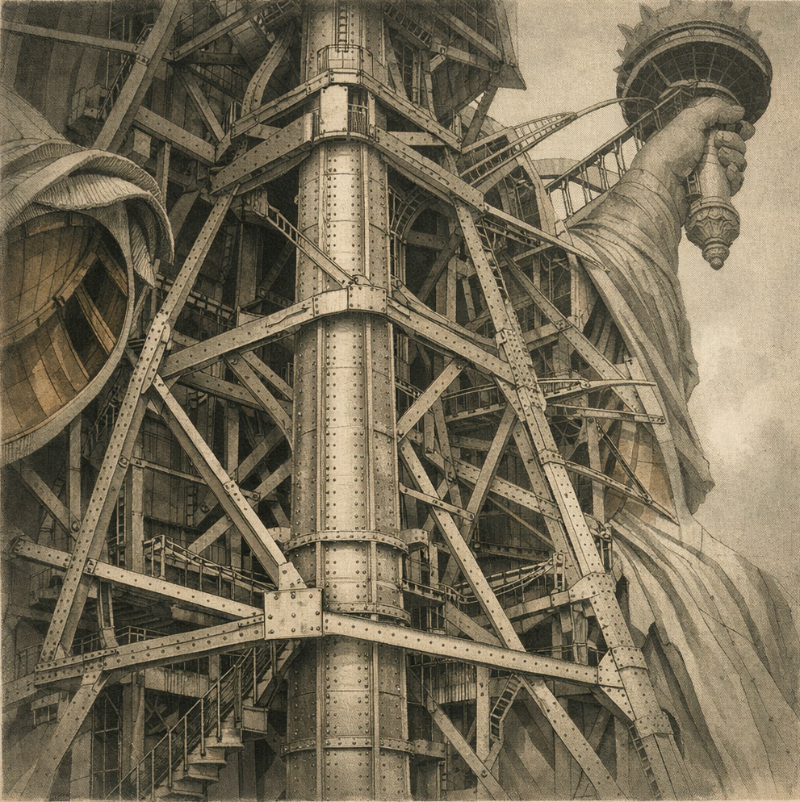
Frédéric-Auguste Bartholdi designed the Statue of Liberty’s exterior in hammered copper. The engineering problem, however, was how to support that thin copper skin against wind and thermal movement without cracking it. The original structural engineer, Eugène Viollet-le-Duc, died in 1879 before finishing the design. Eiffel was then brought in to solve the problem.
A structural principle ahead of its time
His solution was a central iron pylon from which a secondary framework of trusses extended outward. Flexible armature bars connected this skeleton to the copper shell, allowing the outer skin to move independently with changes in temperature and wind. In effect, Eiffel developed a principle that anticipated the curtain-wall logic of twentieth-century skyscrapers long before those buildings existed. When the Statue of Liberty was inaugurated in October 1886, three years before the Tower opened, it was already one of the most sophisticated structural systems of its age.
| Long before the Eiffel Tower defined a skyline, Eiffel had already learned how to make structure disappear behind an image. |
No account of Eiffel’s life is complete without the rupture that followed his greatest fame. The Panama scandal damaged his public reputation, even though the legal outcome was more complex than public memory often suggests.
A public fall
In 1893, Eiffel was convicted of breach of trust in connection with the Panama Canal Company fraud and sentenced to two years in prison. The company, directed by Ferdinand de Lesseps, had collapsed after collecting vast sums from small French investors and mismanaging those funds through incompetence and fraud. Eiffel had been contracted to design the canal’s lock mechanisms and had completed real work for real payment. On appeal, the higher court overturned his conviction, finding no proof that he had knowingly participated in the fraudulent operations. He was legally cleared, but his public standing was badly shaken.
A second life devoted to research
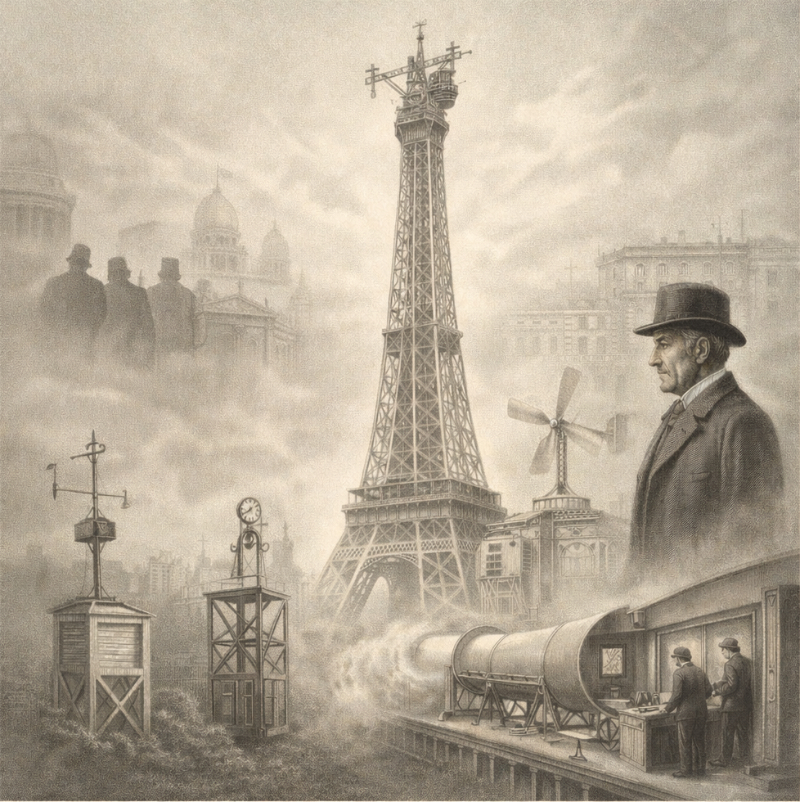
After that episode, Eiffel withdrew from commercial engineering at the age of sixty-one. The final thirty years of his life were devoted to science. He turned the Tower into an instrument. At its summit he established a meteorological station with continuous observations. He conducted wind-resistance experiments and, in 1909, built an aerodynamics laboratory at the base of the Tower, one of the first such facilities in France. The data produced there proved valuable to early aviation engineers across Europe. In 1921 he received the Franklin Medal for his contributions to aerodynamics. He died in Paris on 27 December 1923 at the age of ninety-one.
| After the scandal narrowed his public life, Eiffel widened his scientific one. |
What Eiffel Thought of His Tower
By the time the twentieth century began, Eiffel had lived long enough to see the Tower outlast its critics, outlast its demolition order, and outgrow the controversy that first surrounded it.
In 1900 he remarked, with dry precision, ‘I ought to be jealous of the Tower. It is much more famous than I am. People seem to think it built itself.’ The line is memorable because it is true. The Tower quickly became more famous than its maker, and public memory compressed a long, rigorous career into a single silhouette.
Yet the remark also reveals something essential about Eiffel. He was not sentimental about fame. He understood the distance between the engineer and the object. By then he had outlived most of the critics who had signed the 1887 petition against the Tower. He had also seen the structure serve science, communications, and the First World War. The monument had already become larger than the quarrel that first produced it.
| To understand Eiffel properly is to see the Tower not as a miracle, but as the visible result of a life spent mastering iron, force, precision, and risk. |
Author’s note: This text was written with the intention of sharing and transmitting knowledge, not as an academic work. Its author is not a historian. Some details or interpretations may not reflect current historiographical consensus. For a rigorous approach, please refer to the sources listed at the end of this document
Références : Musée d’Orsay, Exhibition Gustave Eiffel, Bridge-Builder ; Université Gustave Eiffel, Gustave Eiffel and his construction of metal arch bridges ; Archives nationales, Gustave Eiffel, l’homme de fer ; Encyclopaedia Britannica, Gustave Eiffel ; La Tour Eiffel, Le viaduc de Garabit.
OUR BEST TOURS