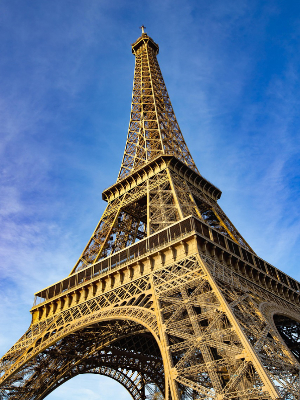
THE FIRST FLOOR OF THE EIFFEL TOWER
An Overlooked Level Where the Tower Begins to Explain Itself

An Overlooked Level Where the Tower Begins to Explain Itself
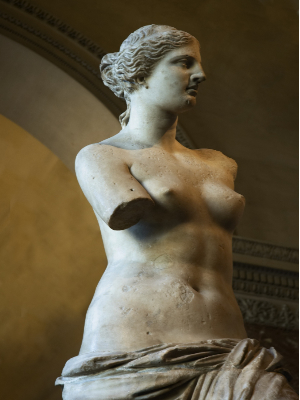
Before heading straight for the Louvre’s most famous ancient sculptures, it helps to understand what kind of department this really is.
Because Greek, Etruscan and Roman Antiquities at the Louvre are not simply a route to two masterpieces. They form a vast Mediterranean collection of around 50,000 objects spanning three millennia, from archaic Greece to Imperial Rome, with the Etruscan world in between. The canonical works matter, of course. Yet the real intelligence of the department lies in what surrounds them, and in the way one object changes the meaning of the next.
So how should this department be approached? Not as a queue between the Winged Victory and the Venus de Milo, but as a structured sequence of encounters with power, devotion, athleticism, portraiture, funerary art and formal invention. Once that shift happens, the galleries become far more rewarding.
The summit delivers range. The first floor delivers understanding.
A view that still belongs to the city
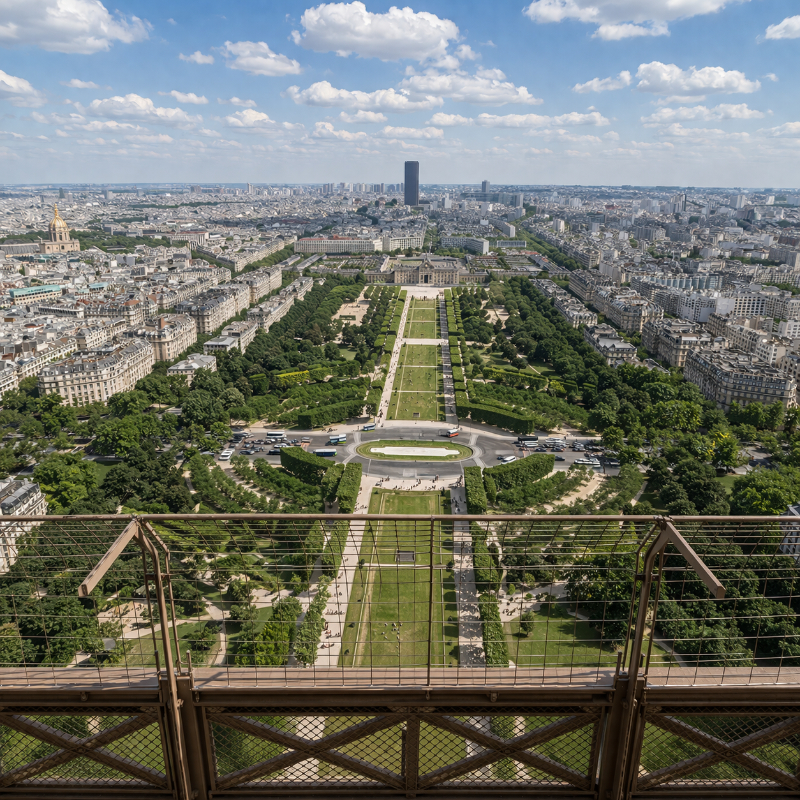
At 276 metres, the summit offers extraordinary distance. On a clear day, the view can stretch for up to 70 kilometres. Yet height has a cost. Streets flatten into lines, buildings merge into patterns, and Paris begins to read as landscape rather than as an inhabited city. The first floor works differently. At 57 metres, you remain close enough to identify individual monuments, trace the exact curve of the Seine, and understand how the Trocadéro gardens, the Champ-de-Mars, and the École Militaire fit together.
Why the altitude matters
This rooftop height is what makes the level so instructive. Les Invalides still holds its dome clearly at eye level. The river still behaves like infrastructure rather than scenery. The city remains specific. For visitors trying to understand Paris, not simply admire it, this is the most useful observation deck on the Tower. It is also usually calmer than the summit and easier to experience without hurry.
| Before the Tower asks you to look far, the first floor teaches you to look precisely. |
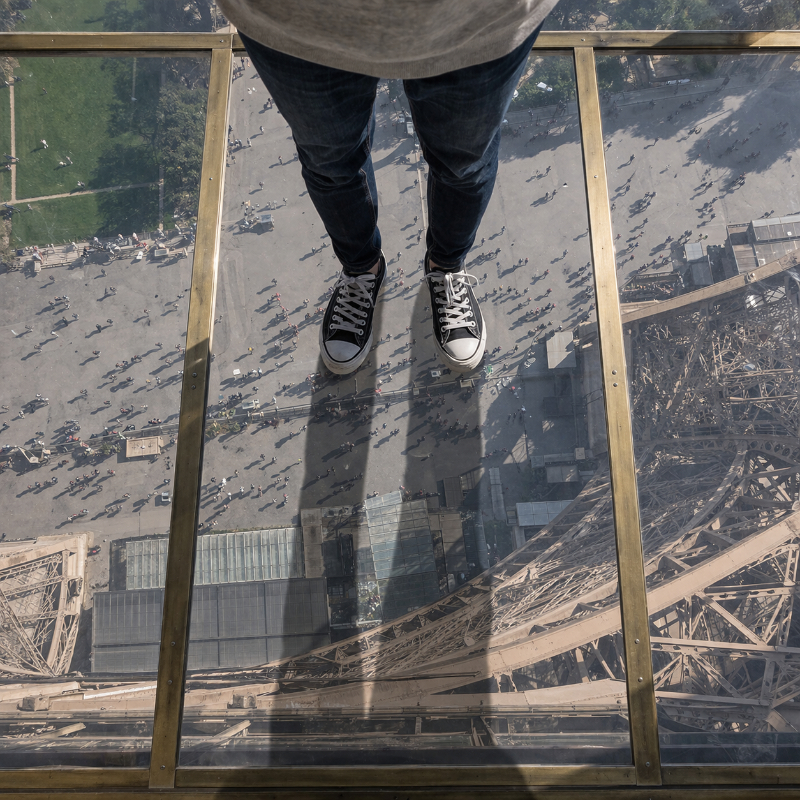
It is one of the simplest interventions on the Tower. It is also one of the most physical.
A controlled encounter with height
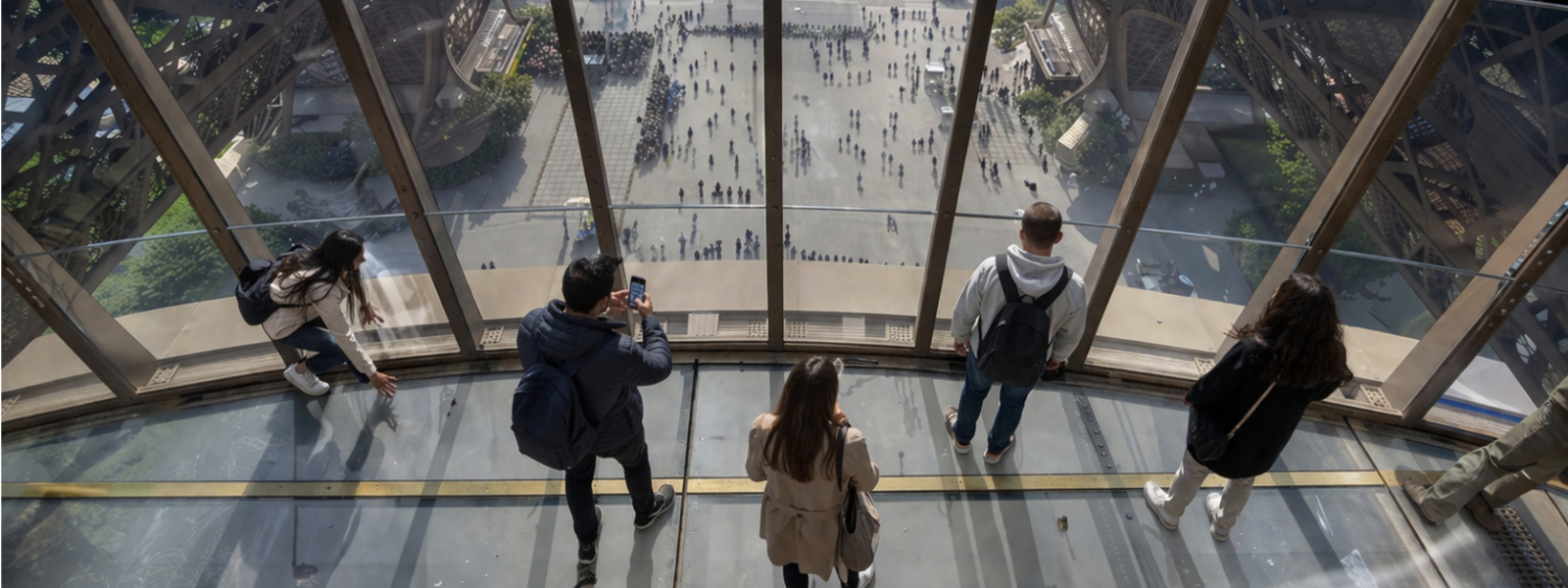
Installed during the 2014 renovation, the glass floor panel sits on the outer walkway of the platform. It measures around 40 square metres and is built from triple layered glass with a combined thickness of 12 millimetres. From here, visitors look directly down to the esplanade 57 metres below, framed by the iron lattice of the structure itself.
Engineered for sensation, built for stability
The floor was designed to create the feeling of standing over empty space while remaining completely stable underfoot. Its surface treatment preserves grip and visual clarity at the same time. The panel is certified to support loads far beyond normal visitor traffic. For many people, and especially for children, this is the most immediate and memorable moment on the first floor. However, the panel closes during icy conditions or heavy rain.
| The view downward changes something. After that moment, the iron around you feels less decorative and more alive. |
On the Eiffel Tower, dining can easily become secondary or purely scenic. Here, it does more than that.
A restaurant shaped by the setting
Madame Brasserie opened on the first floor in June 2022 under the direction of chef Thierry Marx. The restaurant serves contemporary French brasserie cuisine built around seasonal produce and suppliers from the Île-de-France region. The setting matters as much as the menu. At 57 metres, the room opens onto one of the Tower’s most rewarding urban views, especially toward the Trocadéro and the Seine.
What the reservation changes
A reservation includes a dedicated entry lane and lift access to the first floor, which means diners do not need a separate Tower entry ticket. Dinner requires advance booking. Breakfast and lunch may be possible without reservation depending on availability, though lunch is best reserved in high season. Asking for a window table is worth doing.
The overlooked option: breakfast
The lounge bar runs throughout the day without reservation. Yet the least used moment remains breakfast from 9:30 AM. Coffee and a pastry on the first floor in the first hour after opening is one of the Tower’s most accessible small luxuries, and one of the easiest to miss.
| For many visitors, the first floor becomes memorable not because they paused here by chance, but because they chose to stay. |
A few practical decisions make this level far more rewarding.
Do not rush through
Give the first floor at least 30 minutes before continuing upward. The glass floor, CinEiffel, the construction exhibitions, and the rooftop-height view each justify time on their own.
Find the glass floor deliberately
The glass panel sits on the outer walkway on the east-facing side of the platform. Follow the signs from the lift exit. It is easier to miss than many visitors expect.
Do CinEiffel early
The Ferrié pavilion is in the northwest corner of the first floor. Because the experience runs continuously and usually requires little waiting, it works best near the start of your visit, when the construction story can still shape everything that follows.
Time Madame Brasserie strategically
Breakfast is the best value and the least crowded meal service. Lunch is easier with a reservation in peak season. Dinner needs one in advance.
Use the level as context, not a pause
The summit may remain the emotional goal, but the first floor gives the whole ascent meaning. Treated properly, it is not a stop between lifts. It is the level that turns the Tower from attraction into structure.
| Before the summit gives you distance, the first floor gives you understanding. |
Author’s note: This text was written with the intention of sharing and transmitting knowledge, not as an academic work. Its author is not a historian. Some details or interpretations may not reflect current historiographical consensus. For a rigorous approach, please refer to the sources listed at the end of this document
Références : Tour Eiffel, Découvrir le 1er étage ; Tour Eiffel, Explore the first floor ; Tour Eiffel, Restaurants, bars and stores at the Eiffel Tower ; Tour Eiffel, Madame Brasserie, the new 1st-floor brasserie ; Tour Eiffel, Breakfast at the Eiffel Tower ; Madame Brasserie, Reservation ; Tour Eiffel, Ticket to the Top via the Elevator with Brunch at Madame Brasserie.
OUR BEST TOURS