EIFFEL TOWER PRACTICAL TRAVEL GUIDE
Everything You Need to Plan a Smoother Visit

Everything You Need to Plan a Smoother Visit
Before a visit to the Eiffel Tower becomes memorable, it has to become manageable.
This is one of the most visited paid monuments in the world. The difference between a calm, well-paced visit and an exhausting one usually has very little to do with luck. It depends on timing, booking, route choice, and a few practical decisions made before arrival. Opening hours, ticket type, the right Métro stop, the right entry lane, and even the right exit strategy all shape the experience more than most visitors expect.
This guide brings those decisions together in one place. It covers opening hours, ticket prices, booking strategy, transport, security, dining, accessibility, and the practical habits that make the Tower easier to enjoy once you are there.
Before planning the visit, it helps to understand the rhythm of the Tower across the day and the year.
Seasonal opening times
The Eiffel Tower opens every day of the year, including Christmas Day, New Year’s Day, and French public holidays. During the summer period, broadly from mid-June to early September, it opens at 9:00 AM and closes at 12:45 AM. During the rest of the year, it opens at 9:30 AM and closes at 11:00 PM.
Summit access closes earlier than the monument itself. In summer, the last admission to the summit is at 11:00 PM. During the rest of the year, the last summit admission is at 10:30 PM. These details matter, especially for evening visitors who assume the final entry and the final closing time are the same thing.
Weather and exceptional dates
The summit can close independently of the rest of the Tower when wind speeds exceed the safety thresholds set by the operating company. No advance notice is guaranteed, because the decision depends on real-time conditions. If this happens, the first and second floors remain open, and visitors receive a partial refund for the price difference between a summit ticket and a second-floor ticket.
Bastille Day, on 14 July, also operates differently. Opening hours may change, and Le Jules Verne closes for the day. For that reason, the official website should always be checked again before any holiday visit.
| A good visit begins with timing. At the Eiffel Tower, the clock matters long before the view does. |
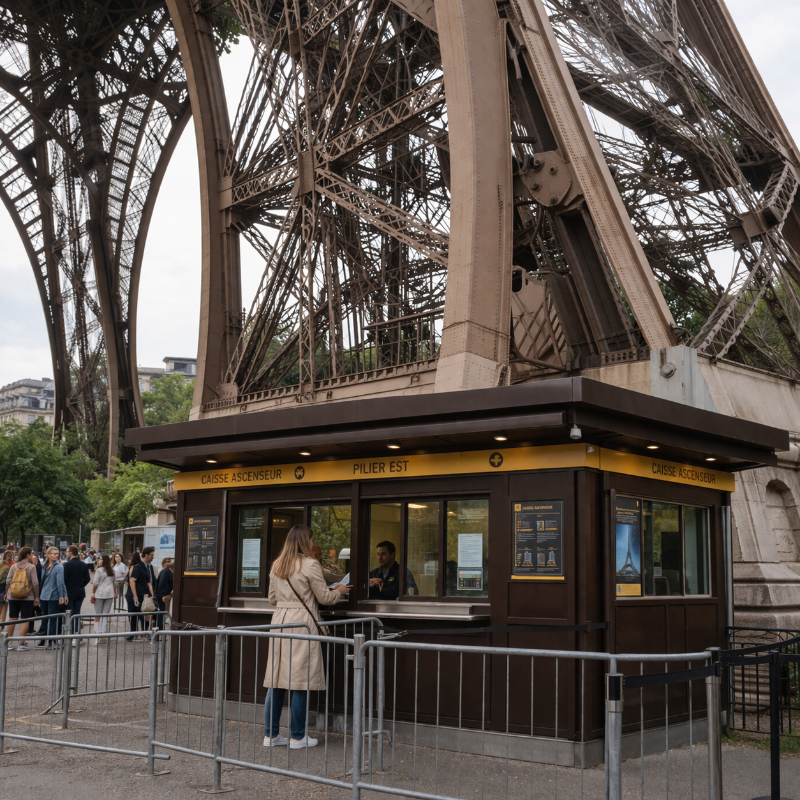
Ticket choice is not only about price. It also determines pace, access, and how much of the structure you actually experience.
Adult, youth, and child tickets
For adults, a lift ticket to the summit costs 36.70 euros. A combined stairs-and-lift ticket to the summit costs 28.00 euros. A lift ticket to the second floor only costs 23.50 euros, while a stairs-only ticket to the second floor costs 14.80 euros.
For visitors aged 12 to 24, the summit lift ticket costs 18.40 euros. The stairs-and-lift combination costs 14.00 euros, the second-floor lift ticket 11.80 euros, and the stairs-only ticket 7.40 euros.
For children aged 4 to 11, the summit lift ticket costs 9.20 euros. The combined stairs-and-lift option costs 7.00 euros, the second-floor lift ticket 6.00 euros, and the stairs-only ticket 3.80 euros. Children under 4 enter free of charge and do not need a ticket.
Reduced rates and extras
Visitors with a recognised disability pay the child rate at all levels, subject to proof of eligibility at the checkpoint. An audio guide is also available to rent for 6 euros and is offered in nine languages from the ticket desk on the esplanade.
In practice, the most important distinction is not between age categories, but between the summit and the second floor, and between the lift and the stairs. Each option changes the visit in a different way.
| The best ticket is rarely the most obvious one. It is the one that matches the kind of visit you actually want. |
Booking is the single most important logistical decision in this guide, and it is the one visitors most often underestimate.
Why online booking matters
Buy tickets online at toureiffel.paris before arriving in Paris. In peak season, that is not just useful advice. It is the baseline strategy. Walk-up queues can exceed 90 minutes in summer and are often above 30 minutes even in quieter months.
Online booking gives access to a timed entry window and to the dedicated lane for pre-booked visitors. That line is consistently shorter than the general same-day queue and removes the most unpredictable part of the visit.
When tickets are released
Tickets are released 60 days in advance. For weekends in July and August, the safest method is to book exactly 60 days before the preferred date, as soon as those slots open.
The system allows full cancellation up to 24 hours before the visit at no charge. That flexibility makes early booking easier to justify, especially for visitors still finalising a Paris itinerary.
What to avoid
Never buy tickets from individuals near the esplanade. Tickets sold on the street near the Tower are fraudulent and will be refused at security. Third-party resale websites also often charge heavy markups for access that is available directly on the official site.
Some guided packages do add value through commentary or small-group organisation. The ticket component itself, however, is not exclusive. The safest and clearest purchase remains the official website.
| At the Eiffel Tower, booking is not a minor detail. It is often the difference between a smooth visit and a wasted afternoon. |
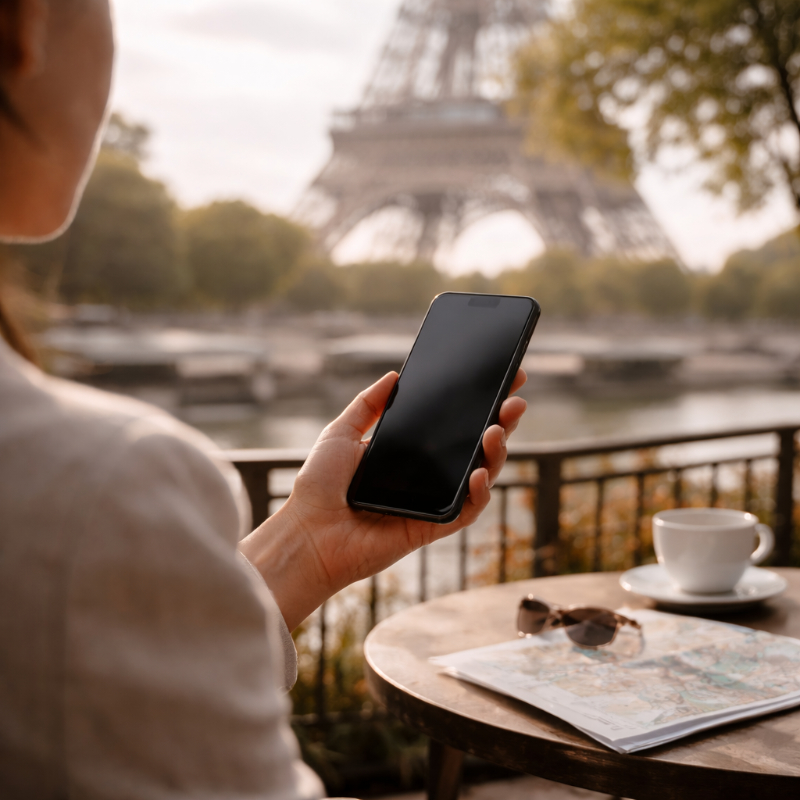
The route to the Tower shapes the first impression. Some arrivals are merely efficient. Others are part of the experience itself.
The most atmospheric approaches
By Métro, Line 6 to Bir-Hakeim offers the most dramatic arrival. The station is elevated, and the Tower appears almost immediately as you leave it. From there, the walk to the esplanade takes about eight minutes.
Line 9 to Trocadéro offers the classic frontal approach. The walk across the Pont d’Iéna takes about twelve minutes and remains one of the best introductions to the monument, especially for first-time visitors.
Fastest and most direct options
RER C to Champ de Mars – Tour Eiffel is the quickest connection from areas such as Saint-Michel Notre-Dame, the Latin Quarter, and Invalides. From the station, the security checkpoint is roughly three minutes away on foot.
Several bus lines also stop nearby, including 42, 69, 72, 82, and 87. Taxi or Uber drop-off on Avenue Gustave Eiffel places visitors within about two minutes of the checkpoint, while Vélib’ stations are available near the Pont d’Iéna and Champ-de-Mars for those arriving by bicycle.
| The best arrival does not always mean the shortest one. Sometimes the walk toward the monument is part of why the visit stays memorable. |
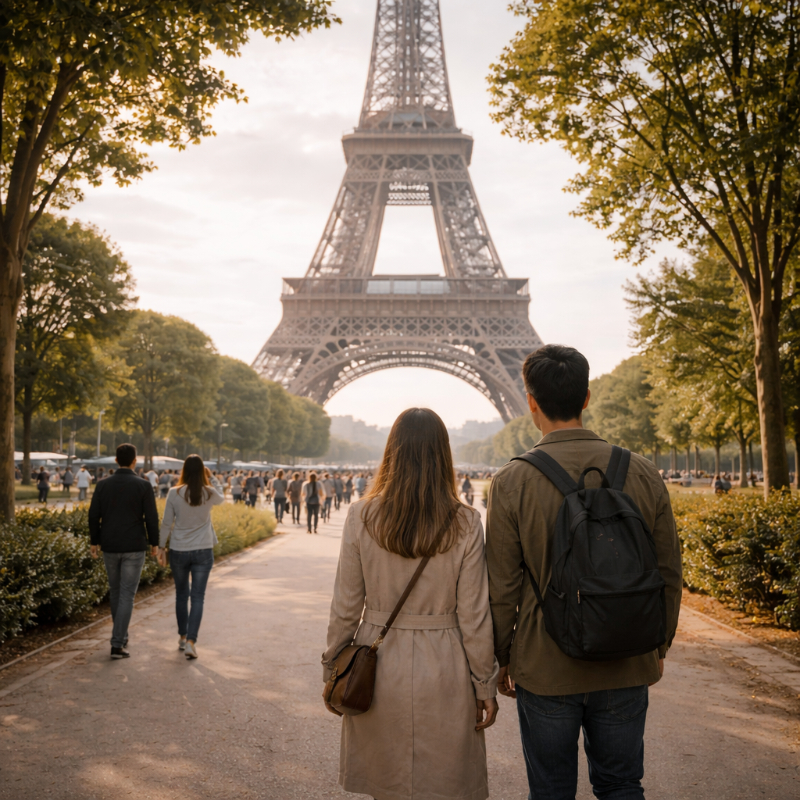
The Tower is unusually strong, by historic-monument standards, in practical accessibility. That matters for planning and for confidence before arrival.
Lift access and mobility
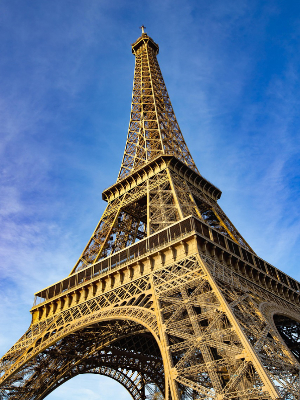
All public levels are accessible by lift: the first floor at 57 metres, the second floor at 125 metres, and the summit at 276 metres. No stairs are required for visitors who use the lift system from the esplanade.
The accessible entrance is on the east side of the esplanade. On the summit, the outdoor terrace includes a brief ramp transition that remains manageable for most wheelchairs and mobility equipment.
Additional services
Hearing loops are available at information desks, and guide dogs are accepted throughout the Tower on all levels. For visitors with specific needs, the official accessibility information on toureiffel.paris should be checked in advance.
That preparation is worth it, because the site’s size and circulation can feel more comfortable once the exact access route is understood before arrival.
| Accessibility is most useful when it is concrete. At the Tower, that means knowing the entrance, the lifts, and the route before the day begins. |
A few practical habits improve the experience more than any last-minute improvisation can.
Choose the right start time
Book the earliest opening slot if possible. Around 9:00 AM, the first floor is still comparatively calm, and tour groups have usually not yet filled the main circulation areas. That first hour remains the easiest moment for quiet photographs and a more spacious first impression.
Use the stairs if you can
If you are physically able, take the stairs to the second floor. The staircase queue is often three to four times shorter than the lift queue in peak season, and the ascent gives direct contact with the rivets, girders, and internal iron structure in a way the lifts never can.
Do not rush the first floor
The first floor is the most content-rich level of the monument. It deserves at least thirty minutes for the glass floor, the CinEiffel experience, and the exhibitions on construction history. Many visitors rush past it and regret doing so later.
Dress for the summit and plan the exit
Bring an additional layer, whatever the weather at ground level. The summit is usually 5 to 8 degrees Celsius colder and significantly windier. It also helps to plan departure deliberately: between 5 PM and 7 PM, transport nodes near the Tower become heavily congested.
Leaving before 4:30 PM or staying through sunset and the first light show usually produces a much calmer exit.
Stay alert
Finally, keep belongings secure. The queues on the esplanade and the lift areas on the first floor are known pickpocket locations. A bag worn across the body reduces that risk immediately. And one rule remains absolute: do not buy tickets from anyone near the Tower.
| The smoothest visits are rarely the most complicated. They are simply the ones where a few practical decisions were made early and made well. |
Author’s note: This text was written with the intention of sharing and transmitting knowledge, not as an academic work. Its author is not a historian. Some details or interpretations may not reflect current historiographical consensus. For a rigorous approach, please refer to the sources listed at the end of this document
Références : Tour Eiffel, Ticket rates and opening times ; Tour Eiffel, Tips & Preparation of your visit ; Tour Eiffel, Questions about your ticket ; Tour Eiffel, Getting to the tower : your questions ; Tour Eiffel, Discover the Eiffel Tower from gardens to the top ; Tour Eiffel, Tips for buying an Eiffel Tower ticket.
OUR BEST TOURS