THE EIFFEL TOWER IN ART & CULTURE
How the Tower Became One of the Most Powerful Images in Modern Culture

How the Tower Became One of the Most Powerful Images in Modern Culture
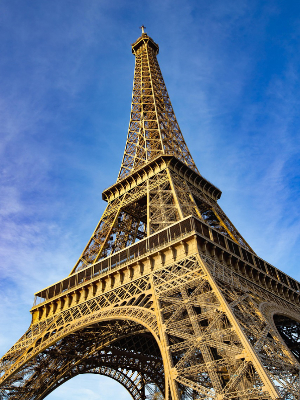
The Eiffel Tower is not only an engineering feat. It is also one of the most documented, debated, painted, photographed, and theorised monuments in modern culture. Its passage from public scandal to accepted symbol happened with unusual speed, and that reversal still shapes the way the structure is seen today. Once this history is understood, the Tower stops being only a viewpoint. It becomes a case study in how cities, artists, critics, and visitors learn to look.
The history of the Tower in culture begins not with admiration, but with refusal.
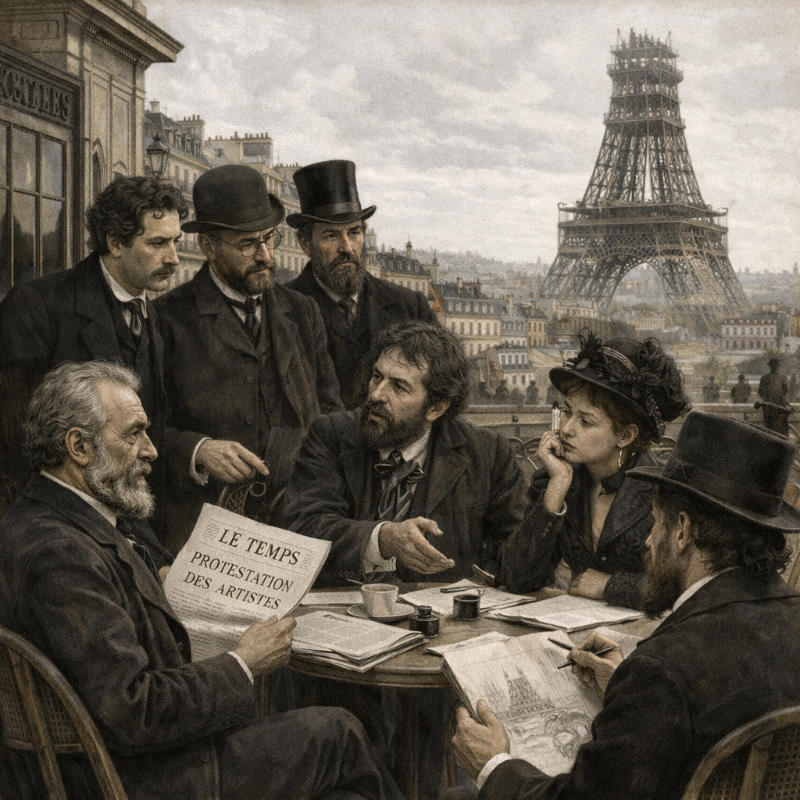
The February 1887 petition against the projected Tower remains one of the most famous acts of artistic opposition in the history of Paris. Among its signatories were Charles Garnier, Guy de Maupassant, Alexandre Dumas fils, Charles Gounod, and more than two hundred other writers, artists, and public figures of the Third Republic. Their complaint was not theatrical exaggeration. It expressed a serious belief that industrial materials and engineering forms had no place in the visual culture of a city defined by stone monuments, royal squares, and ecclesiastical silhouettes.
The petition described the proposed structure as a gigantic black factory chimney and a hateful column of bolted metal. In other words, what later generations would call modernity looked, at that moment, like an aesthetic threat. Paris was prepared to accept iron in stations, bridges, and markets. It was not prepared to accept it as a monument.
Eiffel’s answer, published days later, was historically decisive. He argued that the form of the Tower was not arbitrary, and therefore not ugly in any conventional sense. Its curves followed structural necessity. Its outline was the mathematical solution to wind resistance. Beauty and engineering, in that argument, were not rivals. They were the same thing when design was exact enough. Long before the slogans of modern architecture were formulated, Eiffel had already stated the principle that form could emerge directly from function.
| Before artists embraced the Tower, it first had to survive the judgment of those who believed Paris already knew what beauty looked like. |
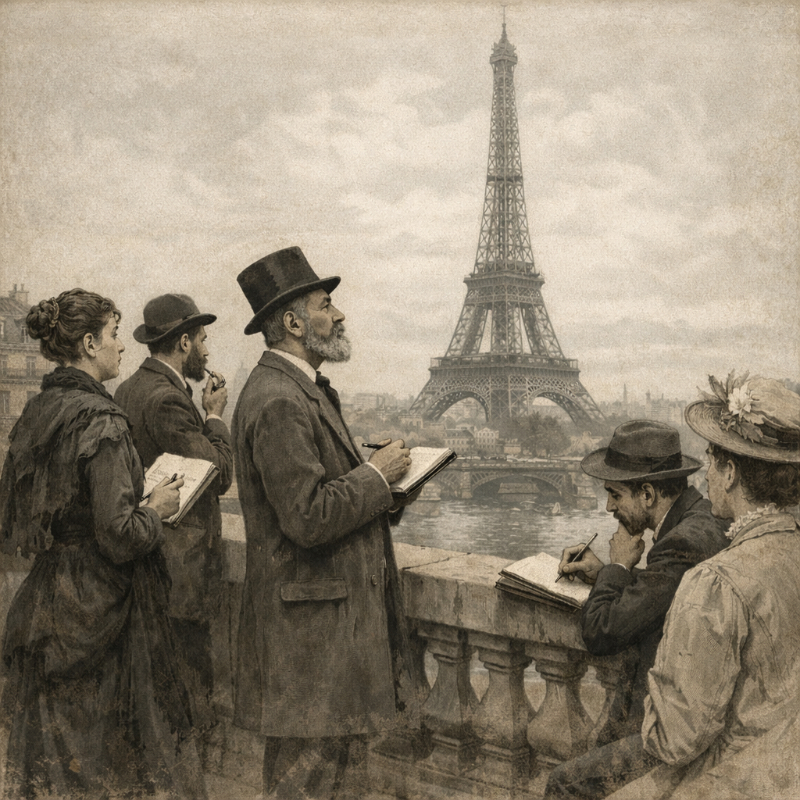
Acceptance did not arrive all at once. It arrived because artists began to look at the Tower without inherited fear.
Among the early visitors to the 1889 Exposition Universelle was Paul Gauguin, who sketched the iron lattice and recognised in it a decorative logic that did not depend on historical imitation. Georges Seurat, in turn, placed the Tower quietly in the background of exhibition scenes, treating it as part of contemporary Paris rather than as an intrusion into it. Henri Rousseau went further. By 1907, in Le 14 Juillet, he could place the Tower inside a festive crowd scene as if it had always belonged there.
That shift matters. Within roughly twenty years, the structure had moved from aesthetic scandal to visual normality. The most radical thing about the Tower’s acceptance is how quickly it became ordinary.
No artist pursued it more intensely than Robert Delaunay. Between 1909 and 1937, he returned to the Tower again and again, producing dozens of paintings and drawings in which its iron form dissolved into movement, colour, and rhythm. For Delaunay, the Tower was useful precisely because it was modern enough to be treated as a visual problem rather than a historical burden. In his hands, it became one of the founding motifs of abstraction in France.
| Once the Tower ceased to be a scandal, it became available for a much richer question: not whether it belonged in Paris, but what artists could do with it. |
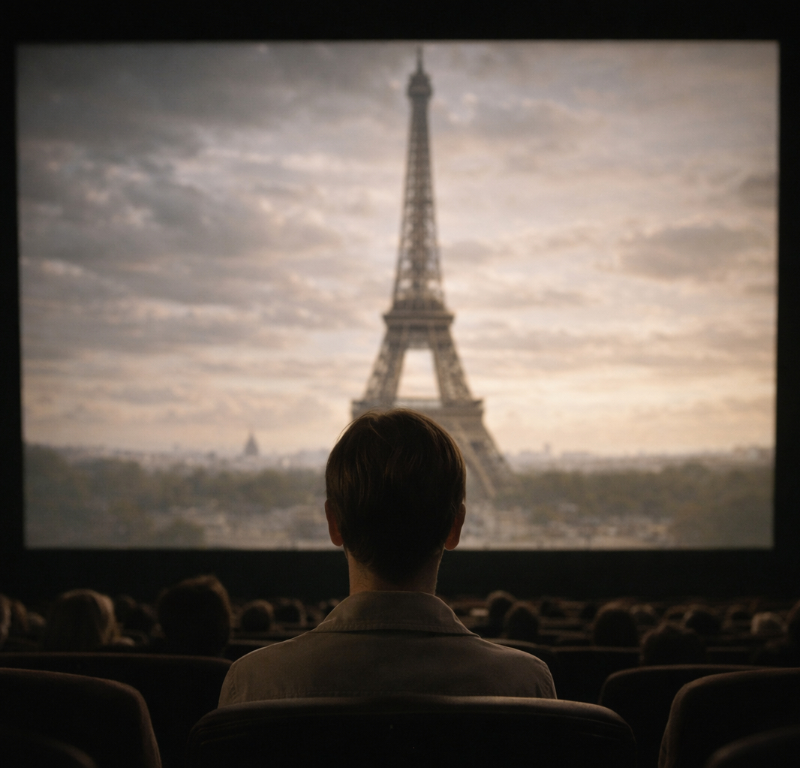
Cinema understood the Tower very quickly, perhaps because it needed what the Tower could do in a single frame.
The Eiffel Tower appears in more films than any real structure in the world outside purpose-built studio sets. Its cinematic usefulness is immediate. One shot is enough to establish Paris for an international audience. No caption is needed. No explanation is required.
In many films, especially international productions, the Tower functions less as geography than as code. It might appear through a window, behind a character in a street scene, or on a horizon that was not even filmed in Paris. Its role in the image is symbolic before it is realistic. It means Paris whether Paris is physically present or not.
This is one reason the Tower remains so central in popular culture. It can carry enormous narrative weight very quickly. Few monuments can do that with comparable efficiency.
| Once cinema adopted the Tower, its image no longer belonged only to Paris. It began circulating through the wider visual memory of the twentieth century. |
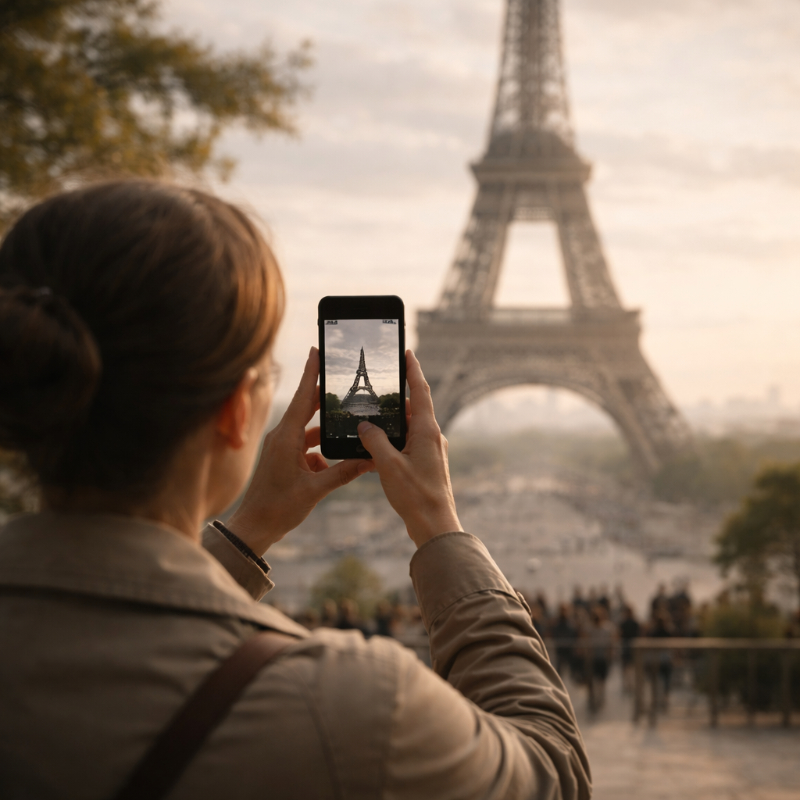
Photography completed what painting and cinema had already begun: it turned the Tower into a global habit of looking.
The Eiffel Tower is often described as the most photographed structure in the world, and the claim is plausible. Billions of images are made of it every year, from professional editorial shoots to casual phone snapshots. Yet quantity alone is not the interesting point. What matters is how photography has changed the experience of the site itself.
From roughly 2012 onward, smartphone cameras and social platforms altered visitor behaviour in measurable ways. Golden hour became a strategic destination. Reflection shots from the Trocadéro pool became a social script. Entire travel routines began to revolve around the Tower’s most photogenic times and positions.
That change has had mixed effects. The popular evening viewpoints can now be heavily crowded. At the same time, early mornings have become more rewarding for visitors who know when to arrive. The Tower itself has not changed. What has changed is the choreography around it. In that sense, photography has not simply recorded the monument. It has reorganised the way people move through it.
| And that may be the Tower’s final cultural lesson: once a monument enters visual history deeply enough, it begins to shape behaviour as much as it reflects it. |
Author’s note: This text was written with the intention of sharing and transmitting knowledge, not as an academic work. Its author is not a historian. Some details or interpretations may not reflect current historiographical consensus. For a rigorous approach, please refer to the sources listed at the end of this document
OUR BEST TOURS