THE 5 BEST EIFFEL TOWER PHOTO SPOTS
Where Paris Frames the Monument at Its Best

THE 5 BEST EIFFEL TOWER PHOTO SPOTS
Where Paris Frames the Monument at Its Best
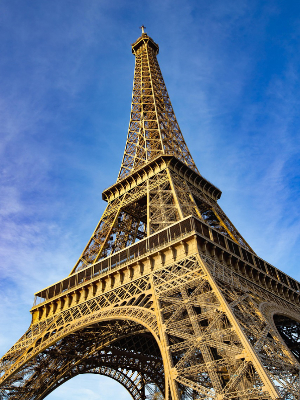
The Eiffel Tower is not seen in one single way. It changes with distance, angle, foreground, and the part of Paris from which it is approached.
For many visitors, the search for the best photograph begins too close to the monument itself. In practice, the strongest views often come from elsewhere: from terraces, bridges, streets, and riverbanks that give the Tower its scale, its framing, and its atmosphere. This guide follows five of the most rewarding viewpoints across Paris, each revealing the monument through a different urban setting.
The most famous view of the Tower is not simply a viewpoint. It is the northern half of the great axis that makes the monument legible.
Why this is the classic approach
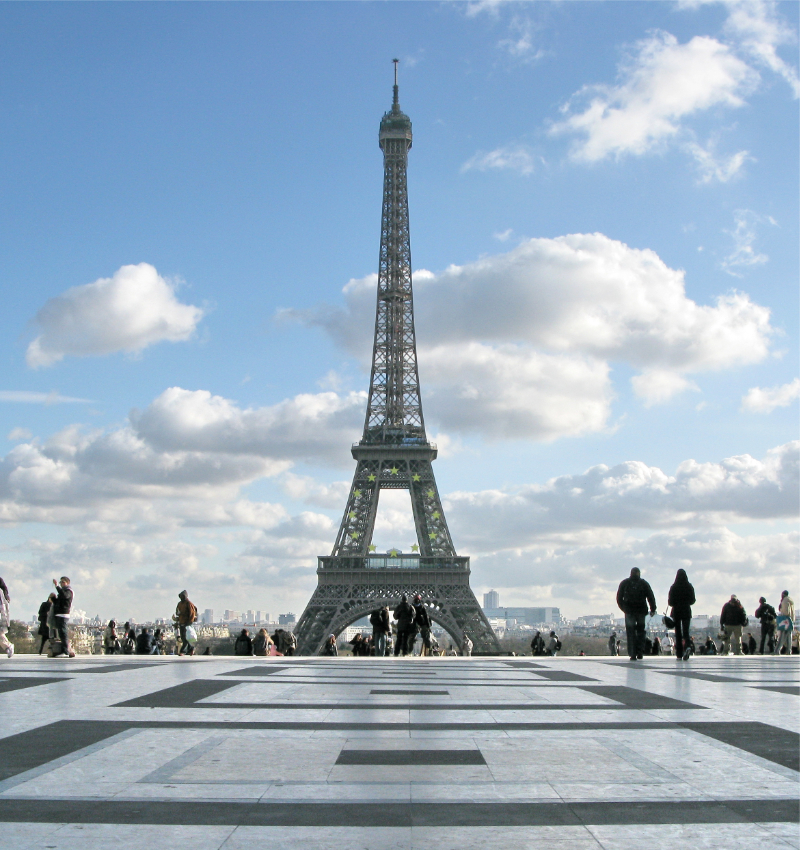
The Trocadéro remains the most recognisable place from which to see the Eiffel Tower because it offers the clearest frontal reading of the monument. From its terraces, the Tower stands at the far end of the Pont d’Iéna with unusual balance and authority. The space between viewer and structure is wide enough to make the whole silhouette readable, yet direct enough to preserve the sense of encounter. That is why so many first-time visitors feel that the Tower truly begins here, before they have reached it.
What the viewpoint actually gives you
What makes the Trocadéro so effective is not proximity, but composition. The terraces provide elevation, distance, and symmetry at once. The gardens below create a descending foreground, the bridge carries the eye forward, and the Tower rises in full alignment beyond. Few monuments in Paris are granted such a controlled approach. Here, the city does not compete with the structure. It prepares it.
Why it remains worth visiting despite its fame
Its popularity can make it easy to dismiss as obvious, but that would miss the point. The Trocadéro is famous because the view works with rare consistency, especially for first-time visitors, sunrise photography, and night views when the Tower’s lighting becomes the dominant feature of the scene. It is less intimate than some closer angles, but far more complete. The monument appears not as a fragment, but as a whole.
| At the Trocadéro, the Eiffel Tower does not merely appear in the city. It arrives through space, alignment, and distance exactly as the site allows it to. |
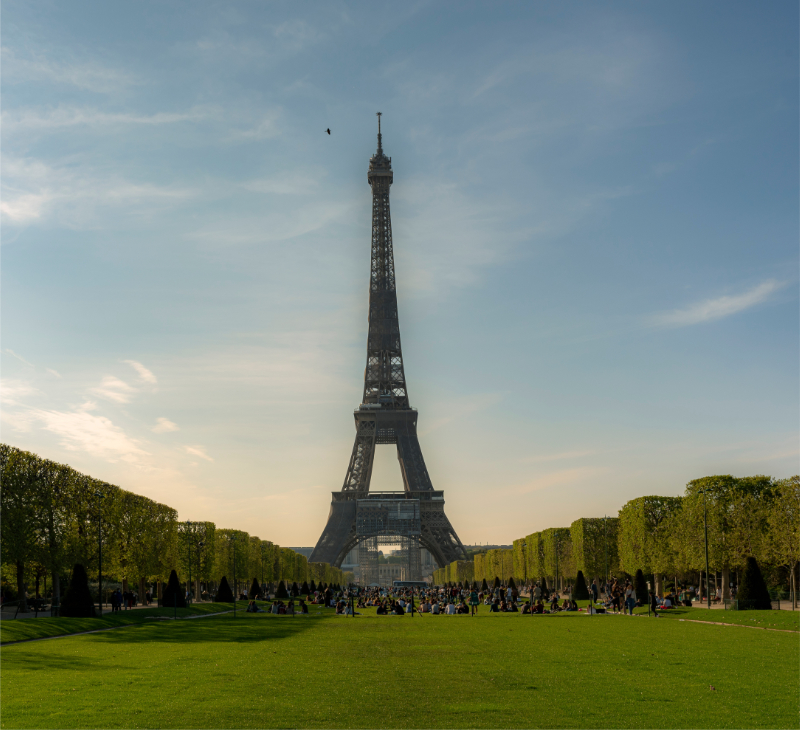
From the south, the Tower is no longer an object across the river. It becomes the far end of a long green approach prepared by open space.
Why this side feels different
The Champ de Mars offers a reading of the Eiffel Tower that is broader, calmer, and more axial than many visitors expect. Here, the monument does not appear suddenly between buildings or above a bridge. It stands at the head of a long stretch of lawn and gravel paths, with space enough around it for the full height to settle into view. That distance changes the experience. The Tower feels less abrupt, more composed, and more fully part of the city’s planned landscape.
What the viewpoint actually gives you
What makes the Champ de Mars so effective is the way it combines scale and clarity. The open foreground allows the eye to move gradually toward the structure, while the symmetrical paths and lawns keep the composition stable even when the space is busy. This is one of the easiest places to understand the Tower not simply as an isolated monument, but as the culminating point of a long urban perspective.
Why it remains one of the essential views
It may be less theatrical than the Trocadéro and less framed than certain bridges or streets, but that is precisely its strength. The Champ de Mars gives the Tower room to stand on its own terms. It works especially well in daylight, when the monument’s proportions read clearly, and in the late afternoon, when the lawns, sky, and iron structure begin to balance into a softer, more atmospheric image.
| From the Champ de Mars, the Eiffel Tower does not dominate the city by surprise. It anchors a long perspective that makes its scale feel measured, legible, and inevitable. |
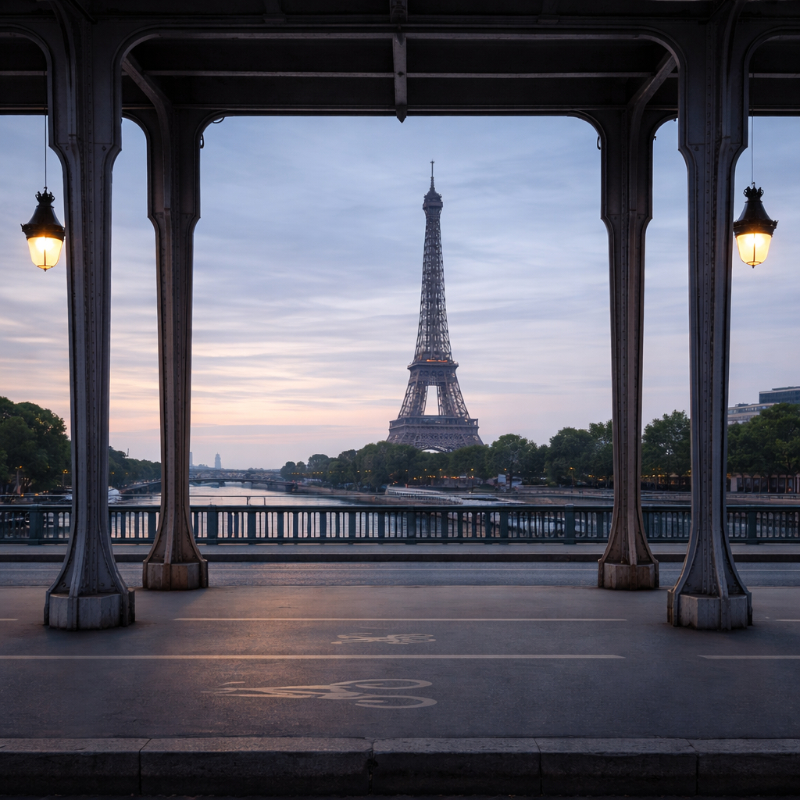
Some views of the Tower depend on symmetry. This one depends on structure answering structure across the river.
Why this bridge matters so much
The Pont de Bir-Hakeim offers one of the most distinctive views of the Eiffel Tower because it does not isolate the monument. Instead, it places it within another work of engineering. The bridge’s metal frame, long perspective, and position above the Seine create a setting in which the Tower feels less like a distant icon and more like part of a larger industrial and urban composition. That is what gives the view its unusual depth.
What the viewpoint actually gives you
From here, the Tower is not simply seen head-on. It is approached through lines, intervals, and framing elements that shape the image before the eye reaches the monument itself. The river adds openness below, the bridge creates rhythm in the foreground, and the Tower rises beyond with enough distance to remain fully legible. Few viewpoints combine architectural framing and open atmosphere so effectively.
Why it remains one of the strongest photo spots
The bridge is especially valuable for visitors who want something more structured than the lawns of the Champ de Mars and less frontal than the Trocadéro. It works particularly well in soft daylight, at blue hour, and at night, when the Tower’s illumination begins to answer the harder geometry of the bridge itself. The result is often more cinematic, but also more controlled, than many of the city’s better-known postcard views.
| From Bir-Hakeim, the Eiffel Tower is not merely photographed. It is framed by another piece of iron Paris, which is why the image feels both urban and composed at once. |
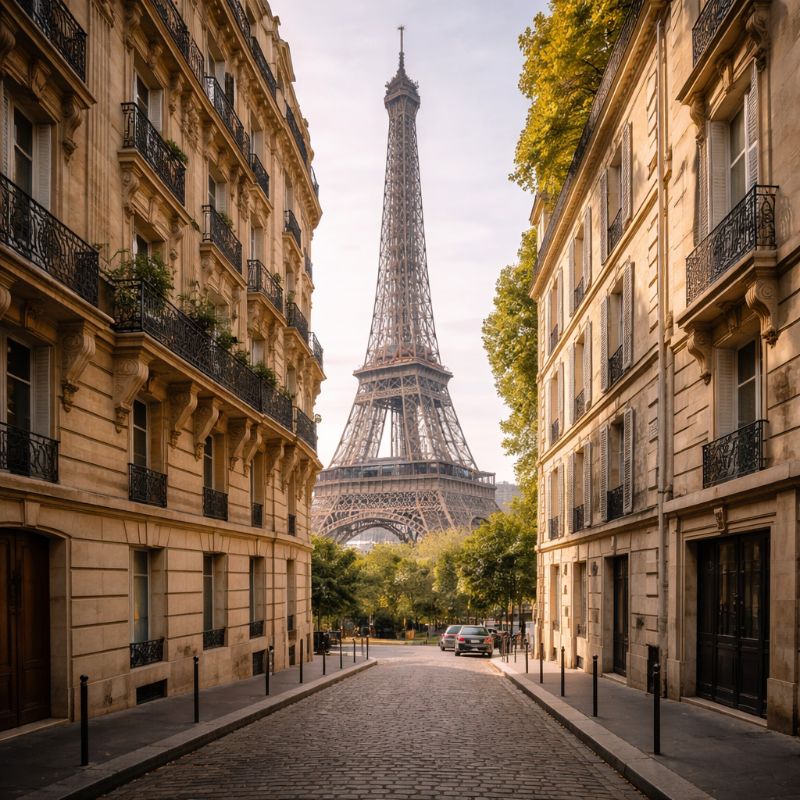
Some views of the Tower depend on distance. This one depends on interruption: the monument appearing unexpectedly within the ordinary fabric of the city.
Why this street became so well known
Rue de l’Université is one of the most recognisable street-level views of the Eiffel Tower because it offers something the larger viewpoints do not. Here, the monument is not encountered across gardens or from a monumental terrace. It appears between Parisian façades, above parked cars, balconies, shutters, and stone buildings that belong fully to everyday life. That contrast is what gives the image its appeal. The Tower feels less isolated, more woven into the city that surrounds it.
What the viewpoint actually gives you
What makes this spot effective is not completeness, but tension between scale and setting. The street narrows the frame, the façades create vertical boundaries, and the Tower rises behind them with just enough distance to feel surprising rather than overwhelming. The result is not the most balanced or monumental image of the Tower, but one of the most distinctly Parisian. It is a view in which the city and the monument remain equally present.
Why it works best in moderation
Its popularity can make it feel more fragile than the great open viewpoints. The street is narrower, busier, and more dependent on timing, light, and traffic conditions. But when the composition clears, the reward is a version of the Eiffel Tower that feels less official and more lived-in. It works particularly well for visitors who want the monument framed by ordinary Paris rather than separated from it.
| On Rue de l’Université, the Eiffel Tower is not staged against open space. It is discovered inside the city, which is exactly why the image feels intimate, familiar, and so often memorable. |
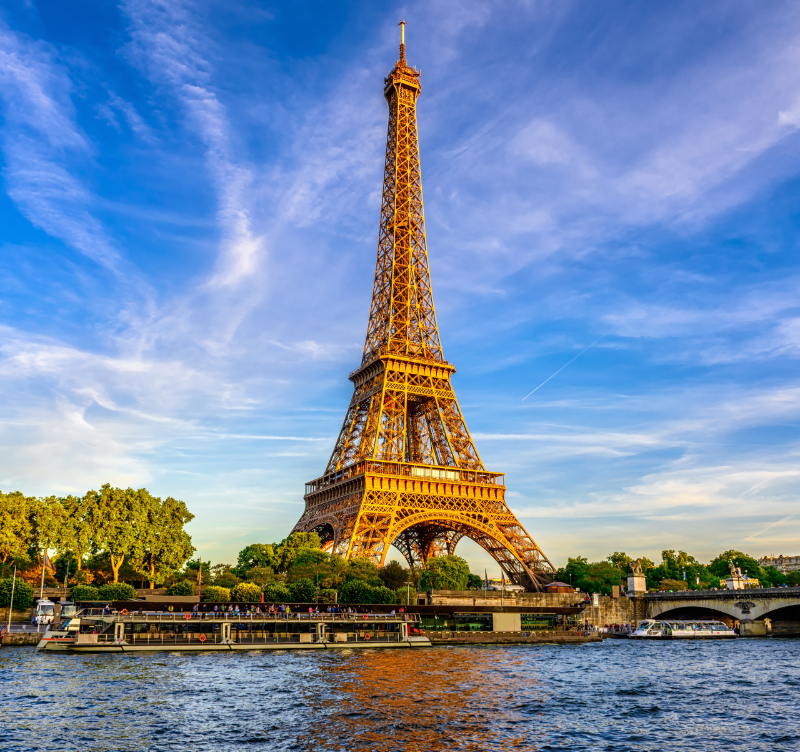
Some views of the Tower depend on a fixed axis. Along the Seine, the monument is shaped instead by movement, reflection, and changing distance.
Why the river changes the view
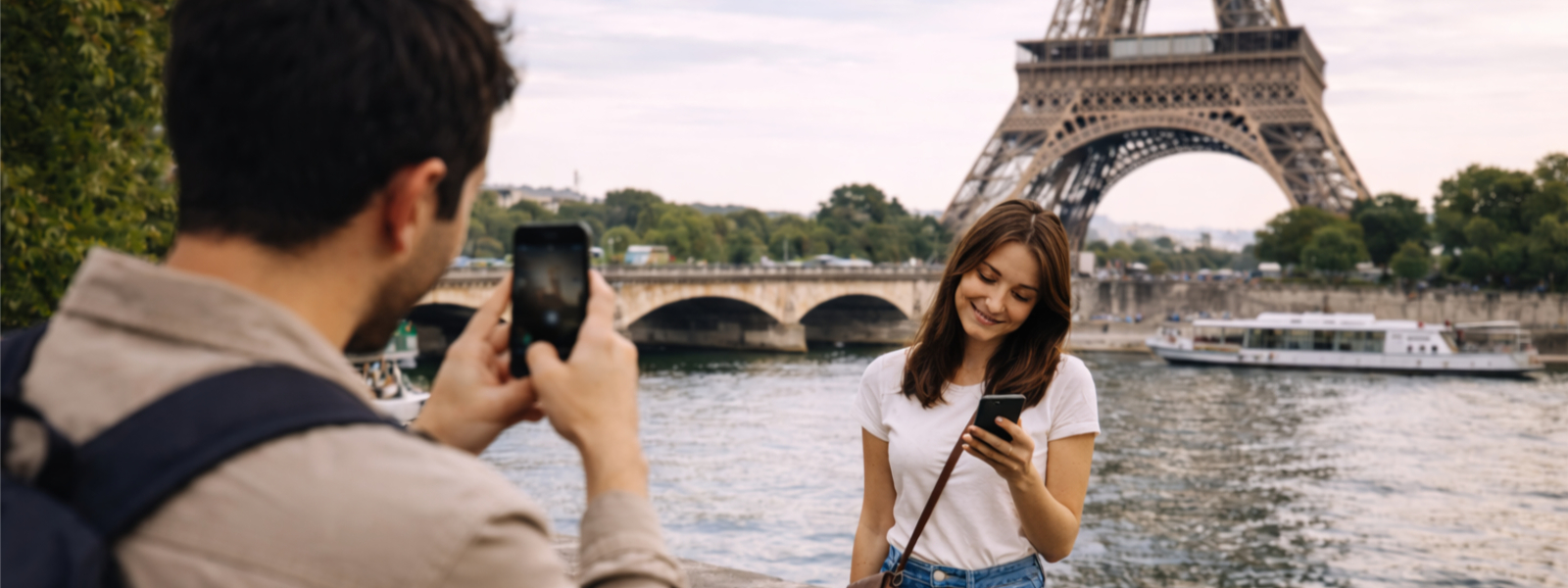
The Seine riverbanks offer one of the most atmospheric ways to photograph the Eiffel Tower because they remove the monument from strict frontal composition. Here, the Tower appears across water, beside bridges, behind trees, and between the shifting edges of quays and embankments. The result is less formal than the Trocadéro and less geometrically controlled than Bir-Hakeim, but often more fluid. The city begins to move around the monument, and the image gains atmosphere as a result.
What the viewpoint actually gives you
What makes the riverbanks so rewarding is their variety. Depending on where you stand, the Seine can provide foreground reflections, open lateral distance, or a softer interruption between viewer and structure. The Tower is rarely isolated here. It is seen in relation to water, sky, embankments, and the broader Paris landscape. That makes the image less monumental in the strict sense, but often more evocative.
Why this view works especially well after dusk
The riverbanks become particularly effective in the evening, when the Tower’s amber lighting begins to reflect in broken patterns across the water and the surrounding city darkens enough for the monument to separate itself more clearly. At that hour, the view is less about perfect symmetry than about tone, contrast, and atmosphere. The Tower is still the subject, but the river gives the image its mood.
| Along the Seine, the Eiffel Tower is not framed by a single viewpoint. It is encountered through water, distance, and reflection, which is why the image often feels less official and more alive. |
Author’s note: This text was written with the intention of sharing and transmitting knowledge, not as an academic work. Its author is not a historian. Some details or interpretations may not reflect current historiographical consensus. For a rigorous approach, please refer to the sources listed at the end of this document
Références : Tour Eiffel, The best spots to view and take photos of the Eiffel Tower ; Tour Eiffel, Access map ; Tour Eiffel, Tips & Preparation of your visit ; Paris je t’aime, Trocadéro ; Paris je t’aime, Pont de Bir-Hakeim ; Ville de Paris, Berges de Seine.
OUR BEST TOURS