EIFFEL TOWER ARCHITECTURE
Understanding the Structure Behind Paris’s Most Famous Landmark

Understanding the Structure Behind Paris’s Most Famous Landmark
Before the Eiffel Tower impresses as an icon, it rewards close reading as a machine. Its silhouette feels obvious today. In 1889, it was anything but. Every curve, every opening in the lattice, and every decision about height, weight, and assembly answered a technical problem that no structure of this scale had solved before.
What makes the Tower so compelling is that its beauty is never added after the fact. The shape is not ornamental. The lightness is not theatrical. The elegance comes directly from the engineering. Once that becomes clear, the Eiffel Tower stops looking like a monument that happens to work. It starts looking like a work of engineering that became beautiful by solving its constraints with extraordinary rigor.
Every serious explanation of the Tower begins with the same force: wind. At three hundred metres, an iron structure in the climate of northern Europe could not simply be made taller by extending familiar methods. The higher the structure rose, the more dangerous horizontal pressure became. A heavy frame of vertical pillars and rigid horizontal bracing would have demanded huge quantities of metal and, more importantly, would have behaved badly under changing loads.
Why the legs curve
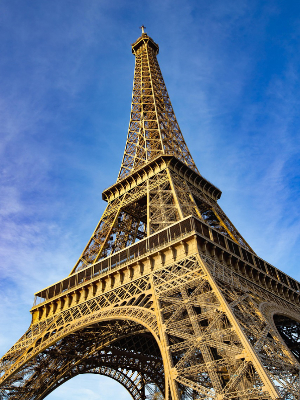
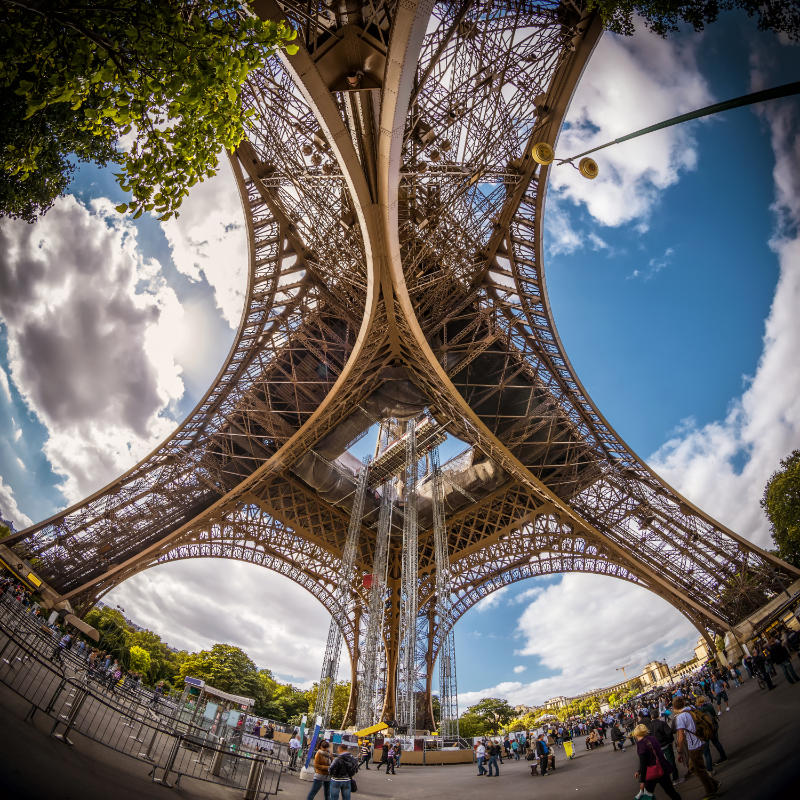
Eiffel’s team therefore chose a different structural logic. Instead of straight diagonal supports, each pier leg follows a parabolic curve that becomes steeper toward the ground. This curve distributes forces progressively, so that the amount of material present at each point corresponds to the stress carried at that level. Weight descends through the structure. Wind pushes laterally across it. The curve resolves both at once.
Efficiency becomes silhouette
That is why the Tower looks the way it does. The four sweeping legs are not a stylistic flourish. They are the mathematical answer to resistance. When observers describe the Tower as graceful, they are often responding to efficiency without naming it. Eiffel himself said as much in 1887, explaining that the curvature of the monument’s outer edges had been mathematically determined for the best resistance to wind while also producing an impression of strength and beauty.
In other words, the Tower’s form was never separate from its performance. That idea later became central to architectural modernism. Eiffel stated it before the twentieth century had really begun.
| What seems expressive in the Eiffel Tower is usually structural first, and visual only because the structure works so well. |
The numbers matter here because they make the abstraction of the Tower easier to grasp. Including the antenna, the structure now stands about 330 metres high. The summit observation deck sits at 276 metres, while the second and first floors stand at roughly 125 and 57 metres. The iron framework alone weighs around 7,300 tonnes. Including foundations and associated structural components, the total rises to roughly 10,100 tonnes.
A lattice of remarkable precision
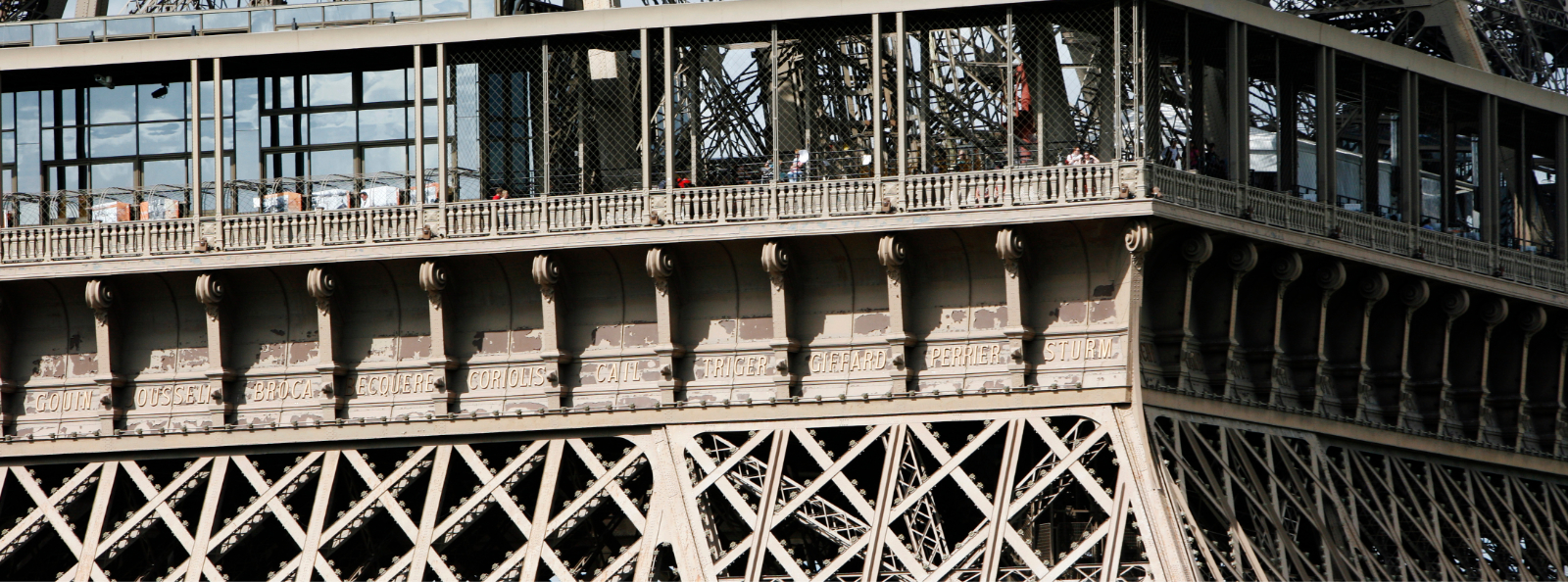
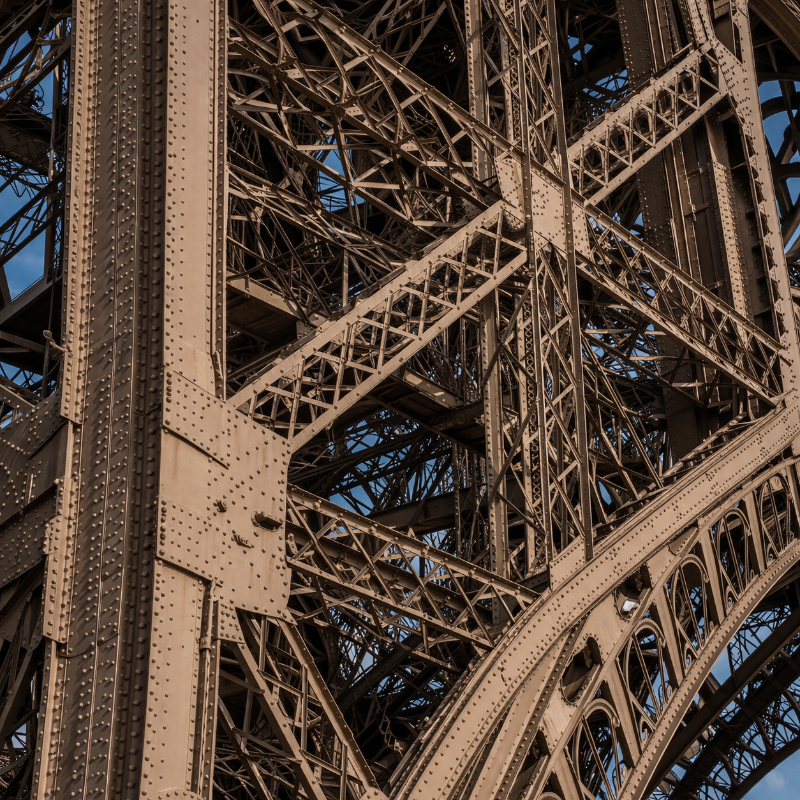
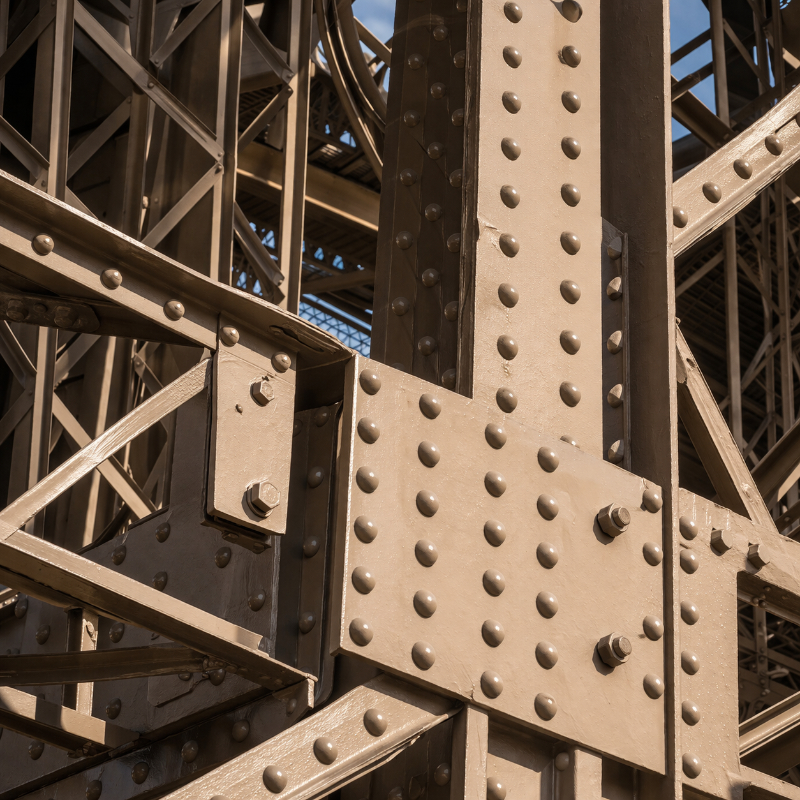
The Tower uses 18,038 prefabricated iron elements assembled with about 2.5 million rivets. The lattice covers a surface area of around 200,000 square metres, yet the structure never reads as bulky. On the contrary, its openness is part of the solution. Air passes through it. Forces disperse through it. The density increases where the loads are greatest and thins where less material is needed.
A structure designed to move
The Tower also changes with climate, exactly as Eiffel expected. In summer, heat expansion can make it about 15 centimetres taller than in winter. Differential solar heating pushes the summit slightly away from the sun until temperatures rebalance. Under extreme wind, the top can sway by several centimetres. None of this indicates weakness. It proves that the structure behaves within the tolerances built into it from the start.
The most revealing point is this: the Tower survives not by resisting movement absolutely, but by accepting a measured amount of movement. Flexibility, here, is part of stability.
| The Eiffel Tower does not stand still in a literal sense. It holds because it was designed to move within precise limits. |
To understand the Tower as an object, it helps to imagine construction at the scale of the joint rather than at the scale of the skyline. Every connection in the original frame depended on rivets, and riveting in the late nineteenth century was skilled, physical, and exacting work.
A four-person operation
Each rivet required a coordinated sequence. One worker heated the rivet in a portable forge until it reached the right temperature, judged by colour rather than by instrument. A second worker caught the hot rivet as it was thrown across the scaffold. A third placed it into the pre-drilled hole. A fourth hammered and finished it from the opposite side. If the metal cooled too early, the fit failed. If it was too hot, the integrity of the iron could be compromised.
Why prefabrication mattered
What made the process extraordinary was the level of preparation behind it. All 18,038 iron components were fabricated and drilled in Eiffel’s workshops at Levallois-Perret before any piece arrived at the Champ-de-Mars. Each element was numbered. Each position in the sequence was known in advance. The site assembly therefore depended less on improvisation than on an almost industrial choreography.
This is one of the main reasons the Tower could be completed in just twenty-six months. Contemporary observers found the pace astonishing. It remains impressive even by modern standards.
| Long before visitors saw the silhouette rise over Paris, the Tower already existed as a numbered logic of parts waiting to be assembled. |
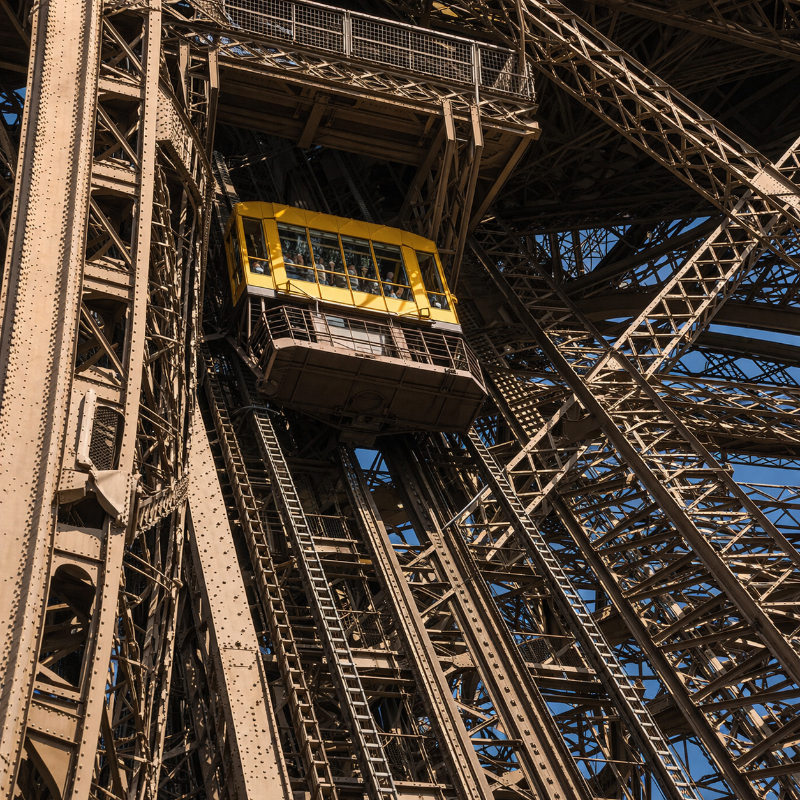
The elevators are often treated as a secondary convenience. In reality, they were one of the project’s central engineering challenges. Standard lift systems of the 1880s ran on vertical tracks. The Eiffel Tower’s lower piers do not rise vertically. They curve.
A transport problem unique to the Tower
To move visitors through those inclined legs, engineers developed hydraulic lifts that followed the geometry of each pier. Different companies supplied different systems for the lower levels, adapting their mechanisms to the changing angles of the structure. Only the lift from the second floor to the summit behaves like a more conventional vertical installation.
An engineering achievement still in use
This matters because the lifts were not decorative technology added to a completed monument. They were integral to how the Tower would function as a public structure. The current summit lift and the rebuilt pier lifts are modernised, but the inclined-track principle remains one of the most distinctive technical features of the monument. It is one of the rare places where visitors routinely use a system whose engineering problem is still visible in the shape of the building itself.
| At the Eiffel Tower, circulation is part of the architecture. Even the way you rise through it has been engineered to answer the form. |
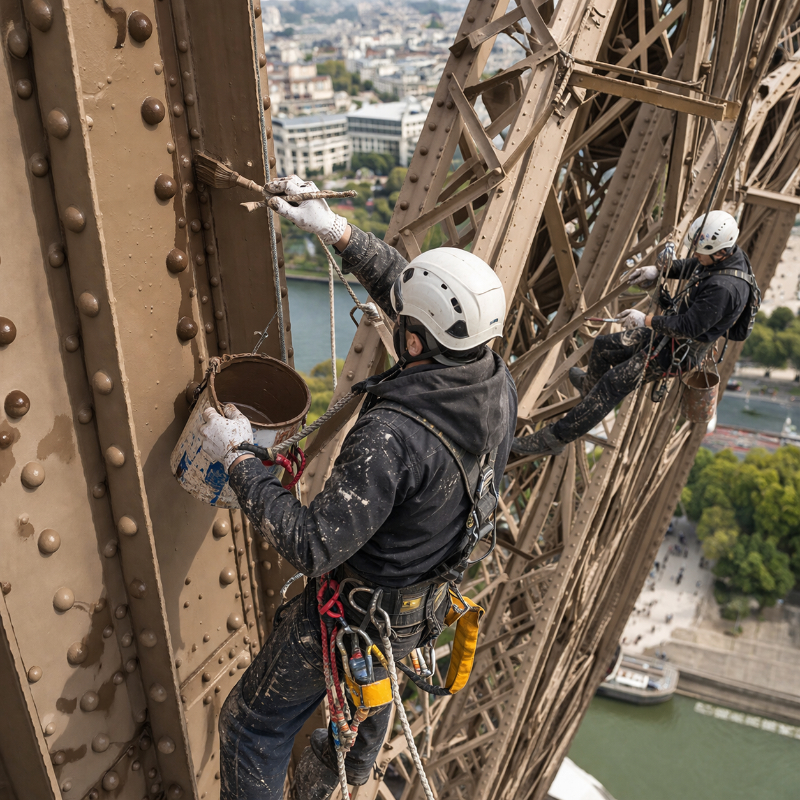
Iron survives only if it is protected. That simple fact turns maintenance into a permanent part of the Tower’s life. The Eiffel Tower is repainted roughly every seven years, and each campaign requires about 60 tonnes of paint, specialist painters working at height, and many months of continuous labour.
Protection as preservation
Seen up close, painting the Tower is not cosmetic maintenance. It is structural care. The paint protects the iron from corrosion, preserves the integrity of the frame, and ensures that the monument remains stable in the long term. Since 1889, the Tower has been painted repeatedly, and its colour has changed several times, from reddish tones to oranges to a sequence of browns.
Colour used with precision
Since 1968, the standard shade has been Eiffel Tower Brown. Even that colour is not applied uniformly. Darker tones are used near the base, with lighter shades toward the summit. The effect is subtle but deliberate. From the ground, the Tower appears taller and more unified. It is an old architectural trick applied to a structure that otherwise feels radically modern.
The result is characteristic of Eiffel’s larger method. Nothing is casual. Even colour becomes part of the engineering of perception.
| The Eiffel Tower is never simply finished. It remains a working structure, preserved by repetition, maintenance, and the same precision that created it. |
Author’s note: This text was written with the intention of sharing and transmitting knowledge, not as an academic work. Its author is not a historian. Some details or interpretations may not reflect current historiographical consensus. For a rigorous approach, please refer to the sources listed at the end of this document
OUR BEST TOURS